
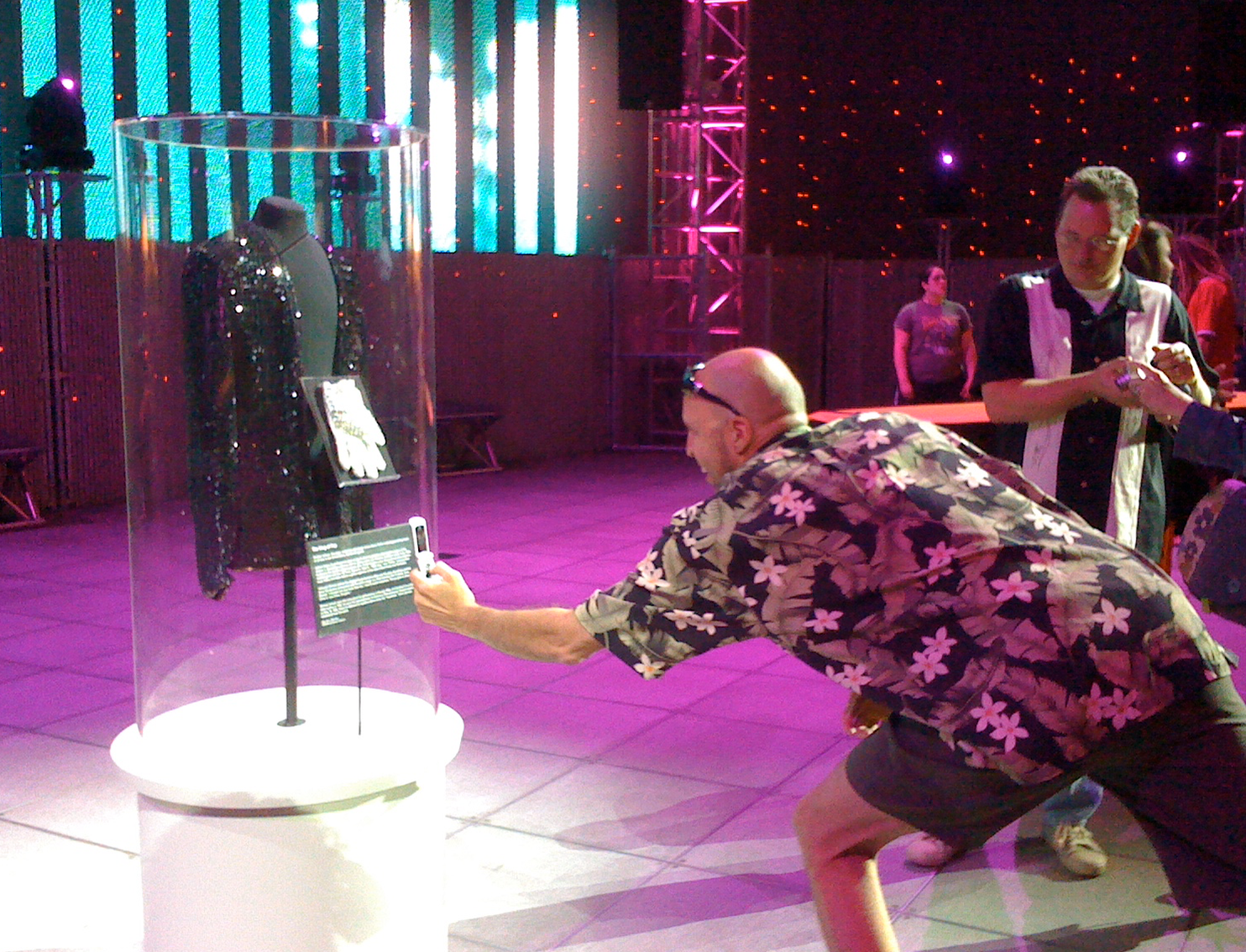
Where were you when Michael Jackson died? By a strange and lucky coincidence, I was at the Experience Music Project and Science Fiction Museum (EMPSFM) in Seattle for a two-day workshop. EMPSFM is one of a handful of museums worldwide for which the death of the King of Pop is a very big deal. On Thursday afternoon, our workshop fractured as curators, educators, media producers, and marketing staff scrambled to talk to press and put together spur-of-the-moment exhibits and tribute programs.
Within 24 hours of the news, the EMPSFM staff hosted a tribute event at a local music venue and mounted an exhibit of Jackson's iconic glove/jacket along with archival concert video in a free public area (appropriately called the Sky Church). They staffed talk-back tables where visitors could write on butcher paper, and outside the museum, they put out boxes of sidewalk chalk to invite people to share their thoughts. They also featured a memorial (and a talk back opportunity) on their website.
I spend a lot of my professional time trying to develop compelling opportunities for visitors to share their thoughts and connect with content that is deeply relevant to their immediate needs and interests. I watched this happen magically and easily for hundreds of people on Friday at EMPSFM, folks of all ages and backgrounds intently taking photos, writing messages, and talking to their friends. It was a rare moment where the cultural and historical importance museums tend to bestow on all exhibits was sought and appreciated by the public. "Yes," every camera and curator and chalk scrawl and family seemed to agree. "This Matters."
There's nothing new about museums serving as spontaneous memorials or providing support in emergency situations. The question is what happens after the news cycle is over, after the urgency diminishes. It's wonderful to see a museum as useful and energized as I saw EMPSFM over the past few days. But what about the rest of the year? Are museums only relevant when they can serve our most pressing needs? And if so, should they seek more opportunities to serve these needs?
I ask these questions amidst recent calls for museums to become more responsive, demand-driven institutions. Elaine Gurian has been speaking and writing about museums as soup kitchens, suggesting that museums should consider new uses of their spaces to provide direct social services to people, especially during the economic downturn. Many potential services, like job training and subsidized food programs, would be incredibly valuable to communities but are foreign to current museum practice. Elaine argues that we should stop worrying about whether these new programs fit the "business of museums" and instead consider whether the business of museums is sufficient to the extraordinary community needs of the day.
I struggle with Elaine's argument. I agree that most museums do not actively and aggressively seek out ways to truly serve the needs of their visitor communities (as opposed to donor communities). For example, museum spaces are often dormant for many hours of the day, and the most basic functions offered--beautiful spaces, clean restrooms, opportunities for food service and event production--could be employed to provide a huge range of community services. Hours before Michael Jackson died and it became the memorial site, I was talking with EMPSFM staff about the under-utilization of the Sky Church, an unusual and impressive public space. And awesome examples like 826 Valencia or the Boston Children's Museum's GoKids program demonstrate that sometimes putting traditional social services like tutoring or food distribution in a cultural context can destigmatize them.
But I also think that museums (like all organizations) need to focus both on who they are for and what they are about, balance the needs of their audiences with the goals of their institution. I'm as interested in how we can find connections between what people need and starting points museums already have--revealing or amplifying relevance--as I am in providing new services for peoples' needs.
It is apropos that the EMPSFM workshop was focused on how the museum can deepen relationships with teen audiences. We weren't talking about bamboozling teens with some hip marketing campaign; instead, we focused on ways that programs which currently serve just a few teens could empower and enable many more teens who are passionate about making music, reading science fiction, and sharing niche interests. We were looking for ways not just to provide more services to small groups of teens but to develop platforms where teens could support and serve each other. And we spent equal amounts of time talking about teens and their needs as we did talking about programmatic responses to support them.
Do these teens need EMPSFM to survive? Probably not. Does anyone need Michael Jackson or Ursula LeGuin or her guitar to make it through the day? EMPSFM may be frivolous in the face of world economic collapse, but it still delivers services that are relevant to some aspect of peoples' lives.
Michael Jackson belongs at EMPSFM (and visitors knew to find him there) because that museum is about pop culture and specifically music. The museum has physical items relevant to his life that served as connection points to visitors' pain and nostalgia. EMPSFM has contextual content that places a dislocative event into a familiar global story. And they have expertise and authority to connote a particular kind of permanent value to the news.
The flipside of this specificity is that when something non-pop culture-related happens that is incredibly relevant and important to Seattle residents' lives, EMPSFM probably won't be there. I think I'm ok with that... but I feel tension as I write this. If EMPSFM is never relevant to the majority of their community's needs, there's a problem. If they are always relevant, there's no problem. The reality--for every museum--lies somewhere in the middle. How do you know you are relevant enough?
Museums can't manufacture relevance to audiences. If you are not happy with the extent to which your institution is responsive to community needs, then by all means, change something. But start by honestly and openly assessing which needs you can appropriately serve. I agree with Elaine in hoping that every museum will earnestly try to do more, will spend more time thinking about what visitors need and less time trumpeting what objects are on display. And to me, providing space and chalk for a twelve year-old skater to scrawl on sidewalk about how Michael Jackson changed his life, well, that counts.


