Monday, March 15, 2010

In Support of Idiosyncrasy


People often ask me which museums are my favorite. I don't like to give a list. I've only visited about 0.01% of the institutions out there and I suspect that the other 99.99% includes some real gems. But when I really think about it, all my favorites (so far) have one thing in common. It's not the extent to which they are participatory. It's not their size or type or subject matter. It's the extent to which they are distinctive, and more precisely, idiosyncratic.

I visit lots of perfectly nice, perfectly forgettable museums. The institutions that stick with me are the ones that have a peculiar individuality. In some cases, that's based on subject matter, as at the Museum of Jurassic Technology or the American Visionary Art Museum. Other institutions are idiosyncratic in their relationship to their environment, like the Louisiana Museum of Modern Art in Denmark, or to their community, like the Wing Luke Asian Museum. Some are scrappy and iconoclastic, like the City Museum in St. Louis, whereas others are august stalwarts like the US Holocaust Memorial Museum. While most of my favorites are small (idiosyncrasy is easier to maintain without too many committees), some are quite large--places like the Exploratorium where a singular ethos infuses a massive facility.

Idiosyncratic institutions aren't just quirky and weird. They are usually staffed by people who feel incredibly passionate about their particular focus. These institutions are often more connected to their specific, local communities than more generic institutions. They are akin to local news organizations and charities. They reflect the soul of the community and can be responsive to its unique interests and needs. They are places that people point to with pride and say, "that's our place."

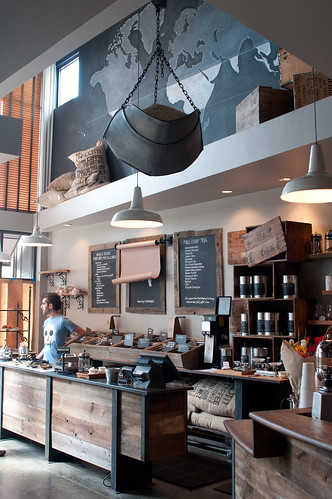
15th Avenue Coffee & TeaEven the business world is getting wise to the power of idiosyncrasy. The 15th Avenue Coffee and Tea shop (shown at right) is not a small community-owned place. It's a Starbucks. Over the last year, Starbucks has been opening stores in a few cities with a very different look--one that emulates the handmade, community vibe of locally-owned coffee shops. Whether you think this is a brilliant move or a corporate swindle, it demonstrates that even a large company with a highly branded, consistent image sees the benefit of individualizing offerings to different markets. Starbucks can't be a small funky startup, but it can try to look like one.

Why are museums going in the other direction, trying to become more consistent rather than celebrating their idiosyncrasies? To some extent, it's externally-driven. Funders and potential donors tend to look for particular benchmarks of professionalism (appropriately), and few are comfortable funding the most risky or content-specific institutions. But that's only part of the story. Mostly, institutions move away from idiosyncrasy on their own accord. I see three significant internal reasons for homogenization in museums:
  1. As money gets tight, museums look for exhibits, program strategies, and revenue streams that are "proven" by other institutions' successes, rather than charting their own potentially risky path.
  2. Many museums no longer employ in-house exhibit developers, relying instead on a short list of contractors and consultants. Design firms' projects often have a common look across different cities and institutions.
  3. Small museums, which are most likely to cultivate local, distinctive voice and approaches, often have an inferiority complex. Rather than asserting their uniqueness, they try to emulate large museums.
The institutions that seem most prey to a "cookie cutter" approach are science centers and children's museums. These institutions have three additional reasons for homogeneity:
  1. The audience cycles frequently as families "age out." Institutions may feel less of a need to offer something unusual or distinctive if the audience will keep refreshing every few years.
  2. The content is often seen as not being community-specific. Science is science, and grocery store exhibits are grocery store exhibits. Funders like the NSF have encouraged science centers in particular to share their techniques and evaluations, which is fabulous but also leads to rampant and sometimes unthinking imitation.
  3. These museums have undergone the fastest growth in the industry in the past thirty years. There is a big business of selling exhibits, copies of exhibits, and exhibit recipe books, and many individuals who start new institutions rely almost entirely on these vehicles to fill their galleries.
I think this is a particular shame because children's museums and science centers have the greatest opportunity to introduce young visitors to the special delights of a uniquely community-focused, idiosyncratic approach. The best children's and science museums are deeply community-interrelated, often in ways that are hard to discern from the exhibits when experiencing them casually. They may feature community gardens or exhibit labels in languages tailored to locals. They may employ local artists to help create visitor experiences. They may build their exhibits to accommodate the interests and needs of particular families and school groups they have known and worked with for years. Or they may just have an unusual and distinctive spirit or ethos behind their work.

I understand why retail establishments benefit from becoming bigger, more homogeneous, and more distributed. People like to buy from chains because they know what they are going to get. But consistency should not be the number one value when it comes to providing visitors with educational, aesthetic, social, and hopefully transformative experiences. I'd argue that one of the top reasons people DON'T visit museums is that they think they already know what they are going to get. Especially when it comes to small museums with limited collections, a distinctive personality is often the best thing the institution has to offer. Trying to cover it up or smooth it out in favor of "best practices" does a disservice to the museum and the audience. It creates another forgettable museum.

Do you share my love of idiosyncratic institutions? How can you cultivate idiosyncrasy in your own work and museum?

Wednesday, March 10, 2010

The Participatory Museum Process Part 1: Overview and Statistics

This is the first of a four-part series on the behind-the-scenes experience of writing The Participatory Museum. This week, we'll look at the overview of the process of the creation of the book and some overall statistics for user participation. Next week, part 2 will focus on participants' experiences. Part 3 will focus on my experience, and part 4 will discuss the self-publishing process. Please let me know in the comments if there's anything in particular you want to know about - I'm happy to share whatever interests you.

Overview: Stages of Development and Participation Types

The Participatory Museum was written over a 15 month period that began in December of 2008. Participants were engaged in the following ways:
  • Content review (open). I wrote the plans, outlines, and multiple drafts on a public wiki that was available for review, edits, and comments. While all stages were open for comment, I made an explicit ask right before releasing the second draft, and consequently, the second draft was most heavily edited. 65 people participated on the wiki, though the vast majority of the activity came from a core group of 15 (more on that below).
  • Content review (solicited). In addition to the volunteers who signed up to help on the wiki, I directly solicited sixteen professionals in the field who I respect to provide feedback on particular chapters (or in some cases, on the entire draft).
  • Content review (stealth). Many of the book sections started as blog posts on Museum 2.0. Sometimes, I'd put out a post on something I was struggling with for the book (see this early example). Readers' comments helped steer the book, even if these commenters never visited the book development wiki. At least 50 blog posts and 240 related comments fall into this category.
  • Copy editing. I invited people to sign up to copy edit sections of the final draft. 17 people contributed to this effort. This process involved people downloading sections of the book, editing them in Microsoft Word, and reuploading them. Each section went through two copy editors for redundancy.
  • Marketing copy. I invited people to help develop marketing copy for the book - to vote on the title of the book, help write the blurb for the back, and comment on the cover illustration. 210 people voted on the title, 6 contributed to the blurb, and about 30 commented on the cover.
  • Image and content research. In a fairly traditional process, I asked professional colleagues to help me source images and examples that should be included in the book. In a couple of cases, I opened this up broadly to my Facebook or Twitter network, for example, when I was looking for a generic shot of visitors checking out a photography exhibition. I also cold-contacted people on Flickr with image reproduction requests, 100% of which were granted.
My general approach was to solicit as much participation as I felt I could usefully integrate. I didn't want to waste anyone's time with work I wouldn't be able to use, but I also wanted to stretch my own boundaries about how much help I really could accommodate. In the end, I felt great about the level of participation and it made a HUGE impact on the book. In particular, participants helped me:
  • Cut the length of the book from 125,000 to 99,000 words. There were many redundancies in the original draft, and Bruce Wyman in particular was delightfully brutal at pointing them out.
  • Restructure the book. You may notice that the graphs below show only six chapters, whereas the final book has eleven. This restructuring was based on their comments and edits.
  • Streamline case studies, especially those in which I was personally invested. Conxa Roda was a queen of cutting.
  • Improve the section on evaluation. Peter Linett, Mark Kille, and Andrea Bandelli were instrumental in making this happen.
  • Track down examples from further afield, especially from smaller institutions, institutions outside the English-speaking world, and institutions that focus on living history.
  • Shift the tone of the book. Sarah Barton and Elaine Gurian in particular helped me settle on a more generous, positive voice.
  • Generally feel confident about making big changes. I made the vast majority of edits and restructuring on my own, but I was bolstered in doing so by the many comments and opinions of the contributors. They cheered me on conceptually as I worked late into the night. Without them, the differences among the drafts would have been much less significant (and the final result of lower quality).

When and how did people participate the most?

With the exception of spikes each time I made a blog announcement about the book development, the traffic to the wiki stayed pretty constant throughout 2009. The dead time in October was an error on my part--that data was lost.
Looking just at the returners (and excluding me), you can see how low the overall traffic was, and how concentrated in the various participatory time periods:
Despite the fact that the wiki enjoyed more visits during the first draft than the second, there was far more editing activity for the second draft. I took a different approach to the two drafts: the first draft was made available as I wrote it, whereas I released the second draft all at once (and gave people a fixed timeframe in which to make their comments). Here's a graph comparing wiki activity during the first draft (Feb-Oct, 2009) and the second draft (Nov 1 - Dec 18, 2009):

Clearly, the numbers of comments and edits were WAY up for the second draft. But this doesn't tell the whole story. When we look at the graph of the relative number of people involved, it looks like this:

Chapter 1, 5, and 6 received a lot more love in the second draft than the first, but the difference otherwise is not huge. The outline is an outlier because it was used as a planning tool and enjoyed lots of discussion among people who were interested in the book in its earliest phases. The number of people actively involved from draft one to two jumped from about 5 to 15--but those fifteen people collectively made hundreds more comments and edits to the draft. Of those fifteen, just six--Sarah Barton, Conxa Roda, Mark Kille, Mike Skelly, Louise Govier, and Claire Antrobus--contributed 95% of the edits. The power law is alive and well.

It's worth noting that I only knew one of these six people (Conxa) before this process began. In particular, Sarah Barton had incredible influence on the content development, and she is someone I would definitely go to in the future for content review.

While I was thrilled by the participation of this small group, it was obvious that a huge number of Museum 2.0 readers were not involved in the wiki process. For this reason, I stepped up the double-posting of case studies and book content on the blog and wiki so I could have the benefit of the comments of a wider group. Blog commenters, who not represented in the graphs above, represented the most diverse and numerous group of participants in content review. Hundreds of people offered a single comment on a post or tweet throughout the second draft process.

The solicited content reviewers also had incredible impact on the book, but in a way that was quite different from that of the wiki and blog commenters. The wiki and blog comments appeared in real time, whereas the solicited reviewers sent me their complete edited manuscripts in one pile in mid-December. This meant that throughout the writing stages, I could rely on blog and wiki commenters to steer me in the right direction. By the time I got back the manuscripts from solicited reviewers, I was pretty much "done" covering the wiki comments and could focus fairly exclusively on the solicited drafts. These solicited commenters in general provided incredibly detailed comments, though a few folks opted to offer an overall impression instead. Frankly, I'm glad that not everyone wrote line-by-line comments - I couldn't have handled it. Special thanks go to Georgina Goodlander, Ed Rodley, and especially Bruce Wyman for doing something very wonderful with their edits: making me laugh.

A few surprises

Every time I do a project that involves user participation, I'm always surprised to find some of my expectations are completely off the mark.

Here are four surprises I encountered in this project:
  1. Unsolicited contributions were at least as valuable as those that were solicited. Part of me suspected that the people who I directly asked to review the drafts would be more honest, more critical, and just generally more helpful in the direction of the book. I expected that wiki volunteers would mostly be Museum 2.0 fans who might not feel comfortable being critical, especially in a public venue. This was not the case. I received FABULOUS critical comments on the wiki, including and especially from people I did not know. In one case, Chris Castle, one of the few people to comment on the first draft on the wiki (and someone I didn't know), became someone I solicited formally for the second draft because I had appreciated her early contributions to the wiki.
  2. The numbers worked themselves out. I was nervous when I threw open the wiki and over a hundred people registered to edit. How would I deal with a hundred commenters and the 16 I'd solicited? But it turned out that only a small percentage of that hundred got deeply involved - a number (15) that was manageable for me. And that's not to say others who made a single comment didn't have impact--I got value out of every comment and edit, even if people only contributed once.
  3. People preferred to comment on a finished draft rather than the work in progress. At the time, I thought people would be MORE excited to comment and help shape the book as I was first writing it than to comment on a complete draft. I was wrong. The second draft was offered to participants with a much more specific, time-limited ask, and it was much more successful than the open-ended "help me as I write it" approach to draft one. This makes sense - the second draft experience was much better-scaffolded - and it made me reconsider the extent to which participants want to be involved in the early development of other peoples' projects.
  4. People loved to copy edit. I was nervous that no one would want to copy edit. I had lined up a good friend to save me if needed (and Dave Mayfield did make many key contributions). But I was totally wrong about this. People were THRILLED to copy edit. Copy editors were the most likely to enthusiastically blog or tweet about their experience. They were also more likely to be young or new to the museum field than other contributors. I think copy editing was a way that people felt they could make a meaningful contribution without having to be some kind of expert. They got a sneak peek of the most final draft. And apparently some people LOVE finding grammatical errors. Heck, I guess I do too.

Next week, tune in for a post focused on participants' experiences--how they were encouraged to participate, how they felt about the experience, and how the feedback and reward structures worked. If you were a participant, please consider filling out this short survey to add your voice to next week's post.

What else do you want to know about this book-writing process?

Monday, March 08, 2010

Chatroulette: Giving Stranger Interactions a Bad Name

This morning, in less than fifteen seconds, I saw live video of:
  • a guy on the phone, lounging in front of his computer
  • a guy taking a photo of me while ignoring simple questions
  • a guy who used a mirror effect to look like an alien
  • a penis
The penis was the last straw. I closed Chatroulette for the third and probably last time.

Chatroulette is an online service that allows you to videochat with random strangers. It pairs you up automatically with other users to talk, and you can click "Next" at any time to jump to someone else (as I did to penis-guy, and as all three of the other users did to me). It's in the same vein as Omegle (a text-based "talk to strangers" system), and it's attracting a lot of media attention and tens of thousands of concurrent users.

Chatroulette frustrates me. It drives me nuts that it's being called "groundbreaking" in the realm of human-to-human interactions. Chatroulette is not groundbreaking, nor is it threatening to the social fabric of society. It's a novelty, and a mostly depressing one at that. Chatroulette exacerbates the perception that stranger interactions are uncomfortable, weird, and often sexual in nature. It encourages people to see each other as entertainment instead of as human beings. And because users use the "Next" button so liberally--to escape gross users, to find someone interesting--the fundamental activity on Chatroulette is not chatting or connecting with strangers. It's evaluating people. In most cases, within two seconds, you or the person with whom you are videochatting decides that the other person is not worth their time. And that means you reject or are rejected by others, multiple times each minute. What an unpleasant feeling. As New York reporter Sam Anderson put it:
I got off the ChatRoulette wheel determined never to get back on. I hadn’t felt this socially trampled since I was an overweight 12-year-old struggling to get through recess without having my shoes mocked. It was total e-visceration. If this was the future of the Internet, then the future of the Internet obviously didn’t include me.
Chatroulette strips away all of the social conventions and scaffolding we use to relate to strangers in public. The interactions are private, which means there's no external social pressure to conform. The interactions are anonymous, which means there's no need to be accountable for your actions. And the interactions are fleeting, which promotes shock value and immediate, dramatic actions. These three characteristics make Chatroulette just about the worst environment possible for interacting with and potentially relating to strangers. It may be a fun plaything for people who like to provoke and be provoked. Occasionally it's a place for a surprising cross-cultural encounter. But it's rarely a place for building relationships--even the simplest kinds--among strangers.

Chatroulette frustrates me most because it doesn't live up to its potential. I blame that deficiency on lack of scaffolding of the social interactions. I can't help but think how much better it would be if the system provided an external prompt--a challenge or a topic to discuss. I could imagine having a great time on videochat debating the merits of a piece of art with a stranger, trying to solve a puzzle together, talking about a news event, or sharing stories. Each time I've tried to initiate this kind of interaction on Chatroulette, my partner in videochat has disconnected from me, leaving me feeling rejected and dejected. While I've heard stories of people dancing with strangers on Chatroulette and generally sharing surprising experiences, the first three attempts/five minutes of use didn't make me want to soldier on in search of positive encounters.

I've had some fabulous interactions with strangers in comparably open-ended environments that offered just a bit more designed structure. Think of the Internet Arm Wrestling exhibit, which allows people to virtually arm wrestle with strangers in science centers around the US. When you sit down to use it, you grasp a metal arm (meant to simulate your competitor’s arm) and are connected to another visitor at an identical kiosk. This visitor may be a few feet from you in the same science center or hundreds of miles away at another science center. You receive a “go” signal, and then you start pushing. The metal arm exerts a force on your arm equal to the force exerted by your remote partner on his own metal arm. Eventually, one competitor overpowers the other, and the game is over.

The Internet Arm Wrestling exhibit, like Chatroulette, connects strangers via webcams in short-term, shared encounters. But because the exhibit experience is focused on a third thing--the arm wrestling competition--visitors are generally playful and positive with each other and walk away from the experience having enjoyed a unique connection with a stranger.

Bringing a "third thing" into the Chatroulette ecosystem would help people interact in a civil manner. It would also help them interact, period. Many times on Chatroulette, I've been connected to someone and we stare at each other, uncertain of how to start a conversation in such a decontextualized environment. And so, out of embarrassment or discomfort or uncertainty, one or both of us click "Next." I've learned that holding up signs or puppets, or playing a musical instrument, helps lengthen chat time. These are all social objects that help get the conversation going.

I could imagine a delightful application on a museum website that would allow me to chat with a stranger about a featured artifact or artwork. The object and the context of the museum website would both provide framing and structure that would likely make for a positive encounter. I could imagine a game in which people were paired up and asked to construct a vision of a better future. I could imagine virtual advice booths, with strangers helping each other solve their problems. Instead, we got Chatroulette--another nail in the coffin for those who believe that peaceful, positive, useful interactions among strangers, especially on the internet, are unlikely.

Now let's go out and design something better to prove them wrong.

Wednesday, March 03, 2010

Book Announcement: The Participatory Museum is now available!


Hey kid! Want to buy a book?

As many of you know, I've been working for the past year+ on a book about visitor participation in museums, libraries, science centers, and art galleries. Now, after long last, the book is here!

The Participatory Museum is a practical guide to visitor participation. It's been described as "essential reading" by Elaine Heumann Gurian and Sebastian Chan, and Kathleen McLean calls it "an extraordinary resource" (more reviews here).

Why did I write this book? Over the past four years, there's been lots of discussion about the "why" of visitor participation, but in my opinion, we've been lacking a good resource on the "how." The Participatory Museum is an attempt at providing such a resource. I hope it opens up a broader conversation about the nuts and bolts of successful participatory projects.

The book is split into two parts, providing what Leslie Bedford calls "a convincing marriage of theory and practice." The first half focuses on principles of design for participation, drawing on examples from the Web, retail, and restaurants as well as cultural institutions for lessons on how to help visitors confidently and enthusiastically contribute in ways that help achieve institutional goals. The second half focuses on participation in practice, looking in detail at ways that institutions can involve visitors while staying true to their mission and staff culture.

While the book draws heavily from the Museum 2.0 blog, many case studies and design principles in the book will be new to even the most devoted blog followers. There are projects from Vietnam to Australia to the Netherlands to the US, from libraries, museums, science centers, zoos, state parks, and art centers. At 388 pages, there's a lot to explore and to help you refine your thinking and participatory project planning. It's available internationally in paperback ($25) and as PDF/ebook ($18), and I'm finishing the free online version this month.

As many of you know, this book was created via a participatory process that involved many individuals. Over 100 volunteers helped steer and refine the content, copy-edit the draft, choose the title, and write the blurb for the back. Over the next month, I'll be posting a four-part series about the participatory book development and self-publishing process. If you participated in the creation of The Participatory Museum--even if you just answered a simple question on Twitter or visited the wiki site during its creation--please consider filling out this survey to help inform these upcoming posts.

I'm also trying to make the website for the book a participatory place for continued discussion and debate about these topics. The site is still in early days, and if you have any ideas about its design, please feel free to share them either as a comment on this post or in the discussion section of the book website.

If you would like to help promote the book, please share the website with your friends and colleagues. You can write a review of the book (once you've read it, please). Blog about it. Tweet about it. I'm particularly hopeful that you might be able to help this book reach people slightly outside the museum field, like librarians, state park interpreters, and community arts organizers. If you have a favorite magazine, journal, or site that should review it, let me know. If you think I should talk about it at a particular conference, let me know. If there's a bookstore or book seller you think should offer it, well, you get the idea. I'm also trying to schedule book events around the world over the next several months - if you want me to come to your city, please fill out this form and we'll start figuring it out.

And... yay!

Wednesday, February 24, 2010

Responsiveness is the Most Important Part of Participation

When I talk about Web 2.0 with cultural professionals, I like to use Tim O'Reilly's simple definition: software that gets better the more people use it. This definition implies two things:
  1. users do something that generates information (they upload content, rate things, comment, buy things, or click search results)
  2. the system adapts responsively to those participatory actions, providing customized experiences based on user behavior
When it comes to visitor participation in cultural institutions, staff focus too much on #1 and not enough on #2. There are many participatory kiosks that are functional black holes--visitors make videos or draw pictures or write stories, drop them in a slot, and... nothing happens.

Museum professionals tend to think this is OK because they think of the contributory act as the important part of the participation. But without responsiveness, you have a broken feedback loop. The response is what makes participation useful and meaningful to future users, including participants themselves.

Imagine if Netflix encouraged people to rate movies but did not provide customized recommendations based on their ratings. Or if YouTube allowed people to upload videos but gave them no information about when those videos would be available for viewing. Such participatory activities would be seen as a waste of time. Why go to the trouble of creating content if nothing is going to happen because of it?

This sounds ridiculous, but it’s the way many museums approach participatory projects. Staff members design ways for visitors to contribute, but they don’t always provide clear feedback mechanisms so that visitors understand how and where their contributions will affect the institution overall. In many cases, museum staff erroneously assume that visitors want to participate “for the fun of it” and don’t care how and if their work will be used.

Why does this happen? It’s easy to look at participatory websites and see the user-generated content without noting the underlying architecture that responds to user actions. Consider the activity of rating videos on YouTube. Why does YouTube allow users to rate videos? It’s not simply because it’s fun to rate things. YouTube invites users to rate videos because those ratings can then be used to prioritize which videos are better than others. The ratings provide valuable information about the relative value of videos, and the system architecture then uses that information to sort and present videos to subsequent consumers. The ratings are worthless without the architecture to respond to them.

I think this is why the Top 40 exhibition at the Worcester City Gallery and Museum was such a success. In that exhibition, visitors could vote for paintings to move them up in a weekly "top 40" ranking chart. The paintings' ranks were tallied weekly and displayed on physical labels in the gallery as well as online and in the local newspaper. Visitors came back again and again to see how the ranks had changed and to advocate for their favorites. It wasn't the voting mechanism that drew them back--it was the fact that the institution consistently responded to their votes in a compelling way. Seeing that their votes mattered likely made people feel more invested in the exhibition (and by extension, the institution) overall.

The concept of responsiveness can easily be extended to all kinds of participatory museum projects. Consider video kiosks in history museums that allow visitors to comment on exhibitions or share their own stories related to the content on display. These kiosks are frequently designed to make contribution as easy as possible. They are rarely designed, however, to “get better the more people use them.” Such kiosks would get better if contributors were informed of when their videos would be reviewed and how their work would be displayed to subsequent visitors. They would get better if visitors were invited to rate other participants’ videos, to sort them by topic or tone, or to comment on them. Most video kiosks don't provide ways for visitors to sit down and watch videos based on their particular interests. Visitors can't flag inappropriate or empty videos. And contributors can't see how others have rated, commented on, and enjoyed their work.

The result is a broken feedback loop. Exhibition video kiosks are degraded to playthings for people who like to see themselves on camera. Occasionally, a visitor will record something truly special, but the review and display systems are rarely set up to highlight those gems, and they certainly aren’t set up to do so based on visitor feedback.

If museums are serious about inviting visitors to participate, they need to design structures for participation that embrace the full spectrum of participatory behavior and provide responsive value to those who engage. It’s already hard enough to ask a visitor to make a video or craft a sculpture or write a label in the course of her visit. These endeavors are considerably more successful when visitors understand how their participation will impact not just their experience but the experience of subsequent visitors and of staff members.

A participatory museum isn’t just open to visitors’ contributions. It acts on those contributions and adapts to better support them. It transforms the contributions into a beautiful, engaging, educational, and meaningful output. By being responsive, it makes participation matter.

Tuesday, February 23, 2010

Thoughts on 3six5, a Successful Participatory Project

Yesterday, I had the delightful opportunity to participate in the 3six5 project, a yearlong participatory project in which 365 people write 365 journal entries for every day of 2010. The posts are short (365 words or less) and are intended to give a personal snapshot of that individual's day. Participants signed up in advance, and the projects' co-managers shepherd contributions through with a set of clear author guidelines and well-coordinated email correspondence.

3six5 has all the hallmarks of a good participatory project:
  • It offers an enjoyable activity that is scaffolded by simple specifications without prescribing any particular result. Participants can share their days however they please, as long as they write 365 words or less and include a picture.
  • The reward for participants of having your contribution displayed is fairly and clearly structured. Participants only get 24 hours of fame, but they know exactly when they are. It's also easy for participants to promote their posts by sharing them on social networks and via email.
  • It showcases diverse voices. I love the differences among the posts from this past week, which covered Mardi Gras, unemployment, network science, attempts to get pregnant, and technology addiction. Granted, the posts so far have been somewhat tech-heavy, but I think that will diversify more as the year goes on. (Techies knew about the project first and were most likely to sign up for early dates on the calendar.)
  • It combines personal stories with a sense of being part of something bigger. The project's originators call it "a crowdsourced journal of 2010." The story we tell together may not be profound or historically significant, but it's intriguing for its diversity of style and content. I think of 3six5 as a coffee table book that is being written one day at a time.
  • Participants sign up in advance, but then have time to consider their contribution. This separates the desire to participate from the actual generation creative output. Of course, it also causes some stress for the project managers (two Chicagoans named Daniel and Len), who have to track down contributors each day to remind them about their upcoming contributions.
  • The project is easy to set up but complex to administer. In advance, Daniel and Len had only to promote the concept, set up the website, and start soliciting and slotting in contributors. But now, they have to continue to market the project, while also getting a post out the door every day. They run a virtual newspaper written by a reporter they've never met, who is replaced every single day.
Participating in this made me wonder: could a museum or library run a project like 3six5? The reasons to do so are many, particularly for a history-focused institution. Such a project would connect community members to the institution, promote the idea that history is being made everyday by regular people, and showcase local, contemporary stories.

From my perspective, there are two primary barriers that would prevent a museum from running a project like this:
  1. Perception of lack of significance. Even as museum staff try to convince visitors that personal journals from the 1800s are thrilling, staff may not think it worthwhile to help visitors write about their own lives.
  2. Complexities of project management. The 3six5 requires maintenance and communication with contributors every single day of the year, including weekends. Museums and traditional institutions are not typically set up to manage participatory projects at such a high level of detail. These institutions are highly capable of managing the complexities of building maintenance and security on a daily basis, but few other functions of the institution are handled this way.
Both of these barriers are easily overcome, not with dollars or equipment, but with a change in attitude. Could your institution make the change?

I'd love to hear your thoughts on whether projects like 3six5 make sense for cultural institutions, and if so, what you think it would take to make them happen. And you might want to check out my 3six5 post about waking up in the woods on Feb 22. I promise a very different window into my life.

Thursday, February 18, 2010

When in Your Life Were You Most Afraid to Talk to Strangers?

Yesterday, I did a workshop with some local teenage girls in an after school program. I asked them to take the social object challenge - to talk to a stranger, get two strangers talking to each other, and create an object to get strangers talking to each other without their intervention. We were in a busy downtown area of Santa Cruz with lots of people strolling and hanging out outside on a gorgeous day--prime "talk to strangers" material.

Before we got started, I asked them how they felt about talking to strangers. They exploded, speaking all in one voice: "I don't even like ordering food in a restaurant." "I ask my little brother to call for appointments so I don't have to." "I like it when people--even weird people--talk to me, but I never ever will be the one to approach a stranger." These girls made it clear that while most of them enjoy social encounters, they almost always want someone else to start them. And there were a few girls who wanted nothing to do with strangers at all.

Needless to say, this led to an interesting workshop. They were nervous but ready for the challenge, and when I explained the idea of social objects (external objects that can be the basis for conversation) they got pretty engaged in the activity. One pair of girls did a survey in a grocery store about whether "the grass is always greener on the other side." One pair started out with a "chicken and the egg" question, but then moved to something more interesting and subversive (a sign outside a pharmacy that recently was bought by CVS asking people which business they preferred). As one girl said, "when we had a mission and a sign, it was easier to talk to people."

After this was all over, we talked about the experience. While they had mostly developed performative approaches to the task, by the end, they were more interested in developing listening approaches - for example, constructing a "tell me a story" booth. And while most of them aren't likely to jump at the opportunity to talk to strangers in the near future, several commented that they'd like to try more "social engineering" experiments in their lives.

For me, the experience changed my perspective on what teens want from social environments and encounters. Frequently, when cultural professionals talk about making museums and libraries more open to young people, we focus on social events and on the idea that these are people who would really LIKE to interact with others in the cultural space. It's easy to forget that teens are most comfortable being social with those they already know, not people who are unknown to them. Online, see Danah Boyd's research for more on how teens use social networks as an extension of pre-existing relationships as opposed to using online environments to meet new folks.

But the experience also reminded me that with a game, a mission, or an external prompt, the same fearful kids can become engaged with strangers in enjoyable ways. And in this way, they're no different from many adults.

Or are they? When I talked with (adult) friends about the experience, some wondered if kids today are acculturated to be more afraid of strangers than kids were in generations past. I'm not so sure this is true. Until I was about ten, I was scared to ask for directions or talk to strangers in public. I don't think I was afraid of the strangers--I was afraid of exposing and embarrassing myself.

I can imagine two arguments for young people being more afraid of strangers than adults:
  1. This is a developmental thing. As you get older, you get more comfortable talking to strangers.
  2. This is a cultural thing. These girls grew up in the US in a post-9/11 world, in a culture of fear that is more powerful than the one I grew up in.
What's your experience? Has your attitude toward interacting with strangers changed during your life, and if so, when and why?

Tuesday, February 16, 2010

Could You Split Your Membership?

Signs like this one (spotted in the window at a large science center) drive me nuts.

Why? Because they validate the highly-problematic concept of membership as a discount. There are many folks who've written about the problems with "value" membership and have recommended that cultural institutions reorient toward offering "affinity" or "relationship" memberships. While value membership focuses on free admission and discounts, affinity membership focuses on building relationships and supporting a community of highly invested visitors.

Making the switch from value to affinity membership programs can sound risky. Value membership is a big business, especially in a tough economic climate. Families like the idea that museum memberships offer a low-cost alternative to recreational activities like the movies, which cost money every time you go. With a membership, you can come to the museum whenever you want--something more visitors may take advantage of as more expensive recreational activities are cut from family budgets. Unsurprisingly, museums are loathe to cut or alter membership programs that successfully serve visitors' needs and generate revenue.

So what can an institution do if staff would LIKE to move towards affinity memberships but don't want to risk losing the revenue and relationships generated by value memberships?

I have a simple recommendation: create two kinds of membership. Offer an annual pass to those who want free admission, and offer a different kind of membership to those who want a deeper relationship. This allows institutions to focus specific resources—discounts, personal attention, and opportunities for deeper experiences—towards the people who want them.

While the groups do overlap, in general, annual pass holders and affinity members want different things. Annual pass holders want free admission and good experiences during their visits. Affinity members want a deeper connection with the institution, which often involves exclusive content or programs. Each of these groups may not care for the services offered to the other. Splitting the groups reduces institutional waste and is more likely to deliver satisfying experiences to different types of members. Some visitors may fall in both categories, but if the different programs are clearly communicated, frequent visitors might choose to become both annual pass holders and join the museum club.

When it comes to optimizing the experience for annual pass holders, all those expensive newsletters may not be effective. Annual pass holders tend to be a high-churn group. To increase renewal rates, institutions should focus resources toward encouraging them to attend, since "doing the math" on visits is the reason they joined in the first place. They didn't join to get special behind-the-scenes content or access to special programs. They joined for free admission, responding to marketing pieces like the sign shown at the top of this post.

In contrast, affinity members may or may not care about free admission. They may care more about being able to talk with curators, attend special events, or contribute to upcoming exhibitions or programs. Some institutions have started offering niche memberships to reach visitors with particular affinities--for example, the Brooklyn Museum with 1stfans (geared toward "socially networked" free 1st Saturday attendees), or COSI with its premium membership (geared toward families with very young children). These membership programs are necessarily small, because they cater to the interests of particular segments of the larger visiting community. For example, COSI's premium membership provides families with access to extended morning hours in their early childhood exhibit area--a benefit that only appeals to visitors who want an exclusive morning experience with their children.

There may even be some kinds of affinity membership that don't cost money to join. Every time a visitor signs up for a mailing list or leaves a comment at the front desk, he expresses his affinity for the institution. I've been working on one project in which we are conceptualizing membership as something you can achieve through multiple visits/contributions, not something you can buy right off the bat. The idea is to model membership off of more natural forms of relationship-building between humans--the more time we spend together, the more substantive that time is, the more we get to know each other and to provide for each other.

While I'm aware that some institutions have gotten push back from visitors when they introduce overly prescriptive membership types, I think that people are pretty comfortable with the difference between an annual pass and a "friends" group or niche memberships. What do you think?

Tuesday, February 09, 2010

How Different Types of Museums Approach Participation


Recently, I was giving a presentation about participatory techniques at an art museum, when a staff member raised her hand and asked, "Did you have to look really hard to find examples from art museums? Aren't art museums less open to participation than other kinds of museums?"

I was surprised by her question. In my travels and research, I've seen all kinds of museums be incredibly successful--and incredibly uncomfortable--with visitor participation. While it's true that art museums have some particular challenges, so do all kinds of institutions in their own ways. This post outlines what I see as the opportunities and challenges for different kinds of museums in pursuing participatory visitor engagement.


History Museums

  • OPPORTUNITIES - History museums are in many ways the best-suited for visitor participation. They are frequently about real people's stories. As cultural anthropology has swung away from a vision of authoritative history and toward the embrace of multiple perspectives, there is potential for those stories to come from all over the place, including visitors themselves. For this reason, I see history museums as best-suited for participatory projects that involve story-sharing and crowdsourced collecting (e.g. MN150). Because of the incredible popularity of genealogy as an activity, history museums are also excellent places for visitor-generated or -supported research projects (e.g. Children of the Lodz Ghetto). Finally, because of their social content, they are good places for community dialogue programming and comment boards (for example, consider the Levine Museum of the New South's extensive use of sticky notes and talking circles). Everyone can have her own personal experience of history.
  • CHALLENGES - Despite their support for multiple perspectives, history museums feel strongly about accuracy and authenticity. They also want to avoid stories or perspectives that reflect hateful or offensive views toward other people. Validating and moderating visitors' stories or contributions is often a top concern in history museums. So is maintaining a narrative thread that is intelligible and enjoyable to visitors. Balancing multi-vocal content with a comprehensive narrative can be tricky. Finally, some history museum staff members feel that they should not be dealing with contemporary social issues or that they are unable to facilitate dialogue on contentious topics.

Art Museums

  • OPPORTUNITIES - Art museums are well-suited for creative visitor participation. They show the creative process, and many visitors may be inspired to create their own art in response to that on display (e.g. In Your Face). While art historians and curators may have their own sense of what interpretations of art are most accurate or valuable, it's generally accepted that everyone has his own experience of art, and that individuals' different interpretations or preferences are acceptable (which encourages some museums to invite visitors to write their own labels). Finally, many art museums do fabulous, highly participatory projects that are led by participatory artists who work specifically in the realm of dialogue or active social participation.
  • CHALLENGES - Art museums have more significant separations between education departments and curatorial departments than other types of museums. This means that an activity construed as educational (i.e. write your own label) often cannot be placed in the gallery if it is perceived by curators to distract from the aesthetic experience of connecting with the artworks. Ironically, art museums often present the most radical participatory experiences for visitors--but only when led by an artist, not by internal staff members. There is also a strong bias in some art museums against amateur content, which prevents some institutions from encouraging creative participation by visitors.

Science Museums and Science Centers

  • OPPORTUNITIES - Science museums and science centers have a long history of interactive display techniques, which makes them naturally suited to encourage other kinds of active visitor participation. They also have a general visitor-centered "you be the scientist" approach, which elevates visitors' own opinions, actions, and contributions in the context of the museum experience. Finally, they are commonly used by school and family groups as learning places. These attributes makes science museums and science centers ideal for participatory projects that are collaborative and action-oriented. Many science centers support participatory design challenges, citizen science projects, and nature exchanges that encourage visitors to engage personally and socially in doing science. Some science museums also present dialogue-based programs and exhibits around contemporary science issues, like race, wealth disparity, and climate change. Several also offer adults-only events or venues to encourage older visitors to engage with tough topics in modern science.
  • CHALLENGES - Unlike history museums or art museums, science institutions do not value multiple perspectives on basic interpretation of science. Theories like evolution and the laws of thermodynamics are not open to visitor reinterpretation. Additionally, the family-oriented focus on fun and shared learning at science centers leads some to shy away from controversial topics or visitor experiences that might be perceived as too complicated to integrate into a family visit. There is also the concern that visitors' contributions are more likely to be off-topic or comment boards used in entirely inappropriate ways, especially by school groups. Visitors are rarely engaged in exhibition development or content production as they might be in art or history museums; participation in science centers is often focused narrowly on teens and young adults who are engaged in formal internships or staff positions.

Children's Museums

  • OPPORTUNITIES - Like science centers, children's museums are highly interactive and visitor-centered. There are many opportunities for visitors to make things both to share and take home in the context of a visit. Children's museums often encourage visitors to explore new ideas and develop narratives around their experiences, and institutions frequently showcase visitors' stories and creations. In some cases, professionals develop exhibitions or shows with children's participation, as in Capital E Theater's opera, Kia Ora Khalid, which was based on and developed with young immigrants. Some institutions encourage visitors to make personal pledges relative to tough topics, like prejudice, personal health, or environmentalism.
  • CHALLENGES - The biggest challenge to visitor participation in children's museums is concern about privacy. Most children's museum staff are not comfortable encouraging visitors to document each other (i.e. take photos of each other's kids), asking for personal data about children, or encouraging children to approach strangers (unsurprisingly). Additionally, many museum staff members assume that family and young visitors are not able to make substantive contributions as participants due to their level of ability and availability.

A Note on Small Museums vs. Large Museums
While the delineations above are by museum subject matter, there are also significant differences between participatory opportunities in large and small museums. Small museums are more likely to be community-oriented and to be comfortable incorporating visitor-generated content without feeling that it disrupts the overall design of the institution. However, small museums are also less likely to have staff support to maintain and sustain participatory projects over time. While large museums are often beleagured by endless committee meetings that can hinder the potential for creative new projects, when all the dotted lines are signed, the projects tend to affect more visitors than those of small museums, and may be better funded over time. Frankly, I think small museums win out on this one--ultimately, they are less focused on authoritative image than large museums and more likely to enthusiastically embrace community involvement.


What kinds of challenges and opportunities exist in your own institution? What types of institutions do you see as most open and closed to participation?

Thursday, February 04, 2010

Quick Hit: Five Evaluation Reports on Participatory Projects

What's the best way to share information about your experiments--what worked and what didn't? Publish. I want to share a few fabulous evaluation and research studies that have greatly informed my work (and specifically, the development of The Participatory Museum, which is going to the printer this weekend).

Note: these are all downloads, which means when you click on the link it will ask you if you want to save a document.
  1. The Catalyst for Change social impact study from the Glasgow Open Museum. This report, published in 2002, chronicles the history and impact of an extraordinary institution founded in 1990 to make museum collections available for use by community members for their own purposes. As founder Julian Spaulding said, "The intention was to deliver what people wanted rather than what the museum thought they wanted or what the museum thought they ought to want."
  2. The evaluation of the first Turkish Living Library, held in 2007 at the Rock for Peace festival in Istanbul. The folks who ran this event required every single participant to fill out an evaluation form, and this report demonstrates their overwhelming enthusiasm for the program as well as the tremendous social learning outcomes. The comically positive graph at the top of this post comes from this report.
  3. Dialogue in the Dark visitor and guide impact studies. This amazing "all dark" exhibition, which visitors experience in groups led by blind guides, has reached millions of people around the world. These impact studies demonstrate its incredible power both as a memorable visitor experience and as a positive impact on blind guides' social and professional lives.
  4. OK, this isn't one download, but I want to honor the Exploratorium, which publishes all of their research studies for public download here. One of my favorites that I've frequently returned to is Sue Allen and Josh Gutwill's 2004 paper, "Designing for Interactivity: Five Common Pitfalls." The content is relevant to all kinds of museums, not just science centers.
  5. A paper on "Evaluating participatory, deliberative, and co-operative ways of working," put out by the InterAct group in England. This useful and easy-to-understand paper spells out several considerations of planning evaluation for participatory projects. Most of the examples are from British civic projects, but there's lots of useful information and frameworks for projects in any field.
There are many other fabulous reports out there to learn from, but there are far more languishing in file cabinets. I was a bit surprised as I worked on the book at how often I could get access to a evaluation report with some sleuthing and asking--and how infrequently those reports were publicly available in any form. Please, if you go to the time and expense of evaluating your institution's projects, find a way to share what you've learned.