Wednesday, December 09, 2020

Looking Back at the Last 10 Years of Social

 In the last week of my senior year of high school, my homeroom teacher pulled out a box and set it on her desk. She looked at the class and said, “These are the letters you wrote yourself your first day of Freshman year.” She passed them out and the sound of shredding and crinkling paper filled the air. I hesitantly opened mine and began to read. It was clear that I grew, I matured, I metamorphosed into something very different in those four years, but more than anything I wanted to go back and tell that girl what to do differently. As I come upon my decade anniversary of managing social media I have a few things to tell the Kaytee from ten years ago. 


Speak up.

I recently saw a tweet from a social media manager that said, “So much of the work we do in social never gets seen (and that can be a good thing). Half of this job is talking people out of bad ideas.” [Tweet url: https://twitter.com/feliciapaigexo/status/1313538686433341444?s=20] 


I like to think social media managers have their hands on the pulse of society. We see and hear the conversations that play out across platforms and between audiences. Early in my career, I would hear bad ideas or be asked to share something I knew could potentially have backlash, and while I did make suggestions, I didn’t truly speak up and say, “Hey! This is a really bad thing and I don’t think we should promote it, or share it, or say it!” 


Over the years I have developed the ability to communicate those “gut checks” and voice it in a way that can sometimes lead to change. Secondly, I’ve learned to speak up for those that aren’t in the room. Ten years ago I wouldn’t have asked myself, are the people who should be part of this conversation here? Are their voices being heard? I’ve learned to do that and not only has it made the content we create better, but it’s also led to policy and structural change within our organization.


Find your community. 

Early on in my career, I was barely treading above water in a sea of social media. I spent years thinking I was the only one who felt the way I did. It wasn’t until I started to attend conferences, follow other people in my field on Twitter, and join online groups that I realized I wasn’t alone. It was like one day I looked up and here came a life raft filled with some of the brightest, funniest, and most helpful people I have met in my life and they pulled me from the water. 


It can be hard to ask for help, especially when you aren’t sure what you’re asking. Don’t be afraid to ask even the simplest of questions, because chances are someone else has experienced it and wants to help. 


You never stop learning. 

You blink and there is a new social media platform. You take a breath and there is a new tool. You take one step forward and you’re somehow five steps behind. Digital communications and social media are constantly changing environments, and at times you will feel like you’re running through an obstacle course. You may get knocked down a couple of times, but you will get right back up. For many, like myself, you will learn graphic design, copywriting, video editing, branding, digital advertising, video production, and so much more. You will be a one-person band that will lead to an outstanding and memorable portfolio filled with some of your best work. 


Give yourself grace. 

You will see the best of people and you will see the worst of people. You will be yelled at and then get a direct message from someone saying the photo you shared is one they had never seen of their great grandfather. In the moments when you feel you’ve fallen overboard remember it’s okay to ask for help, it’s okay to turn off notifications, it’s okay to only work 40 hours or less a week, and it’s okay to talk about burnout. It’s okay to change career paths and sometimes the grass is greener on the other side. 


The truth is I am not sure if I can do this for another ten years, but I know that I am proud of what I’ve accomplished and grateful for the relationships I’ve made along the way. I’ve grown, I’ve made mistakes, but more importantly, I’ve learned from them. 


Take a deep breath... it’s going to be okay. 


Author: Kaytee Smith brings more than 10 years of digital communications and museum outreach experience to her role as Chief Content Officer at the North Carolina Department of Natural and Cultural Resources, where she helps tell North Carolina's story and oversees the department's editorial and content production team. 


Monday, December 07, 2020

Living through the Terrible, Horrible, No-Good Year Okay


I took months off writing. I wished I could say it was purposeful. Instead, it was like a stumble that turned into a topple. It started when I took a single morning off my long time practice of writing for ½ hour when I first woke up. I didn’t even mean to. I just didn’t do it. Like when you step on the back of your shoe, rather than untie and retie the shoe, the back of the shoe is never quite the same. Practices only need to be broken once to be compromised. 

Stopping blogging was also the beginning of my slow decline into burnout. I knew the signs, and yet, the uncompromising culture of 2020 meant there was nothing I could do, but watch it overcome me like a wave. The tsunami of burnout was taking down many people in this field. Every tweet I was reading, every meeting I was attending, everyone I knew--we were all drowning in work and worry. 


My smoldering lack of creativity and productivity went into full flame of emotional trash fire when I let some criticism get to me. Listen, it’s not that I haven’t been criticized. (And, I’d assert criticism and critique are wholly different.) In the year since I took on the awesome task of writing this blog, I’ve often been told I’m not measuring up to Nina. And, hey, she is taller. Mostly, I took that as it was--the truth. We’re different. And, that’s okay. But this year, criticism hurt in ways I hadn’t imagined. 


It’s not surprising. Everything felt amplified, personalized. You might also feel that way. It’s because in the world before the epidemic, you had work and your personal life. You might have been the person who said yes to hobbies and a social life also. Your full life was a combination of personal conditions and personal choices. This year, that fairly full life got a surprise addition--doom. I’m going to mix metaphors, as I so often do. We were like servers, balancing a tray of expensive champagne. We were doing well enough. Then the owner, a person we rarely thought of, decided to add a dozen glass Christmas ornaments, unwieldy and unpredictable, on our tray. Hard, eh? That’s a bit like the way we’ve had to take on the extra mental load of the pandemic. But, then this owner decided, it really is better for everyone if you did this serving thing on skates. (I mean, IG is full of hot chicks on skates.) That is the level up we’ve all had to do with the cultural and economic changes that resulted from the pandemic. Basically, we’re loaded up, then the load gets harder to keep in the air, and then the method of keeping it up hits a snag. We’re doing more, with less, and under harder circumstances. 


The worst thing is that our society sets us up for challenges. Before this pandemic, the world was more productivity, more success, more everything and right now. We weren’t mentally prepared for this crash, skates, glasses, and all into the wall. So we all feel bad for not doing what we did before or think we should do. 


In the weeks that I didn’t blog, I thought of the hundreds of followers of the blog and of Nina. I felt incredibly guilty. I felt like a fraud. I also went into my coping skills. I forgot about you. I ignored museum twitter. And, then the guilt came back. I wondered how I could possibly start again. I feared starting. Then I felt guilty. 


I’m telling you this because I think sharing my struggle might remind everyone their personal struggles are okay. We’re humans in a pretty inhumane society with a human rights problem.


One of my steps back was a comment from someone. They asked me why someone’s negative comment would make me question myself. I really wished I’d written down the person's name who said that. They really jogged me out of my deep hole. I realized for me critique is essential. Plenty of people tell me I’m wrong, incorrect, or plain off the mark. Those people are talking about my work. And, my work isn’t me. The people instead who use their meanness and pettiness, well, those folks shouldn’t matter to me. I mean, we’re dealing with the worst health crisis in a century. We’re looking out for a future where things could be better. I have too much to think of. And I needed to decide those haters just aren’t my priority; they can keep their negativity at their house.  


How did I get to this point where I started feeling a bit more like myself? First, I noticed I was losing it. That comment I mentioned helped. I also had to spend a bit of time thinking about my feelings. I realized that I was a sponge so sopping wet no more liquid to be absorbed. I had to wait until some of the liquid evaporated. I needed time. Then I chipped away at things. I played with ideas. I read and thought. In other words, I filled my personal reserves. Then I reached out. For me, that means, my Museum Computer Network friends. But, we all have the people it feels good to interact with. (If you need those folks, you might consider MCN.)


Then I looked ahead for the next few months. I made a goal that I would take some time away in December. Since much of my time, as a manager, is related to the time of my colleagues, I also tried to set up work to wane in December. After all, I can’t enjoy my relaxation while my colleagues are overwhelmed. My premise was that we were taxed by the constant decision-making since the rate of change was constant. So we tried to get many of our decisions made early or set up systems where we had A or B plans ready. We also canceled many meetings for this month. Another stress was a lack of time for our own labors as well as an inability to get into a personal flow.  For managers particularly, WFH has meant more meetings probably, since you can’t just run into folks. Finally, we also gave us less work. We chose to take a week off social. We decided to pick the easiest way to solve certain problems. 


Now, the choice to do less was hard for me. I like to do more. And, I’m not sure for me, I’d stick to do less year-round. Some people, like me, have a motor in their minds. Doing less feels stressful. So, I’d caution anyone from feeling bad if you read the do less/ productivity is death literature. If it isn’t you, that’s okay. But, even those who feel they need to do a lot at work, need time off. 


This weekend, I asked people how they were feeling:


The overwhelming response was negative.


We’re in a terrible moment as a society. But many museums aren't meeting the needs of their teams:


If you have the chance as a manager or leader to advocate for decreases, I’d suggest it. For the number crunchers, I’d suggest a slow down across the board would lead to more work long-term. Work slowdowns can’t happen by accident though. You have to plan for them. You have to do the work ahead, sometimes, or decrease the work that needs to happen. Then you all need to commit to this. You need to discuss it. I have been talking about our “No decisions December” for months. I’ve had to keep myself from suggesting things that might be “cool” which is also management speak for time-consuming. I had to remind myself that my staff might all feel like oversoaked sponges. I've had to remind myself long-term success is better served by sanity in the short term.


2020 is the terrible, horrible, no good year for everyone. If your organization does a bit less in December and early January, I bet your patrons won’t notice. I also bet your staff will not only notice but thrive after some time away.


Monday, November 30, 2020

Centering Community (NOTES from my VEX talk)

 Recently I had the pleasure of speaking for the VEX conference. After so much deconstruction in the field this year, I wanted to focus on how we could collectively build something better after all this mess. 


Before thinking about our future, I’d advocate that we should frame the future as the “after” rather than back to normal. Our previous situation might have been a certain normal, but for many people this normal was precarity and uncertainty. In fact, many people’s positive normal created other people’s terrible normal. It’s pretty normal for Western museums, for example, display objects taken from Non-Western countries. Normal is not equivalent to best or most ethical, and our future can be something more, better than the past. Hence, I advocate for constructing an after better than our past. Some day, when this “after” is constructed, that will be our new normal. 


So, what is this after we’re creating? I invited attendees of VEX to help me think out what parts of our field we wanted to fix. The first thing they wanted to tackle, and I’d argue the essential challenge of our work, was the relationship between museums and communities. The November/ December 2020 Museum magazine had an interview with urbanist Richard Florida he says “Museums are our community gathering spaces where we explore our differences, learn from our past, and plan for our future.” A cursory look at Richard Florida’s CV indicates he’s never worked in a museum, and I suspect that’s where his optimism about museum’s comes from. 


Most museum workers have the experience of friends and family telling them how “cool” their museum jobs must be because they get to wander through the galleries all the time; most museum workers have had a moment when they realized they’ve gone days without just wandering through the galleries. Museum work is invisible to those not in the field, as are our norms. Florida’s read of museums, unfettered by the gatekeeping and field-chauvinism, as gathering places, therefore, is a useful measure of where we could go. The VEX participants took Florida’s possibility for museums one step farther. Their suggestion was to create a museum that centers the community by making the community part of the museum’s creation. 


Co-creation isn’t a fairy tale but it's a serious commitment to breaking our norms. It requires dismantling the hierarchy of knowledge inherent to our work, placing the community above curators. Donors would be challenged by a community-centered model, losing their most-favored voice status. It would require a commitment from funders and boards to transforming the stakes. But, this transformation could also ensure the long-term stability of the field. 


In getting to this future, I asked the VEX participants where we are now. The community has a hard time feeling they are part of museums, they noted, as one needs to learn how to be part of the museum. Accession numbers on labels, for example, are an example of something museum people expect but require learning for others. Most non-museum people read labels when they’re purchasing items online. Numbers in those contexts are sizes, ratings, and cost. They will use that frame to help them make sense of our labels. Many labels in galleries don’t include scale, assuming the reader can tell the size as they’re standing there. So, for visitors, this number might seem like either a rating or a value. They’re using what they know to make meaning, because we’ve presented them with nothing else to help them. We’re setting up a system where we want them to get our world with little to no orientation. We replicate this type of problem throughout our field. Why? Because we don’t even notice this is a problem.


The first step to an after is to look at the many ways we alienate and exclude visitors in our work. Many of these practices are about physical accessibility. We might choose to decrease seats for object space, for example. We could just as easily preference humans to objects in that instance. Previous precedents toward objects don’t need to stand. We can choose humans. We can decide. 


But, in making these choices, we need to be careful of our motivation. As the VEX participants noted, so much of museum work has up to now been exploitative of community. I’d wonder how much money comes into museums for community projects that stop once the grant money ends. Decreasing exploitative relationships with communities requires a transformation of funding and budgeting. Community engagement lines need to be not only folded into operational practice but also prioritized. In case you need a business argument for this, at some point, your traditional audiences will dry up if you don’t find new and younger ones. 


I asked the VEX community for the worst possible future. One participant, and sadly I forgot to write down their name, said, “othering our communities until we fall into obsolescence.” Many of our practices focus on “museums” rather than people, and we could be on the track for this future. This idea of loss of audiences as the traditional groups die really struck me after the VEX talk. Change happens to you or with you. Department stores were the norm in our country for about a century, and they’re likely to fade into the past or transform. When I was small, we went to SEARS for hammers, dishwashers, and just to browse. It was part of our life. Do museums have this central position in the life of most people? To me, this indicates they’re even more precarious if they don’t change. People might not really miss them. 


The ideal future for the VEX participants is one I really hope for: “A listening inclusive organization that learns and is responsive so as to become an expression of the community.” This future requires museums to be willing to be wrong and not be the authority on all things. Curatorial privilege will need to cede and donors will need to not be centered. Museums will instead need to be authentically welcoming. Because remember what is at stake--our whole field.


Also, if you're interested in thinking more about precarity, might I recommend a podcast: People Change Museums: Precarity.


Tuesday, November 10, 2020

What Now? (pt. 2)

I wrote yesterday's post on the eve of the 2020 American Election. The whole country felt coiled up, tight with anticipation. I'm not sure anticipation is really the exact word. I feel as if there might be a German word that summarized the national emotional state on November 3. It would mean a combination of fear, anticipation, exhaustion, and horror. In fact, I suspect this emotional state is the only thing that brought Americans together on that day. 

I decided to post yesterday's piece, in relation to this one. Yesterday's post was an introspective one, long on ideas and short actionable advice.  Today, let's try to focus on actions. We've had helplessness foisted on us this year, with the pandemic. The lack of agency against coronavirus is frustrating. You're susceptible to so many other people's choices, and you have no idea if you're making the right choice when you get to make one. It's exhausting. 

To add to this, we find ourselves splintering like so much broken glass. We're red/ blue; mask/ no mask; science/ no science. We're this or that. Either/or. 

Museums are seeing such deep divides as well; the old order and the new one. The divisiveness is not conducive to moving forward. Imagine walking while doing the splits. But, how are we going  to be able to move forward? Well, the first is to have some really uncomfortable conversations. 

In fact, that's why I decided to post yesterday's comments. That probably felt a little hard for some people. You might say, but I know I'm white but I'm doing my best. I'd answer, I bet you are. It's just really hard, and it's going to get harder. We're not going back to the before. There is only going forward. So how are we going forward? Assessing our problems is a good place to start. Well, first, I think we'll need to assess what was wrong with the past. 

Here are some problems I see: 

  • Academia is our boogie man. We'd defer to the fear of not seeming academic whenever someone proposed shocking changes, like bullet points in labels. I truly believe learning and scholarship are the engines of museums. Curators, I assure you that your colleagues are not reading the labels to judge your intelligence. They're not reading your labels; my mom is. And, my mom just wants to know what she's looking at. (And, frankly, we should be thrilled someone is reading our labels, because that isn't even a given...) So, we spend all this time fearing we're "dumbing it down," when we don't really interrogate why we even think explaining and bringing everyone to the same level might be really smart for our field. 
  • We made small things really big--fearing even the smallest changes. Whenever I see something interesting in a museum, like a family guide done well or an interesting sign, I assume there were 100 meetings and at least one moment of an emotional outburst. This is because in museums we make the stakes very high for small things. Think about signage. Ever wanted to try a funny or off the wall sign at your museum? For most museums, that is really controversial work. But, those kinds of things only matter in the museum field. If or if you don't put up a sign, is completely inconsequential outside the field. And, in the end, it meant we didn't deal with the biggest problem; were we actually serving as much of society as we should. 
  • There is no right answer, but we often act like there is one. The hierarchical structure of museums often means highly credentialed people have more say. Those people often make decisions based on their training. As such, a certain "right" decision is seen as a given. For example, what is "allowed" to be hung in your main exhibit hall? Why is that what's allowed? Who decided? All those answers might be true, but there is probably a whole host of other right answers you're not thinking of. 
  • We built our present, though by bad building decisions. Many of the financial woes of our field are due to the large operating incomes we have due to building projects. Those building projects were well and good when we had the rental income to buoy us up. When that went, we found ourselves as a field financially sinking. 
  • Diversity. Oh, Diversity. You might refer to yesterday's post on this one. Underlying that post, you should have noticed a woman of color who is tired. For so long, this field has made people of color do their diversity work. It's exhausting. 
  • For the love of it is killing us. Most museum professionals need a graduate degree for their job that will make them so little money that they'll not be able to pay off that degree. They do it because they love the knowledge and the field. We're like buskers who went to Julliard, well-educated and performing for pennies. 
What are some of the problems you see? 

Now here is the important part. Let's get all these problems out there, and then let's start thinking about how to actually fix them. 

Monday, November 09, 2020

What now?


When my father was born, he wasn’t a human. It was the last days of the British empire and his family lived on land they’d been on since 1500 BCE. He was not really a citizen of anything. He was a colonial subject, less than on his own land. To put it in context, my daughter just turned 11. 

If that is not your family story, think about that. I’m in between the long arm of colonialism and the future. And I’m not close to being alone, or even close to being the most marginalized. My father might not have been considered a human by the British, but he was born to a financially privileged family. He was not only high cast but privileged. His grandfather owned the first car in their city. And, it’s no accident that I became an American. Privilege celebrates privilege. I might be an immigrant’s kid, but like my great grandmother, grandmother, and mother, I went to private school and then to a career. There was no Faisal-like bootstrap pulling in my family. My successes were on the backs of many. My father showed up here on a TWA plane. My struggles as a brown woman in this country are minimal. 


Many, many peoples struggles are much greater than mine. Many American Blacks have been here long enough to be in DAR, but cannot travel freely in America. Race stacks people against each other, creating hierarchy born of bias. 


What does this have to do with museums? Here’s the thing. Everything we think about collecting, exhibiting, and sharing is predicated in white supremacy and its handmaidens, classism and masculinity as power. There is nothing our field does that is independent of this pervasive world view. It is why “Women artists” are “finally getting their due.” It is why Jackson Pollacks are worth more than Lee Krasners. It is why in the great museum upheavals of 2020 no white male director of import ended up getting toppled. It is why academia requires only academically trained artists succeed. It is why art museums have greater financial resources than other ones. 


The big next step for most museum professionals will be the hardest. If you want this field to grow with our society, you will need to reckon with the culture of white supremacy. This whole mess is not going away. There is no way to make museums better and not tackle white fragility. White people in museums can post black lives matter on social media, but if they still feel too fragile to talk about race, we’re still where we were before. You will need to think hard about why you do what you do. White or not, you will need to be pretty unsparing in your focus. You’ll need to be truthful with yourself about our failings as a field, and how our training has bound us as much as empowered us. 


When I was first starting out, I remember having to teach a Robert Colescott painting. African-American artist Colescott showed race in America in unsparing detail tinged with the kind of acerbic humor that brings discomfort to liberals and conservatives alike. As a new gallery teacher, armed with works like heterogeneity and hegemonic paradigms, I felt ready to engage visitors in the critical race theory required to appreciate Colescott’s work. Then I started to teach the painting. Well, everyone was less than happy. The patrons were stunned into silence, gagged by their propriety. I was unable to turn my theory into constructive action. I did in the end learn how to teach that object after many uncomfortable tours. But the experience stuck with me. It seems an apt metaphor for the state of museums. We have plenty of solid theoretical ideas. We have visitors who want to enjoy seeing collections. We as practitioners stand in-between this experience. We can make choices that will allow everyone to enjoy the museum experience, and by that I mean anyone and everyone. To do that, we’ll have to compromise. We might need to change our language or our approach. To get to that compromise, we’ll need to see what’s holding us back. I assure you race and class will be at the top of that list. And, then we’ll need to find an approach that helps us breakthrough. But, we won’t be able to skirt these issues. We won’t be able to whisper about them or use coded language to hide them. What happens if we ignore them? Society will have to deal with this. We’re in the pressure cooker right now. And, if museums don’t, we’ll become obsolete. 


So, are you ready? 


Wednesday, July 01, 2020

What we are called to do now

This post by Jackie Peterson was so impactful I asked to repost if from her blog:
I’ve been thinking about what to say, where to start. So many more folks in the world have said things more poignantly and eloquently than I ever could. Like most Black folks, I’m exhausted. The last time I was on an airplane was for a family memorial service. Every one of my joyful plans (family vacations, birthday celebrations, professional conferences) has been cancelled, postponed or moved to a virtual meeting. And then, nearly every day I check on the news or social media, another black person has been victimized by white supremacy. There are so many things happening in the world to rage at, to be sad about, to wear me down. But there’s one thing that keeps me perking up my ears despite all of that.
While I agree that some of our greatest work lies in unlearning the vile things white supremacy has us believing (yes, I’m including myself), the biggest challenge ahead of us is imagining - and then creating - a new world. A world that allows everyone to be free, and to reap the benefits of that freedom. This is an unprecedented opportunity for every single person alive right now. About half of the conversations in my house of late have been about the future. What DOES safety look like without police? What DOES a neighborhood with community land ownership look like? What DOES justice look like without our existing criminal justice system? These are things I believe are wholly worth our energy right now. Why? Because unless we all literally feel these things in our bones, nothing will change. The vision and the will to support that vision must precede action.
“There’s power in giving ourselves permission to be the one to imagine the next phase…what am I contributing to what comes next?”
— adrienne maree brown
To be clear: I am an abolitionist. As a public history practitioner, I know that reform will always be insufficient. We’ve tried it in so many ways, shapes, and forms that the continued harm done *still* significantly outpaces the gains we’ve won. It’s time to think bigger. It’s time to challenge ourselves and believe that we can build something better. As much as we need to dismantle and analyze every existing institution in our society, we also need to create new systems, new models, and new institutions. And it’s also time to let go of the perfectionism that keeps us from trying in the first place. We can’t be held back by the fear of doing it wrong. We need to be fueled by that beautiful vision so we can keep getting back up again if and when we fail.
For myself, the imagining is the easy part. That freedom - that true freedom - we all talk about wanting? I can describe it. I can see it, smell it, touch it, taste it. What I struggle with is what happens in between. How do we pave the path(s) to get us from here to there? And more importantly, how do we begin sowing the seeds of collective action? 
I was talking to my spouse about what it would take it truly live in an equitable society. I posited that a good number of people would need to sacrifice a lot in order to make it work. His immediate response addressed financial sacrifice. But I argued that financial sacrifices from a small percentage of individuals is a short-term solution. Does it need to happen? Yes. I live in a state that has no income tax. The city of Seattle continues to propose an income tax that is, in my opinion, incredibly fair. The starting point for those who would have to pay any income tax is pretty high, and the starting percentage is minimal (less than 5% in most cases). So from that perspective, yes, a sacrifice by those high wage earners is small, maybe even unnoticeable. 
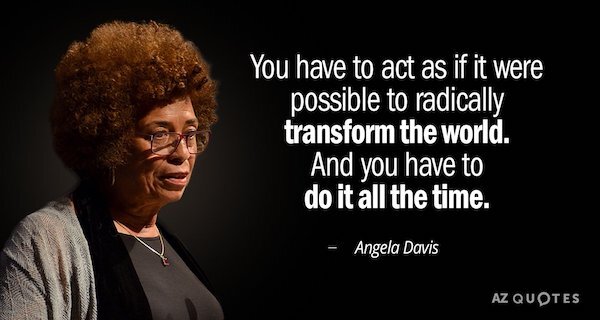
But the shift and sacrifice that I believe needs to happen goes well beyond a financial one. It means shifting the way we distribute land. It means prioritizing care of the natural world over our individual needs for convenience and luxury. It means changing how we educate people and the value (or lack of value) we place on certain kinds of education. It means creating a new kind of economy where amassing significant wealth is neither desirable nor incentivized. It means utilizing a new kind of governing and decision-making process that de-centers accumulating or usurping power. It means a radical shift in how we see and value each other. 
Quotation-Angela-Davis-You-have-to-act-as-if-it-were-possible-to-81-31-89.jpg
Individualism and exceptionalism in an American context has held us back from acting in the interest of the collective on a large, national scale. But when it does happen, it’s an extraordinarily beautiful thing. My challenge to everyone right now is to think about how you can better move collectively. How can you begin to make space for others in your dreams and goals and visions? How can you more deeply investigate whether your goals and visions and dreams were implanted by capitalist, ableist, heteronormative, white supremacist society or whether there is a way for them to be in service of the collective? I’m not talking about the whole of humanity either. There’s no way any of us can tackle everything that needs attention in every corner of the world. But we can tackle something that is within a 2-block radius from our homes. Or our kids’ school. Or our 5-person team at work. Or our Saturday volunteer crew. If we start looking at what’s immediately in front of us, we can start to imagine what we can make look a little different, feel a little different. And then we begin to grow a larger practice of collective visioning and collective work. 

Tuesday, June 16, 2020

No longer in extremis.

Each week, I’ve been ceding the blog to others as a chance to hear many voices share their thoughts about our field, where we are, and where we are going. Before I introduce our writer this week, I will say, reach out if you’d like to add your thoughts. This field is varied, and each voice adds to our collective understanding of the situation.

For this week, I’m re-posting Andrea Montiel de Shuman’s Medium post with permission.

Andrea has been a leader in the museum technology field. I’ve always appreciated working with her on committees and spending time with her outside committees. Her grace and thoughtfulness are obvious in this post. I hope you appreciate it and her—I know I do:

—-
Author: Andrea Montiel de Shuman
Today, it is with a heavy heart that I announce my resignation.
I could not be any more proud of the years that I invested at an institution that has dedicated decades to serving an immeasurable amount of visitors from diverse backgrounds. The Detroit Institute of Arts has been a precious anchor where many of us have created memories that helped define who we are today.
It would be difficult to count the wonderful opportunities I’ve had here. Among other highlights, it was an honor to lead the ambitious AR project Lumin, which helped us, and the field at large, to confirm that it is possible to create meaningful AR experiences, even when technology has some catching up to do. It is hard to describe the gratification of seeing families meaningfully engaging with the Asian interactives we prepared with many advisors that included local members of the Asian communities. Both projects received awards by AAM. At large, I am proud of the countless hours of cross-departmental and community collaborations that will inspire me forever, hand-in-hand with colleagues who have invested their best efforts on behalf of the people we are committed to serving.
Representing my institution, I’ve had the honor of engaging in multiple professional development opportunities, such as speaking at conferences like SXSW, Museums and the Web (MW), Museum Computer Network (MCN), and other convenings dedicated to exploring best practices, ethics, and moral implications of arts + technology. This work led to my appointment as an organizing committee member of AAM’s Tech & Media MUSE Awards, my election as Program Co-Chair of MCN, being part of Knight Foundation’s initiative to support positions with digital expertise, and receiving grants to continue digital efforts. For the last three years, I’ve had the pleasure of collaborating with the Smithsonian Latino Center as part of the Educators Advisory Council, in preparation for the forthcoming Molina Galleries, which will focus on celebrating the contributions of Latinos in the History of America.
During our current crisis, knowing that the world largely communicates via digital platforms, as the Digital Experience Designer I strived to incorporate my best professional advice, along with the most relevant recommendations from my networks and the field at large, to help the institution make informed and strategic decisions. Numerous colleagues and I made suggestions and prepared resources to ensure that we had protocols, and that our digital projects were accessible to anyone regardless of internet access or physical ability.
However, unfortunately, our strategies have gone only partially used — Instead, many of us have struggled to understand how leadership is managing the digital efforts, and to gain active support for something as basic as commitment to a comprehensive accessibility approach, despite having the funds and internal expertise to do so. As a consequence, I believe that we have neglected a number of communities who support our operations through the millage, some who already go underserved by our institution and who need our attention the most these days.
Today we must face our reality:
It is not just the pandemic, the situation only exacerbated larger, systemic issues most staff are well aware of. In the past couple of years, the institution has been reshaped into a form that many of us cannot recognize — it is a contradictory, hostile, at times vicious and chaotic work environment that is no longer anchored in the visitor-centered practices that gave us our legacy, the one that we use in our marketing materials and that we quote to pursue funding.
I cannot identify a single strategy-level decision maker with visitor-centered expertise and enough cultural competency to develop and apply successful, proven methodologies in-house, let alone share with other institutions nationwide and beyond.
I understand the field at large is struggling to catch up with the demands of digital resources. However, the DIA is privileged to have one of the most comprehensive understandings of visitor experience in the field, thanks to world-class methodologies developed by the research, interpretation, and education teams; work led by respected colleagues in the field like Nancy Jones, Jennifer Wild C., Swarupa Anila, and Ken Morris. These practices have led to more meaningful, equitable, accessible, and diverse engagements with our visitors and one another. We are seated on a legacy of more than 25 years of comprehensive contributions to the museum education field, including formative and summative evaluations of how our exhibitions and engagements with various communities have performed.
Instead of using our best tools and talent we have in-house, many of my colleagues and I have been systematically disenfranchised. We constantly have to justify and defend our expertise, often unsuccessfully. We are being hurt by leadership that has fostered a totalitarian, oligarchic system, which is currently extinguishing our best efforts to be reflective and meaningful in what we do. And it shows.
There are numerous examples of the consequences of ignoring and dismantling our best practices. The one example that is clearest in my mind is witnessing the violence of Spirit of the Dead Watchingpaired next to The Yellow Christ during the staff preview of the Humble and Humanexhibition. A label accompanied the two paintings that barely acknowledged that the naked body on that purple bed was a 13-year-old indigenous girl named Tehamana. The label did not address that the artist sexually abused her, gave her syphilis, and colonized her home. When I saw the cross near Tehamana’s gaze of terror, I was immediately transported to the terror I experienced as a young girl after being molested by a worship leader. On that purple bed I no longer saw Tehamana, it was my naked body, exposed, and my colleagues were collectively watching.
I immediately wrote a detailed letter to leadership describing how the pairing fell into critical cultural sensitivity and interpretive errors that any museum educator would identify, including the dangers this presented for our communities. I asked how the DIA was preparing front-line staff to handle conversations around power dynamics, colonial abuse, and sexual assault — particularly of minors. I was especially worried as we were about to open the exhibition that annually drives our largest indigenous participation, Ofrendas: Celebrating Día de Muertos. The DIA was also about to receive hundreds of students who visit to celebrate the student exhibition show. Most troubling was knowing we were the hosts of two groups of sexual abuse survivors who engage with the institution for healing. All in all, I did my best to make clear that my experience had fulfilled the mission of the institution: I saw myself in art, and it was horrifying.
Soon after, a local social worker postedher own experience, an episode that confirmed what I had warned to museum leadership days ahead. Attempting to prevent further damage, I used all of my available channels and resources to bring up the issue and seek a meaningful response. Instead of a responsible solution, I ended up in the HR office, told that 1. The “Strategy” (senior leadership) team had discussed and determined that this was largely a personal issue (meaning, only I had a reaction since I was molested as a child), and 2. That the DIA was not going to be a censoring institution.Which is a lie.
Across museums we censor, and we do it all the time. It is done strategically, systematically, and at the wish of decision makers. We do it for money, to protect reputations, out of ignorance, or to please the political views of the one audience most museums seem to be willing to create a space for. And that makes us complicit.
We censor the stories of colonial abuse, we censor the truths of how we acquired our collections, we censor the pain of communities of color, we censor the struggles of women. The biggest burden I personally carry is the way museums censor the voices of their workers of color and our allies:
We are subjected to these systems and are told that to navigate them we have to stay quiet or forgo our careers, even though these systems, which are put in place by the powerful institutions that we work for, often directly exclude or harm us.
Instead of being allowed to do our best work and meaningfully contribute to the field, we have to meet behind closed doors to encourage each other and share resources on how to deal with the Amy Coopers of our own institutions, those who — probably even unconsciously — look down at our expertise, who know that our voice is limited, and who use that to their own advantage. There are known reports on the psychological and emotional consequences of dealing with systemic racism in museums. After the situation with Tehamana, as well as other related experiences I had to endure, I was forced to take a month-long mental health break.
I have been told that if we stay quiet and play the system, eventually things will change. But how am I supposed to have hope if at my institution decades of museum education and visitor-centered practices were dismantled in a matter of a few years? Those practices led to the inclusion of my communities. I remember the first day I visited the DIA and saw myself in art, embraced as part of humanity, by the creative collective memory of the multitude of nations. Those practices that made me feel accepted, no longer an alien, because that day the DIA was speaking directly to me: the immigrant, the Mexican, the woman of color — and it told me that I belonged.
The conversation that prompted me to formally resign happened at the end of a call with the team discussing digital experiences during the first week of the recent protests against police brutality. After not hearing anything related to the Black Lives Matter movement, I raised the question of how the institution was planning on responding. The deputy director replied that, “since in earlier conversations we had discussed DEAI considerations, all of our digital offerings should be healing and helpful to our Black communities”. Unsatisfied with the reply, I asked how the institution was planning on meeting the specific, personal needs of our Black communities and the rest of our audiences affected by the current situation. “I have to go”, she added as she signed off the line. I knew that I too, had to go.
Any statements the DIA has released since have read to me like attempts to prevent the type of backlash that many museums are facing across the nation for weak responses that do little to recognize our part in supporting white supremacy. We have to remember and acknowledge that the victims of systematic racism are not only those at the end of a gun.
“The entire system and structure of this country has been built on racism. And that is what systemic racism is.” During a recent discussion hosted by AAM on Racism, Unrest and the Museum Field, Lori Forgaty, director of OMCA, encouraged museums to take the necessary next steps when she stated “It is the laws, the structures, the roles, the government, property ownership, every facet of our life. Museums have been built on that power of white people over people of color and particularly Black people.”
I personally find it criminal to take money from African American donors and supporters, and benefit from the hard work of my African American colleagues as we actively turn our backs on practices that are specifically designed to protect them.
If leadership actually understands the complexity and ramifications of the situation, does that mean they don’t think we can meaningfully contribute to the transformation and future of our communities? if we don’t believe we have an integral role in this, then what’s the point of our museum at all, other than retaining, increasing, and collecting people’s wealth? How can we believe in the transformative power of the arts and yet so blatantly ignore or even deny its potential to inflict severe pain and trauma? Why do we deserve the support of our diverse communities if we do not do our best to respect them and incorporate their diverse perspectives?
The only way I see my beloved institution restoring the quality of work our constituents deserve is if it has the courage to look in the mirror and meaningfully reflect, then commit to not only apply, but to actively endorse the development of visitor-centered, education and evaluation practices that lead to the eradication of racist structures. I also believe it is crucial to add layers of transparency and accessibility that protect our legacy and ensure the work is not dependent upon the competency of the leadership in place.
I encourage the DIA Strategy team and Board of Directors to discuss their stance with our audiences. I support the millage and the institution — I always will — but our communities have the right to ensure the institution uses their investment in a way that will most benefit them.
While some might interpret this letter as hateful, I want to emphasize it is written out of love. My heart is certain there are good intentions amongst the leadership of the Detroit Institute of Arts.
I was told this letter will ruin my career, that I will be forever labeled as a disgruntled employee. I disagree. This letter exists as a tribute to the immeasurable support that my colleagues have gifted me with, and that has resulted in courage. I look forward to the days ahead as I plan on applying to a research-based postgraduate program that explores the arts and technology and how they affect communities of color, particularly indigenous peoples. But for the following weeks, my plan is to focus on recovering from this all. I look forward to that.
At 3:05am, a few hours before delivery, I wonder how to end this letter.
I do not think I have anything left to say at the time, but the words by James Baldwin in his book, The Fire Next Time, are compelling. It is an encouragement to imagine the opportunities ahead:

“To accept one’s past — one’s history — is not the same thing as drowning in it; it is learning how to use it.”

Thank you, DIA, for everything. I am hopeful.
A. Andrea Montiel de Shuman

Wednesday, June 10, 2020

Injustice In Science [Museums]

Many of you are probably old museumcampers. Nina Simon, Lauren Bentua, and many others would host us in the halls of the Santa Cruz Museum of Art. And like Camp, those people you talked to huddled late at night in the Lobby hold a special place in your heart. Ivel is one of my fellow campers. She has a big heart and a great smile. Combine this with a conviction that science education can be part of a more just social, and you have an extraordinary voice to think where we go next in this field.

—-

Injustice In Science [Museums]

These days it seems like all cultural institutions and organizations have put out a statement rebuking racism and aligning with justice movements, science museums and centers are also joining in. The statements purport “standing with the Black community” and to be “devastated by the murders”. It’s hard to see now how these statements will manifest into meaningful action, especially since it seems like many of these same institutions have been languishing over issues of diversity, equity, access, and inclusion (DEAI) for decades. The systems in which these organizations are operating under are not designed with these tenets as part of their fabric, in fact  the opposite is true. Organizations are perpetuating systems of oppression by their very nature. Science is not absolved from justice issues. Historically, these institutions have claimed the “neutrality” and “objectivity” of science to divorce themselves from reckoning publicly with systemic racism. The veil of neutrality has been lifted, the time to bring justice to the forefront is now.
One of the ways I have thought about this in my own life (as a person of color) is “how do I thrive in a system I am actively trying to overthrow”, it seems counterintuitive. If we map this line of thinking onto an entire organization it becomes even more problematic, there are Board of Directors and employees to contend with.  When people talk about “systemic oppression” what are the systems they are referencing? What are their names? Is it capitalism? Is it the hierarchical structure of organizations? Sexism, racism? All of the above?
As a self proclaimed solutions oriented positivist I have been trying to overcome my helplessness by identifying promising ideas around change. I would like to share them with you, in case they resonate as something you could do and/or propose in your organization. When we think about mapping these ideas onto an organization I think about how museum leadership can take these on personally as individuals (CEO, COO) and as departments (Human Resources, Education) and so on.
Accountability- any statement about an institutional position on racial equity should be accompanied by what action steps the organization is undertaking to challenge the status quo. Acknowledging your role in structural racism is a good start but not enough, what are you going to do about it? Who is keeping you accountable?
Vulnerability- it’s ok to be wrong and to not know what to say, don’t let that paralyze you. Especially when it comes to creating a space where we can grow and come to terms with the extent and ramifications of privilege. No one is expecting you to have all the answers- cultivate the courage to admit that and work on this together with others. Be transparent about it. 
Humility- most of the great leaders I have known have been humble. What does it mean to truly embody the principles of being a work in progress? Admit you don’t know everything, don’t pose thoughts as gospel, be ready to admit fault, don’t cling onto your dogmas so tightly, and elevate the voices of those around you. 
Patience & Persistence- these have to go together! I get tired, I take a break, I keep on it. It's helpful to know that resistance can take on different forms and important to know that it is slow. I have to remind myself often of this because I want to see change happening yesterday, which it did, and does keep on happening.
Coalition Building- you can’t do it all by yourself! FInd people who are interested in doing the work and surround yourself with them. Follow them on social media and connect with them if you need help. Not everyone (maybe not even most) will be motivated to do this kind of work, don’t be too discouraged by this, focus on your journey.
Science museums are a forum and a space for communities to tackle issues that are important to them- climate change, poverty, food insecurity, air and water quality. Science has a role to play in creating a more just society and science museums are an integral (and I hope inextricable) part of that. They are connectors that work to bridge scientific communities & research with people who don’t necessarily identify with the scientific enterprise. They inspire curiosity, promote inquiry, encourage failure and critical inquiry, it’s a good time to focus on doing these things with a lens of social justice!
Ivel Gontan is a Community Science Fellow at the Association of Science and Technology Centers (ASTC), she has spent the last 7 years working in science museums with a focus on connecting communities to science to advance their own priorities.