Monday, July 27, 2009

Helping Strangers Participate through Instructions: Deconstructing the MP3 Experiment

I’ve long admired Improv Everywhere, the NYC-based participatory public art group. They construct wild performances in everyday settings, invite regular people to participate, and document their work well.

I particularly like the MP3 experiments, events at which Improv Everywhere distribute an audio file to people for free as a podcast. Participants gather in a physical venue with their own digital audio players, and everyone hits “play” at the same time. For about half an hour, hundreds of people play together, silently, as directed by disembodied voices inside their headphones. The MP3 experiment is a model for how a typically isolating experience—listening to headphones in public—can become the basis for a powerful interpersonal experience with strangers. In this way, the MP3 experiment is an example of the ways that technological barriers can become benefits by mediating otherwise uncomfortable interactions.

The MP3 experiment is an exercise in following instructions. The voice tells you what to do –stand up, shake hands, play Twister, make silly shapes—and you do it. Over the years, the experiment has grown in popularity (recently, thanks to this NYT article), and the participants have a sense that they will be asked to do something a little unusual in the context of the event. But it’s still impressive how quickly the recording sets a supportive tone in the face of absurdity. And I think there are lessons in the details of the recording for anyone interested in encouraging visitors/users/participants to step outside their comfort zones and try something new.

Listen to the first 5 minutes 30 seconds of the audio file for mp3 experiment 4 (download via this page), held in Manhattan in 2006. Deconstructing just these few initial minutes of the program reveals a lot about what makes this project so successful.

The recording starts with two and a half minutes of music without talking. While this feels long if you are listening at home, in the context of the event it’s a way to get comfortable with the whole idea of the experiment without being asked to do something right away.

Two and a half minutes in, the “omnipotent voice” Steve introduces himself. He explains that you will have to follow his instructions to have “the most pleasant afternoon together.” Steve has a deep, fake “god” voice, which makes him sound both benevolent and like someone you want to please. He’s not your friend, but he likes you. He’s not quite human, but he understands your world. You feel like you are in safe hands.

The first thing Steve asks you to do is to look around the park to see who else is participating—or not. This is an incredibly easy introductory task that doesn’t make you look silly. It bolsters your confidence that others are participating and that they also look like regular folks, not stupid at all. Then he asks you to take a deep breath. Again: easy, non-conspicuous, non-threatening.

Finally, at 3:45, after those two non-physical activities, Steve asks you to stand up. Like a preschool teacher, he asks you three times if you are ready, and then says, “stand up now.” He asks you to wave to others who are standing up. Now you are starting to feel a little foolish and exposed, but also welcomed by the others who are waving to you. It’s a friendly kind of discomfort, and you’ve had enough build-up to feel okay doing what you are told.

At 4:30, Steve starts a “pointing game” in which he asks you to point to the tallest building you can see, then the Statue of Liberty, then Nicaragua. For each of these, he says to point even if you can’t see the place – just point to where you think it is. You don’t have to have the right answer: you just have to try. After giving you a few seconds, Steve always says, “good.” After the Nicaragua question, Steve says, “Most of you are pretty good at geography.” This is hugely generous of Steve. He could easily make fun of the (likely many) people who can’t identify the direction of Nicaragua. Instead, he declares that you are pretty good.

Finally, Steve asks you to point to the ugliest cloud. These silly requests establish complicity between you and him, an understanding that you are special people doing special things. You have moved from making a factual judgment to a subjective one, and again, Steve validates your choice, saying, “I agree. That cloud is pretty ugly.”

The experiment continues, and participants do stranger and stranger things—following people, playing freeze tag, taking pictures of each other, forming a giant dartboard. But it’s all founded on these first few minutes, which create an environment of safe progression, clear instruction, and emotional validation.

I think many of us could construct comparably successful participatory experiences of this type to develop exhibits or audio tours that explicitly support unusual social and interactive behavior. But it’s rare that museum exhibit designers or audio tour developers are willing to explicitly require certain kinds of actions by visitors. It feels too "guided"--even when it opens doors to new kinds of experiences. We want our cake (exciting social interactions) but aren't willing to overly prime visitors. Perhaps one of the obstacles is a lack of an introductory framework to help people feel comfortable engaging in an open and creative manner. How can you provide as friendly and comforting an introduction to strange cultural experiences as Steve does? How can you use specific yet evocative instructions to invite visitors into complicit acts of exploration and art?

Tuesday, July 21, 2009

Innovative Punch Card Systems that Motivate Deep Engagement

When I moved across the country, a friend gave me a gift of a National Parks passport. This little booklet that lists all the US national parks and has a spot for a special stamp that you can obtain at any of them. In the years I have owned this passport, I have visited several national parks. But I have never stamped the passport. It sits in the glove compartment, helpfully taking up space.

I have another item in my glove compartment—a National Parks annual pass—that I use all the time. This card allows me free entry into national parks. It’s a membership.

I find it very strange that the parks passport and the parks pass are not related. Why doesn’t the passport motivate me to visit more parks with rewards? Why isn’t my annual pass fee or renewal status in some way correlated or discounted based on my stamp collection? In short, why isn’t this a better incentive system?

Recently, I’ve been exploring the range of unusual punch card incentive and loyalty systems. In February, I wrote about the complex and somewhat creepy system that Harrah’s casino employs to promote loyalty, but today I’m focusing on the lowly punch card. We’re all familiar with the most basic version, ubiquitous in coffee shops, in which you can slowly accumulate stamps or hole-punches and receive a free drink after six or eight or ten purchases. There are virtual versions, such as the REI coop system, in which members of the coop receive 10% back on all REI purchases available in store credit or cash at the end of the year. There’s even a theater that offers a play with forking paths (such that you can’t see the whole show on one occasion) and a diminishing ticket price for each subsequent visit.

I’ve often wondered why I’ve never seen a museum with a punch card system. Even at the most basic level, punch cards do a couple of important things:
  1. They establish an expectation that you might visit multiple times.
  2. They allow staff to see, with no complex technology, that you have visited previously.

Presumably, a membership does these things as well. But many large museum membership database systems are dismal at tracking members’ or visitors’ repeat attendance. While the visitor is “growing their relationship” with the institution over several visits, the museum plays the amnesiac, treating each visitor like it’s the first time. And where the databases fall short, punch cards thrive. Seeing that a person’s card has been punched several times allows front-line staff to engage in conversation about what they liked on previous visits, what’s new, and what they might particularly enjoy.

But a simple punch card is not enough. Like national parks, people visit museums infrequently enough that the punch card does not incentivize repeat use. If you get coffee every day, and there’s a place that offers you a free cup for every ten you buy, then you can get free coffee every couple of weeks. Museums don’t work that way. I suspect that most people (with the exception of rabid young families at children’s and science museums) would lose a museum punch card before making it to visit number ten.

Here are some clever innovations on the punch card system:
  1. Menchies, a frozen yogurt shop in Los Angeles, offers a punch card with a free yogurt after you’ve purchased seven. When my dad entered as a first-time customer and bought a yogurt, he was given a punch card with six punches already completed—functionally, a two-for-one coupon for his next visit. Not only did this bring him back to Menchies, it was probably more effective than a coupon would have been in priming him to take a new punch card and presumably continue frequenting the shop. Some museums have been experimenting with sending students home from school trips with a free ticket for a followup visit with the family; maybe starting them with a punch card would be a more effective way to connect them to the institution.
  2. Tina, We Salute You, a hip coffee shop in London, makes their punch cards a social in-venue experience. Rather than carrying your own card, you are invited to write your name on the wall and draw a star for every coffee you’ve drunk (see image at top). Purchase ten and you receive a free coffee—and a new color to continue advancing your stars. This creates a feeling of community and entices new visitors to the shop to add their own name and get involved. There’s a game-like “keeping up with the Joneses” aspect where people feel motivated to get more stars, to have a more adorned name, etc. because their participation is being publicly showcased. Instead of the reward when you reach ten and get a free coffee being a private feeling, you get to celebrate with the store and the rest of its patrons. Again, this could be a lovely way, particularly for a small museum, to encourage visitors to think of themselves as part of the museum community and to desire a “level up” in their nameplate on the wall. It’s like a low-budget, dynamic donor wall.
  3. The Winking Lizard Tavern is an Ohio-based chain of thirteen restaurants that puts on a yearly “world beer tour,” this year featuring over 150 international beers. People can join the tour with a ten dollar entrance fee, which grants them a color guidebook of all the beers, a punch card for the beers they’ve tried, and an online beer-tasting tracking system. When you hit fifty beers, you get a gift, and at one hundred, you receive the “world tour jacket” featuring the names of the year’s beers. This is functionally a membership, including email newsletter and special events, but it is driven by the idea that you will keep purchasing new (and different) beers. It’s a brilliant way for each entry, each purchase, to enhance the value of the punch card rather than making people wait entirely until the end. If only the parks service had taken this path with their passport. You could easily imagine a similar system for a museum to incentivize visiting different institutions, exhibits, or trying new experiences across the institution (educational programs, lectures, performances, discussions, etc.).

Punch cards and incentive schemes aren’t just about getting people in the door. They’re also a way to establish a deeper connection with regulars and to reward people for whom the museum is a significant part of their lives. As more museums have moved towards offering “value memberships” that are essentially discounts on admission, membership renewal relies largely on repeat visits. If the member doesn’t come several times, she won’t renew. Particularly at children's and science museums, there are many visitors who use the museum as an extension of their other family learning activities and environments, but membership programs don’t fully exploit this. While children's progress in online educational game environments is tracked and provides feedback to parents, no such feedback exists for museum visits. Exhibit designers spend hundreds of hours developing content that is developmentally appropriate for different kinds of learners, but that information is not used to enhance and amplify the learning value of the museum experience. There are many children's museums that provide label text at adult eye-height encouraging parents to observe and learn from their children's approach to play. Why can't the museum automate some of this observation, bake it into a membership punch card system, and provide recommendations that can help families "grow with" the museum? If the Winking Lizard Tavern can do it for beer, why can't we do it for children's education? Why can’t we do it for any visitor who is eager for the deepening, complex relationship museums purport to offer?

There is no such thing as a townsquare for faceless individuals. When you are treated like a "regular," that connotes special value. Punch cards are a simple step towards acknowledging that value, encouraging repeat participation, and moving towards more robust museum communities. How might you use them to meet your institution's goals?

Friday, July 17, 2009

MuseumNext: Camp Comes to the UK, Oct 22-23

Many of you know how much I love camp-like professional experiences. And so when Jim Richardson of Sumo Design (the guy behind the brilliant I Like... Museums site) asked me if I'd like to come to England this fall and put on some kind of camp with him, I was thrilled.

MuseumNext will be an intense 24 hours of fun in Newcastle upon Tyne, England, which I've heard is just like the beaches of California but with more beer. We are using a hybrid unconference/workshop model in which participants work collaboratively to explore and brainstorm a few pre-selected "wild ideas" for future museum initiatives related to audience participation. I often feel frustrated that conferences focus generally on topics without explicitly applying the content to specific projects of interest. In the case of MuseumNext, you bring the projects (or skills to support new projects) and we will all leave having hammered out some of the particulars--from the creative to the practical.

Let me give you an example. I'm working on a project to open an interactive museum/bar in Santa Cruz focused on social participation. It's slowly moving from the "dream" stage to the "possible" stage - but it's still far from being real. I have some ideas about how it is going to work, but there are a lot of big questions in my mind about how we are going to connect with audiences, run a functional business, and design experiences that are inclusive and exciting without feeling clubbish or overwhelming. I work on this project mostly on my own, and I often wish I had the opportunity to hash out ideas for it with other smart, energized people with complementary skills.

So many of us have private fantasies like this, projects we wish we could start or complete. They may be small programs you'd love to get going at your museum, or an idea for a whole new kind of exhibit or venue. These dreams tend to get trapped in our own heads and get shoved aside by more pressing day-to-day work. MuseumNext is a place to bring these dreams out to play, and hopefully, push them closer to the "reality" side of the ledger.

Not everyone has to have a project, or, as we're calling them, "wild ideas," to participate in MuseumNext. To keep it manageable, we'll select just a few project proposals on which to focus the workshop. Everyone else will be asked to come with their unique skills in mind, and to consider offering unconference sessions (discussions) on topics that relate to making innovative projects happen. Whether you are a graphic designer, an educator, a designer, a marketer, or a programmer, you have some skills that can help make someone's dream possible. You don't have to be an employee of a museum or in the museum field to attend; you just have to be enthusiastic about supporting innovation in cultural venues.

Please feel free to contact me or Jim with any questions. You can sign up now; there is an earlybird rate of £130 until August 14, at which time the cost will go up to £190. I'm trying to come to London beforehand and hope to have the chance to see many of the fabulous museums behind the people and projects I've admired from across the ocean.

And I can't wait to hear what wild ideas you're going to bring to Newcastle!

Monday, July 13, 2009

Museums that Get Better the More People Use Them

On Wednesday, it's my birthday. Today I got an early present from the San Francisco NPR station, KQED, which aired a piece on Museum 2.0 featuring me (as well as the fabulous Lori Fogarty of the Oakland Museum of California).

In the interview, we talk about the idea of Web 2.0 being based on a simple premise: software that gets better the more people use it. Every person who clicks on a Google search result, rates a movie on Netflix, or adds a photo to Flickr improves the overall experience for subsequent users. The extent to which I can learn from Wikipedia or waste time on Youtube is directly proportional to the volume of other users' participation--creators, critics, and spectators alike. This is what Tim O'Reilly refers to as an "architecture of participation"--one in which the rewards of engagement are not felt only by individual users but by the community as a whole.

This concept has spawned a question I like to obsess over: What would a museum look like that got better the more people used it? Not one that got more dirty and broken, or crowded and frustrating, but one for which every subsequent visitor experience was improved by those that had come before?

What might this look like? It might be a recommendation system that helps visitors find things that they'll like or be inspired by based on the preferences of previous visitors. It might be an exhibit that evolves over time, growing richer (but not cluttered) by continued visitor participation and contribution. It might be an educational program that links visitors to each other via their affinities and skills rather than staff providing all of the instruction. It might be a membership program in which the member can grow with the institution not via donor levels but via deeper content experiences with other members.

In the next chunk of the book I'm writing, I'm exploring the ways the network effects of many visitors' actions over time can generate exciting possibilities for subsequent visitors. I'd like to push beyond the most obvious and often-technologically mediated examples to find some clever, elegant, low-tech ways for visitors to enhance each others' experiences. The Haarlem Oost library book drops are one example, but I'm sure you have seen or created others.

And so I have a birthday request for you. Sometime this week, please think about this question and share your response here as a comment.
How could a museum get better the more people use it?
You will make everyone who reads this blog's experience better by sharing your brilliant ideas, and you'll give a great gift to one curly-haired almost-birthday girl. Thanks in advance!

Thursday, July 09, 2009

Making Alternative Meaning out of Museum Artifacts


Seb Chan has a lovely, long interview up at Fresh+New with Helen Whitty about the Powerhouse Museum's new mini-exhibition, the Odditoreum. The Odditoreum is a temporary gallery for the summer school holiday in which the Powerhouse is displaying eighteen very odd objects alongside fanciful (and fictitious) labels written by children's book author Shaun Tan, schoolchildren, and visitors.

The Odditoreum is another wrinkle in the study of visitors' understanding and interpretation of authenticity in museums. That discussion has traditionally focused on visitors' ability to distinguish real artifacts from props and the question of whether an experience with a reproduction is lesser than, equivalent to, or superior to engaging with "the real thing."

But in the Odditoreum's case, it's not the object that's in doubt but the interpretation. The objects are real, the labels absurd. Of course, the objects were chosen for their pecularities, and in some cases, such as a giant licorice tricycle shaped like a shoe, the imagined usage (guide dog training distraction device) is almost as reasonable as the real thing (2000 Olympics closing ceremony vehicle).

Last month, I met an artist who was part of a group that created a renegade podcast tour for the Portland Art Museum. I enjoyed listening to it (virtually, not at the museum). The silly imagined situations that corresponded with the art certainly got me looking at the pieces for a longer period of time than I typically would, and in some cases, made me think about the deeper meaning of the piece or what might have inspired the artist. But I also found myself wondering if this imagined set of interpretations for the art was any more compelling or useful than any other imagined set of interpretations. If I made up stories to go with the art, wouldn't I think just as hard about what it might mean, what inner jokes or profundity I might spin into my creation?

For this reason, I was not surprised to see that the Odditoreum's talkback area is sparking "a remarkable level of participation." There is a very popular part of the Odditoreum where visitors can write their own labels for the artifacts, and the visitor-submitted ones (such as the one at the top) appear to be inventive and on-topic. People are having fun with this experience, and who can blame them? We make up stories about strange objects all the time--the makeup torture devices in our aunt's bathroom, the weird old statue in the outhouse (yes, I have one). We use these stories to try to understand objects and the people who own and use them, and to poke a little fun while we're at it.

Here are a few design decisions I noticed that I think really add to the Odditoreum's success:
  1. They are only featuring a few objects. At the end of his interview, Seb wondered if you could have "an entire museum" like this. You can (and there is - the unparalleled Museum of Jurassic Technology). But the educational value of the Odditoreum rests on the fact is that it is situated in a large museum full of objects with accurate labels. In the Museum of Jurassic Technology, you feel as though you are in a funhouse. You feel disconcerted and overwhelmed by the ambiguity of the interpretation. In the Odditoreum, you know you are being given a little space to have fun and poke at the rest of it all. The rules of the museum still exist, and it's more powerful to subvert them in little bits than to throw them out altogether.
  2. The framing is about imagination and meaning-making from objects, not silliness or childishness. While the Odditoreum was initiated fairly explicitly for children and family on holiday, the Powerhouse doesn't message it as something just for kids. The introductory label talks about "strangeness, mystery, and oddity" and comments that, "when things are strange, the brain sends out feelers for meaning." This is a powerful statement that encourages visitors to really think about the "why" of these objects. It made me recall researcher Sherry Turkle's work with "evocative objects" and her statement that "we love the objects we think with." At this year's AAM conference, Sherry struggled to provide us with a good metric for determining which objects are evocative enough to have emotional and intellectual resonance. It appears that the Odditoreum is full of these, and that the framing--both by Shaun Tam and by the Powerhouse--accentuates the mystical power of the objects rather than their ridiculousness.
  3. The participatory element employs an accessible speculative question. I've written before about the power of "what if" questions and the fact that it is easier for visitors (or any novices) to answer speculative questions than factual ones. The Odditoreum's "write your own label" program is very successful because visitors are being asked to author imaginative content. There are several museums that have experimented with "write your own label" programs, but they tend to involve some programmatic hand-holding to help people get over the threshold fear that they will do it "wrong" in some way. There is no wrong answer to the question, "what do you imagine this thing might be in your wildest dreams?" It is a much easier and less pointed a question than, "what do you think this thing is?"
  4. The participatory element is modeled well by the "official" content. Theoretically, you could take the idea of writing imaginative labels and offer that as an activity anywhere in the museum. That's functionally what the Portland Art Museum renegade podcasters did. But it's much harder for the institution to motivate visitors to be imaginative if the official museum content around them is accurate and dry. It feels like the visitors are being asked to do an extraordinary (and possibly denigrated) activity that is atypical museum behavior. That's why the podcasters were "renegades"--they were deliberately subverting appropriate interpretative behavior. Not every visitor is willing to be subversive. In the Odditoreum such irregular actions are not only invited but modeled. The official labels are beautifully written and artfully printed, but they are comparable in content and tone to what visitors are being asked to do. They model the requested visitor contributions. And the addition of schoolchildren alongside the celebrated author means the museum is also modeling that anyone can be a successful contributor of interpretative content.
  5. The answer is given, but separately. One of my favorite parts of the interview is Helen Whitty's explanation of how the museum chose to display the "real" information about each object. As she puts it:
    I didn’t want the fantasy label immediately next to the real information, thus spoiling the approach (’really you thought we were going to fun but really its business as usual’).
    Instead, the museum mounted the real information ("What they actually are!") together on one large panel nearby. It's available, but it's not the point of the whole exercise.
  6. It's not self-important. Seeing the content from the Odditoreum made me reflect on all the art pieces I've seen in which artists comment on regular life or objects in some way. When it works, it's great, but too often it feels like an inside joke not meant for me to understand--one that might be disrespectful to the object as it winks in an insular direction. I think the family focus (and perhaps the fact that it was initiated through the public programs department) kept the Odditoreum from being overly self-important or ironic. It was interesting to read that Shaun preferred not to select art objects because those already had a layer of interpretation "built in." The Odditoreum labels I've read seem genuine in their desire both to entertain and dig deeper.
Seb concluded by asking if you could make an entirely fictitious museum. I'm ending in a slightly different place, asking: Why isn't there an Odditoreum tucked into the corner of every collecting museum?

Tuesday, July 07, 2009

Quick Hit: Kathy McLean's Work Now Online

I have a confession to make. When I tell the story of how this blog started in 2006, I say it was a personal learning experiment around the question of how Web 2.0 culture might affect museums. And that's true... but it's not the whole story.

The true story is that I desperately wanted to find a way to engage in discussions with some of my museum heroes. I am shy in large groups. I'd sit quietly at conferences, wishing I could talk to some amazing person onstage, not knowing what to say or how to start. And I figured if I started thinking and writing about topics that were interesting to them and to me, we might have a reason to connect.

Kathy McLean is one of my heroes who motivated the start of Museum 2.0, and I am honored and thrilled that we have become friends over the last few years. I have learned so much from her work as an exhibition designer, audience advocate, and facilitator.

And now, finally, a bunch of her work is online. I'm not going to say much about her site, just that you should prepare to get lost in the exploration of her inspiring projects, writings, and talks. Kathy believes strongly in the need for museum professionals to be more literate in the history and evolution of museum practice, and checking out her work is a good starting point for a particular kind of radical museum education.

Kathy's website includes:
  • images and descriptions of some of her most interesting projects, including the acclaimed Darkened Waters exhibition at the Pratt Museum, the newly opened Center for Creative Connections at the Dallas Museum of Art, and many exhibitions at the Exploratorium, where Kathy served as Director of the Center for Public Exhibition and Public Programs from 1994-2004.
  • downloadable PDF versions of several essays (and links to her great books on exhibition design). I particularly enjoyed her account of "opening up the Exploratorium" and her provocative piece about the future of exhibitions, comparing the curatorial concerns of 1998 to those of 1958.
  • video and papers from some of her talks, including this recent and relatively short treatise on science center and museum design.
Kathy also has a blog on the site that is under construction, and she's looking for feedback. So if you've worked with her, learned from her, or are just confused by some part of the site, please leave her a comment.

Happy hunting!

Thursday, July 02, 2009

Designing Recommendation Systems that Go Beyond "You'll Like This"

How would you design a recommendation system for a museum? Recommendation systems are tools that offer suggestions, most commonly in the "if you like that, you'll love this!" format. We've all become familiar with online retailers who address you by name and offer suggestions--some helpful, some annoying--based on your past activity and purchases.

When it comes to museums, recommendation systems are a natural solution for the problem of the customized tour. How can a museum offer each visitor suggestions for exhibits and experiences that will uniquely serve their interests? There are many lovely example of museums providing quirky tours based on particular interests. For example, The Tate Modern offers a set of pamphlets featuring different tours of the museum based on emotional mood. You can pick up the "I've just split up" tour and wallow in depression, or the "I'm an animal freak" tour and explore your wilder side. And the site I Like Museums lets you find whole institutions of interest based on your preference for trails like "making things," "nice cup of tea," or simply "pigs."

But what if you want to provide a truly emergent recommendation system, like the one used to recommend new songs to you on Pandora or new movies on Netflix? These systems use forms of collaborative filtering to analyze what you've liked and find things that might be similar based on both expert and user data. In this way, you could imagine a visitor moving through the museum, starting by expressing her love of optics, then discovering via an enjoyable exhibit that she also is into magnets, and so on.

There are two problems you have to address to create a great museum recommendation system.

Problem #1: Getting the Data

The first challenge is technical--the lack of explicit data. Recommendation systems use a combination of explicit and implicit information to provide you with suggestions. You make explicit designations by making purchases, expressing preference via ratings or reviews, or choosing some things over others. But you are also always generating implicit data passively via the things you click on, items you spend a long time looking at or listening to, and the choices your friends are making. In the physical space of a museum, visitors make very few explicit data contributions. You may buy a ticket to a special exhibition or show, or actively elect to take up an audio guide or exhibition brochure. But most of your preferences for one museum experience over another go unregistered and untracked. This means there's very little data on which museums can automatically offer recommendations for further experiences.

If we really want the explicit data, there are ways to encourage visitors to provide it. Consider the case of Netflix, the dominant US online movie rental company. Netflix makes movie recommendations based on your ratings of films you've watched. There is no reason in the life cycle of movie rental that a user should be expected to rate a movie. Pre-Netflix, there was never a history of people giving something "four stars" when they dropped it in the return slot. But Netflix realized that their ability to sell subscriptions was directly related to their ability to provide users with a steady stream of good movie recommendations, so they invested heavily in creating a rating system that is fun and easy to use.

Rating content from one to five stars may seem like a frivolous activity, but for Netflix, it's serious business. Netflix knows that good recommendations are key to their bottom line. If Netflix suggests too many movies that you don't like, you will either start ignoring the recommendation system or cancel your subscription altogether. The underlying message of the recommendation system is that there is always a movie you'll love on Netflix, so you should never stop subscribing.

This implicit promise is also the key to why people willingly rate hundreds of movies on Netflix. Netflix promises to give you better recommendations if you rate more movies. Your user profile is functionally an aggregate of the movies you have rated, and the more finely tuned the profile, the more useful the recommendations. The more you use it, the better it gets--and that symbiotic relationship serves customer and vendor alike. This promise is what is missing from so many museum rating systems. When museums allow visitors to rate objects or express preferences, the visitors' expressions are rarely, if ever, fed back into a system that improves the museum experience. The presumption on the part of museums is that rating things is a fun activity onto itself and that's why people use them on Netflix and other sites. But they aren't just fun ways to express yourself. They have direct personal impact. Whether you are panning a movie or gushing over a book, your explicit action is tracked and used to provide you with better subsequent experiences.


Problem #2: Designing the Value System

But what's "better" in the museum context? One of the biggest concerns about deploying recommendation systems in museums is that visitors will only be exposed to the narrow window of things they like and will not have "off path" experiences that are surprising, uncomfortable, and valuable.

Fortunately, not everyone is in the business of selling movie rental subscriptions (or woks, or books, or whatever). While online retail recommendation engines are unsurprisingly optimized to present you with things you will like, there are other ways to filter information based on preference.

For example, Librarything, a social network for sharing books, has a "books you'll hate" feature called the Unsuggester. Type in How Children Fail by John Holt, and you'll find its antithesis: Digital Fortress by Dan Brown. This is an undoubtably silly exercise.

When the BookSuggester was released in November of 2006, programmer Tim Spaulding wrote a blog post about the addition of the Unsuggester. After noting the patterns of opposition between philosophy and chick lit, programming manuals and literature, Tim writes:

"These disconnects sadden me. Of course readers have tastes, and nearly everyone has books they'd never read. But, as serious readers, books make our world. A shared book is a sort of shared space between two people. As far as I'm concerned, the more of these the better. So, in the spirit of unity and understanding, why not enter your favorite book, then read its opposite?"

The Unsuggester is based on different values than Netflix's Movies You'll Love and the BookSuggester. It's also based on different data. Whereas Netflix bases its recommendations on ratings, Librarything bases its recommendations on the books you have in your library (read why here). Instead of saying, "if you like this, you'll like that," Librarything says, "if you have this, you'll like that."

This may sound like a trivial difference, but it leads to a real value shift when it comes to the Unsuggester. The Unsuggester doesn't give you books you'll hate; it gives you books that you'd never otherwise encounter. The format is "if you have read this, you are unlikely to read this." The value system for the Unsuggester is based on the idea that we can learn something from things that are foreign to our experience. The books on the list are the ones that are least likely to be found in your Librarything collection or the collections of other users who also have your books. It's a window into a distant and somewhat unknowable world... not unlike the world of wild and disparate artifacts that curators would like to reveal to visitors.

And users have responded positively. When Tim suggested that few people were likely to actually read books on the Unsuggester list, an anonymous user responded,

"You underestimate Thingamabrarians. Some of us are just looking for new ways to branch out from our old ruts... and something flagged as 'opposite' to our normal reading might just be what we're all looking for. (Besides, a lot of the 'niche' books are throwing up classics in the unowned lists, and many people like to improve their lit-cred.)"

In other words, recommendation systems don't have to be optimized to give you something you like. They just have to be responsive to your personal inputs in some understandable and meaningful way.

The Unsuggester is based on the value of finding enjoyment in highly incongruous things. What other values might we want to base recommendation systems on, in museums or otherwise?

Monday, June 29, 2009

Museums and Relevance: What I Learned from Michael Jackson


Where were you when Michael Jackson died? By a strange and lucky coincidence, I was at the Experience Music Project and Science Fiction Museum (EMPSFM) in Seattle for a two-day workshop. EMPSFM is one of a handful of museums worldwide for which the death of the King of Pop is a very big deal. On Thursday afternoon, our workshop fractured as curators, educators, media producers, and marketing staff scrambled to talk to press and put together spur-of-the-moment exhibits and tribute programs.

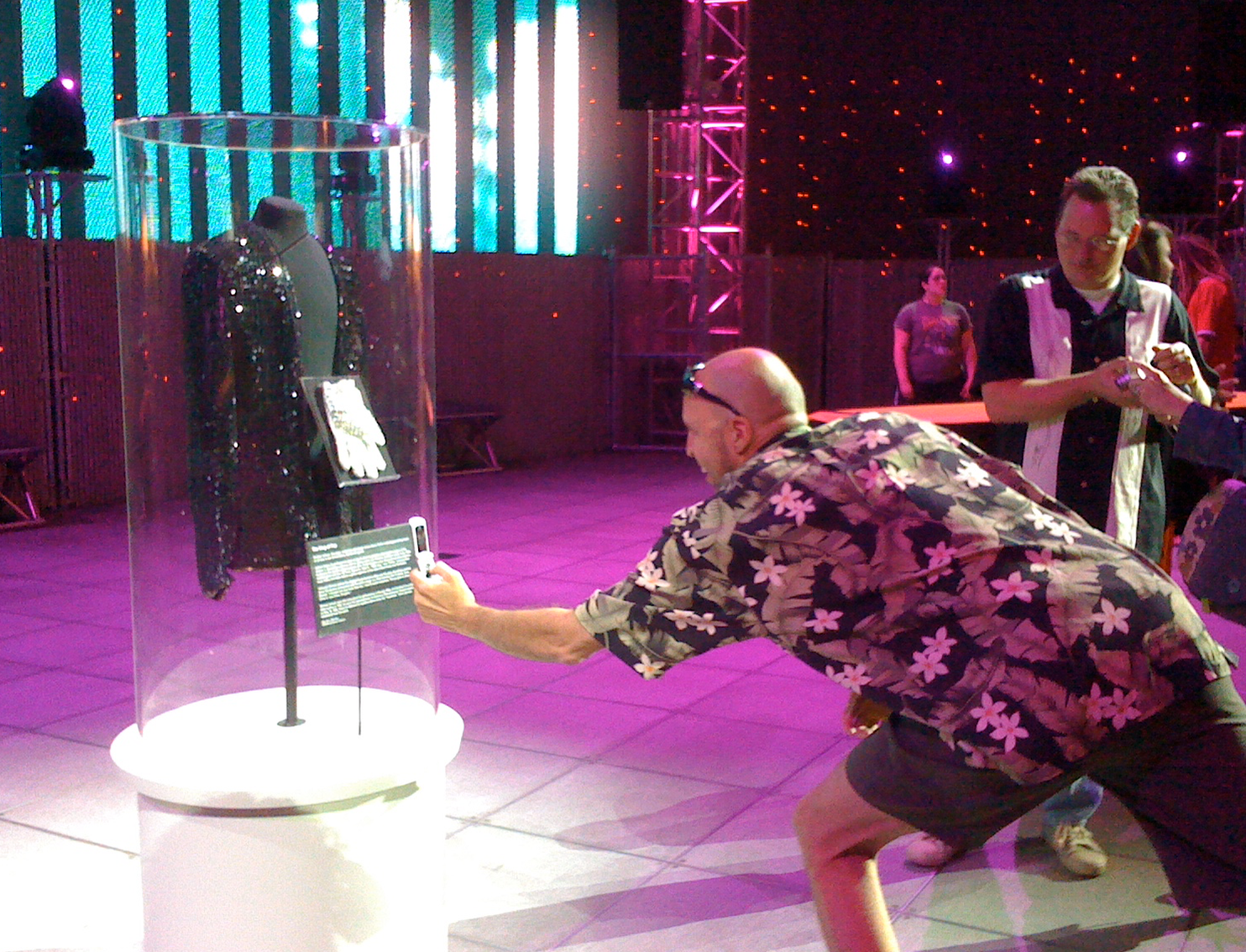
Within 24 hours of the news, the EMPSFM staff hosted a tribute event at a local music venue and mounted an exhibit of Jackson's iconic glove/jacket along with archival concert video in a free public area (appropriately called the Sky Church). They staffed talk-back tables where visitors could write on butcher paper, and outside the museum, they put out boxes of sidewalk chalk to invite people to share their thoughts. They also featured a memorial (and a talk back opportunity) on their website.

I spend a lot of my professional time trying to develop compelling opportunities for visitors to share their thoughts and connect with content that is deeply relevant to their immediate needs and interests. I watched this happen magically and easily for hundreds of people on Friday at EMPSFM, folks of all ages and backgrounds intently taking photos, writing messages, and talking to their friends. It was a rare moment where the cultural and historical importance museums tend to bestow on all exhibits was sought and appreciated by the public. "Yes," every camera and curator and chalk scrawl and family seemed to agree. "This Matters."

There's nothing new about museums serving as spontaneous memorials or providing support in emergency situations. The question is what happens after the news cycle is over, after the urgency diminishes. It's wonderful to see a museum as useful and energized as I saw EMPSFM over the past few days. But what about the rest of the year? Are museums only relevant when they can serve our most pressing needs? And if so, should they seek more opportunities to serve these needs?

I ask these questions amidst recent calls for museums to become more responsive, demand-driven institutions. Elaine Gurian has been speaking and writing about museums as soup kitchens, suggesting that museums should consider new uses of their spaces to provide direct social services to people, especially during the economic downturn. Many potential services, like job training and subsidized food programs, would be incredibly valuable to communities but are foreign to current museum practice. Elaine argues that we should stop worrying about whether these new programs fit the "business of museums" and instead consider whether the business of museums is sufficient to the extraordinary community needs of the day.

I struggle with Elaine's argument. I agree that most museums do not actively and aggressively seek out ways to truly serve the needs of their visitor communities (as opposed to donor communities). For example, museum spaces are often dormant for many hours of the day, and the most basic functions offered--beautiful spaces, clean restrooms, opportunities for food service and event production--could be employed to provide a huge range of community services. Hours before Michael Jackson died and it became the memorial site, I was talking with EMPSFM staff about the under-utilization of the Sky Church, an unusual and impressive public space. And awesome examples like 826 Valencia or the Boston Children's Museum's GoKids program demonstrate that sometimes putting traditional social services like tutoring or food distribution in a cultural context can destigmatize them.

But I also think that museums (like all organizations) need to focus both on who they are for and what they are about, balance the needs of their audiences with the goals of their institution. I'm as interested in how we can find connections between what people need and starting points museums already have--revealing or amplifying relevance--as I am in providing new services for peoples' needs.

It is apropos that the EMPSFM workshop was focused on how the museum can deepen relationships with teen audiences. We weren't talking about bamboozling teens with some hip marketing campaign; instead, we focused on ways that programs which currently serve just a few teens could empower and enable many more teens who are passionate about making music, reading science fiction, and sharing niche interests. We were looking for ways not just to provide more services to small groups of teens but to develop platforms where teens could support and serve each other. And we spent equal amounts of time talking about teens and their needs as we did talking about programmatic responses to support them.

Do these teens need EMPSFM to survive? Probably not. Does anyone need Michael Jackson or Ursula LeGuin or her guitar to make it through the day? EMPSFM may be frivolous in the face of world economic collapse, but it still delivers services that are relevant to some aspect of peoples' lives.

Michael Jackson belongs at EMPSFM (and visitors knew to find him there) because that museum is about pop culture and specifically music. The museum has physical items relevant to his life that served as connection points to visitors' pain and nostalgia. EMPSFM has contextual content that places a dislocative event into a familiar global story. And they have expertise and authority to connote a particular kind of permanent value to the news.

The flipside of this specificity is that when something non-pop culture-related happens that is incredibly relevant and important to Seattle residents' lives, EMPSFM probably won't be there. I think I'm ok with that... but I feel tension as I write this. If EMPSFM is never relevant to the majority of their community's needs, there's a problem. If they are always relevant, there's no problem. The reality--for every museum--lies somewhere in the middle. How do you know you are relevant enough?

Museums can't manufacture relevance to audiences. If you are not happy with the extent to which your institution is responsive to community needs, then by all means, change something. But start by honestly and openly assessing which needs you can appropriately serve. I agree with Elaine in hoping that every museum will earnestly try to do more, will spend more time thinking about what visitors need and less time trumpeting what objects are on display. And to me, providing space and chalk for a twelve year-old skater to scrawl on sidewalk about how Michael Jackson changed his life, well, that counts.

Thursday, June 25, 2009

Technology for Experience's Sake: Guest Post by Bruce Wyman

In this guest post, Bruce Wyman, Director of Technology at the Denver Art Museum, shares his process for developing interactive technologies to extend familiar experiences in art museums. You may remember the Denver Art Museum from this post about their newest (highly interactive) exhibit space, Side Trip.

It's a running joke at the museum that I'm frequently the person in the room that doesn't advocate for the very things that I'm responsible for (technology). It's not that I don't firmly believe in the power and potential of what technology has to offer, it's just that so often it's a red herring when we're designing experiences for our visitors. I want the technology to disappear. I want the visitor to have an amazing experience in general at the museum, and not leave thinking some piece of technology was the thing that stood out. More often than not, if the technology is memorable, it's usually in a negative way -- something didn't work as expected.

So, let's make it easy on ourselves and start off by largely ignoring the technologies that we could be using. Frankly, visitors frequently don't care about the technology and I agree with them. Give them something rewarding, some meaty bit of fun and engagement and concentrate on designing what that experience could and should be. Once you get a good sense of that, the technology begins to fall into place and you stumble across new kinds of experiences that have the power to delight the visitor and probably more efficiently serve your original goals.

Of the different sorts of things that we've design at the Denver Art Museum during the last five years, it's unusual that I have a particular technology in mind at the outset (I'm sure someone could easily call me out on that, but let's pretend together, shall we?). Our standard practice is to deliberately ignore the possible implementation and tease out the details of what will make the experience compelling for the visitor. If we're going to show a video, how is that different? What will make the video compelling? Is there a particular *kind* of interaction that's important to satisfy the experience? etc.

At some point, as you begin to think about how visitors might interact with whatever your experience could be, you start to draw on real world analogies and natural patterns of behavior and interaction begin to emerge. The real world doesn't always have the *best* interactions, but it is filled with interactions that people already know and understand. The critical behavior in making the shift to designing in concert with these interactions is to get in the habit of just watching people all around you and how they engage with the rest of the world.

Let's consider a quick possible scenario. I work at an art museum and one of my long term desires is to know what works a visitor finds interesting without having to deliberately make them punch a button or use some piece of technology that interferes with a visitor's rapt
attention with our artworks. In this theoretical situation, my simple interaction goal is to concentrate on the *capture* of information rather than delivering something back to the visitor. I'm simply trying to find a clean way to judge visitor interest.

When I'm a visitor, if I'm interested in sharing something with a friend, I might point at it. If I'm walking around in an art gallery, I'll pause in front of work that interests me. If I'm really interested, I'll lean in or get closer to the ubiquitous tiny label nearby to read a spot of info. Those are all things people already know how to do and have been doing for thousands of years (in the latter example, the thousands of years that art museums have existed, certainly). So, without even having considered the eventual technology application, I've determined that I'm interested in tracking a visitor's location, proximity to known objects, and time spent in a location. I can then begin to consider ways to do that -- vision tracking, possibly sensing a handheld the visitor may be using to gather information, or RFID tracking a membership card on their person. Given privacy concerns, I'm not sure that I actually want to do any of those, but the important part of the process is that I'm defining an eventual solution by the visitors and their interactions, not from the starting point of specific technologies we want to implement.

The Select-A-Chat in our Western Galleries had an interesting evolution. The final implementation is essentially a small theater space in our galleries. As you enter the area, there's a wall projection resting on our jauntily angled interior walls. Next to you is a comfortable sofa and a coffee table in front of it. The top of the table has a graphic depicting a number of artworks from the nearby galleries with different interview questions superimposed. To select a particular topic, there's a coaster-sized metal 'X' that the visitor places on the table. Simply, the whole interaction is described in one sentence: "X marks the spot." If you want a more detailed tour of the Select-a-Chat, check out this video.

The goal of the experience was to interview selected artists and give visitors some insight to their efforts and process. We wanted artists that felt very human and dispelled the idea that the creative process was a magical one but rather took real effort with some days being great, others not so much. The real strength of the overall interactive is the videos themselves, so we recognized early on that we wanted a relaxed environment where the process of choosing the videos largely disappeared for the visitor.

With these ideas in mind, it became substantially easier to brainstorm different approaches to how we might achieve a simplified end result. In an early iteration, we imagined something very direct -- giving voice to the artist -- in which the table would be more akin to an old telephone operator switch board. The different artists would have headphone jacks for mouths and you'd plug directly into the display. Moving on from that, but still with the same idea, we imagined a large set of fabricated lips as being the object moved around on the table. We quickly moved on when we started to imagine the mockups of photoshopped artist faces without mouths and were left with a decidedly unsettling image. The metal 'X' was a response in trying to step back to what the actual mechanism was, but by that point, we had a good idea that the general interaction was right.

Our visitor testing satisfaction surveys support our belief that the experience works well. People find the experience easy to use and at the same time, we've added a little bit of magic to the interface. The visitor *can't* do anything wrong -- if the 'X' is on the table, the experience works. It's easy to figure out and if you watch someone else do it, you learn what to do in an instant.

On a slightly different note, while we spent a lot of time thinking about the experience before getting to the technology, having a solid understanding of our goal let us think through a few permutations of how to implement the technology. At one point, we'd abstracted the interaction design so far that we considered using the building's new security system. The same system is in use at airports around the world and is particularly good at detecting potential terrorist threats -- the system is able to detect a piece of unattended luggage left in a terminal after a certain amount of time. When that happens, the system triggers a video feed in a central control room. Our problem was the same; an object left in a location (an 'X' on the table) triggers a video feed (different artist videos). We ultimately developed an alternative solution when it became apparent the cameras wouldn't have the resolution or view that we required.

Our visitors have responded well to this approach in our technology design. Not only with the Select-A-Chat, but our visitor surveys in general indicate that the Denver Art Museum's interactive components are easy to use, effective, and enjoyable. We don't always get it right the first time, and we've had to accept that, but we do believe in an iterative approach based on what we learn over time. Even better, from an internal point of view, we accept technology as part of the visitor experience and not as a competitive element that happens at the exclusion of other parts of the visitor experience.

Monday, June 22, 2009

What Makes an Innovative Idea Actionable?

What do you do when you encounter a really great and unusual idea, one that you could implement but would require you to change some aspect of what you are currently doing? Do you jump in or do you shelve it? And what distinguishes the former from the latter?

Recently, I've been wrestling a lot with the relationship between innovation and impact. I'm working on a personal project (slowly) to open a cafe/bar venue that is also a design incubator for participatory exhibits. My goals are two-fold: to develop a dynamic, creative, social platform for my community and to distribute its successful elements to other civic learning institutions (museums, libraries, community centers). The further this moves towards reality, the more I'm focusing on how I'm going to serve the people walking in the door and the less I'm thinking about my colleagues. My strategy is: make it work really well, research what works and doesn't, and share the design lessons with the world. If the venue is successful and we share our honest results, won't others want to adopt some of our practices?

Maybe not. I was recently discussing this project with an audience research specialist, Peter Linett, who is working on a related project to encourage experimentation and risk-taking in museum practice. Whereas I'm taking the "make it as awesome as possible and they will pay attention and want to steal the ideas" approach, Peter is trying very deliberately to create a structure that supports participation from diverse museum professionals and museum venues from the very beginning. My model is the shining star. His is the virus.

Which has more impact on your actual daily practice? I draw design lessons from outside models all the time, so "creative thievery" approach feels natural to me. There's a whole section of this blog called Unusual Projects and Influences. Whether it's an online game like Signtific, a tutoring center like 826 Valencia, or an educational event like Living Library, my engineer brain wants to figure out what makes these innovative projects tick and then tinker with those design lessons in my own work.

But I also remember the first time I participated in a RIG (Rapid Idea Generation) session with Julie Bowen, then of the Ontario Science Centre, at a conference in 2004. Julie got about 25 of us incredibly excited about their innovative three-dimensional brainstorming process. We loved it. And then at the end, when she asked how many of us could do this in our own museums, no hands went up. We all felt like the process was too alien to our work environments, too hard to sell, too hard to integrate. We saw that it was brilliant, but we weren't willing or able to make the changes so we could use it.

So that's one big reason innovations don't get integrated: they are just too foreign to our standard practices and work environments. That's an internal barrier--something about ourselves and the way our teams approach new ideas. But Peter pointed out an external barrier I hadn't anticipated: some innovations just don't feel "museumy" enough. Get a few museum exhibit designers talking about their favorite museums and some serious outliers like the Museum of Jurassic Technology and the City Museum will pop up high on the list. And yet, as Peter pointed out to me, if we love those unusual standouts so much, why don't more museums adopt elements of their practice? Peter commented,
I did hear from several people that the museum folks who loved visiting the City Museum when they were in St. Louis were quick to add, 'It's not a museum.' These categorical objections operate on assumptions that aren't really examined, and not just about educational values or the status of objects, but also about the personality and tone that define museums in some minds.
I was somewhat surprised by this. I'd always thought that museums didn't adopt more of the fabulous outlier work because it wasn't decoded in an understandable and actionable way. That's why I required my museum studies students to carefully document their Advice exhibition--so that the learning from that unusual project wouldn't be lost and could be applied in other places.

But Peter suggested that places and projects that are fundamentally not "museum-like" will not have impact on traditional museums. This worries me because the implication is that no matter how successful my venue is at connecting strangers in creative and intellectual play, museum professionals will look at it and say, "that's nice, but it isn't a museum."

The further I go on my own personal design process, the less I care about this issue. I'm enjoying designing a place that I think is going to be successful and a hell of a lot of fun. I realize that it is presumptuous and a little silly to worry about field-wide impact. But I want to keep grappling with this problem, because my ultimate goal IS to make existing institutions more dynamic, relevant, and audience-centered. I'm not interested in creating a whole new set of institutions to replace or compete with the old ones. But I do want to start by pushing from the outside where the ground rules and constraints are different. I want to make a well-documented model to serve as an engine of new physical ideas.

I imagine that many of you who read this blog are interested in outside models for innovation in museums. What does an outside model have to have for you to be willing to take a risk and make some internal changes? Do you need research? Ticket sales reports? Does it need to take place in a venue similar to yours? How can I (or anyone) design a project that is both maddeningly challenging and incredibly useful?