Showing posts sorted by relevance for query "shelley bernstein". Sort by date Show all posts

Friday, July 11, 2008

Why Click! is My Hero (What Museum Innovation Looks Like)


There’s a value of this exhibition that extends beyond the exhibition itself. We’re accustomed to the notion that people are enfranchised in the democratic process. We’re not accustomed to the idea that they are enfranchised in the cultural process. This is a really unique experiment. Things like this are far and few between.
No, these are neither the words of a self-important curator nor a well-spoken museum director. They are the words of a contributing editor at Wired Magazine, Jeff Howe, and he’s talking about Click!, the crowd-curated photo exhibition now open at the Brooklyn Museum of Art. Why is a leading technologist paying such loving lip service to a photo exhibition? Because Click! isn’t a standard exhibition. As Shelley Bernstein, organizer of the show, puts it, “it’s a conceptual idea put on the wall.” It’s a research project about crowd-based decision-making—one so well-executed and interesting that Jeff Howe can’t help but get excited.

Click! is an exhibition of photos that were submitted by open call and judged by individuals over the Web in an experiment following the collective intelligence model set forth by James Surowiecki in his book The Wisdom of Crowds. In keeping with James’ model, the judging process was highly designed to mitigate influence (people could not view other votes or comments, vote more than once, or skip to specific images), respect the artists (judges used a sliding scale instead of quantifiable ratings, artists could choose to be anonymous on the web, in the museum, or both), and capture diversity (judges were asked to self-identify by geography and art expertise).


I’ve written at length about what excites me about Click! It is a substantive research contribution by the museum to the social technology field at large. As James comments in the attached podcast (scroll down), Shelley’s team did something that he thought was “too hard” to do in his work—tackle the effect of crowds on the subjective question of art evaluation. The research is now very understandably portrayed on the Click! website, where you can explore the results in a variety of ways (and if you get confused, there’s a webcast tour to guide you).


Click is not just a clever use of technology—it’s an original use of technology. To people like James and Jeff Howe, it’s a new data set in their work on crowd-sourcing and collective intelligence. To the museum world, it’s a new attempt to merge people, the web, and a physical exhibition. Shelley’s team created new rules for every step, from the attribution options during the open call to the way the photos were sized and hung to represent the data set.


You may not think it’s pretty. One of the most challenging moments in the podcast is when contemporary art curator Eugenie Tsai says, “[Click!]’s about data, and making the data visual. It’s not really a photography show in the way I would curate a photography show.” Shelley and Eugenie are both explicit about the fact that Brooklyn made decisions in favor of the research and against the most beautiful exposition of the art. All the photos were printed with the same process, and their sizes were determined by the judging process, not aesthetic preferences. Both the New York Times and the Washington Post commented that the resulting show is not that visually impressive, but they are comparing Click! to photo exhibitions, which Shelley and Eugenie would deem inappropriate. It would be more correct to compare it to data visualizations like tag clouds or spark charts.


And that’s a really interesting element of this whole story. Click! isn’t just a research project; it’s a deliberate attempt by the museum to present something and say, “don’t judge this as art.” Not everybody believes or wants to hear that. I asked Shelley if she received any negative feedback from the artists about their work being treated like data rather than art. There was rousing debate about the validity of the crowd-curated model on the blog before the opening, but Shelley said that for the most part people got it because her team was so open with the artists throughout the process. And as one woman comments in the podcast, for her, the thrill was about having her photo in the museum. There is dynamic tension between what the museum wants to present and what participants, visitors, and reporters want to experience.


And that’s a good thing. It’s proof that Click! is not a popularity contest made to "give the people what they want". As with any good museum exhibition, Click! was designed and created by staff to challenge, educate, and add value to patrons’ lives. On the podcast, Eugenie Tsai reacts with surprise to the fact that online evaluators spent an average of 22 seconds on each image. She thinks of that as incredibly long, both compared to her own curatorial process and to the standard museum visitor (who spends an average of 6 seconds on each piece of art). Click! produced a new kind of visitor behavior. As in the Exploratorium’s experiments in active prolonged engagement, Click! designers devised new models that connected visitors with exhibits in a different way. Not necessarily better, but different and new.


A wise poet once said to me: the only way to get any better is to change. We have to do these experiments, explore the different and new, if we ever hope to get better at what we do. Click! may not be the future of museum exhibitions. But it’s the best thing we have so far to help us get there.


Please go to the Click! website and see the results for yourself. Please listen to this amazing 52 minute recording of the discussion among Shelley Bernstein, James Surowiecki, Jeff Howe, and Eugenie Tsai. You can also download the audio here and listen to it in the subway and fist pump at the good parts.


If 52 minutes sounds daunting, here are some highlights to jump to:

  • On Implementation: Concise, useful information from Shelley about the specific choices they made “to come up with a formula that was good to show the data and also respectful to the artists,” (starts at minute 25) and to hang the show as data, not art (43 and 48).
  • On the Role of the Curator: Eugenie Tsai talks about the range of curatorial options and expands on the concept that “museums should be looking for new ways to organize exhibitions” (min 19).
  • On Value to the Field: Jeff and James discuss how this reflects something “very different than the kind of collective problem solving or endeavors that you see on the web.” (min 32)
I’ll leave you with this gem from an audience member at the very end of the show:
You have set a model for doing this—research! It’s a research project! You are setting an example for museums to go out and find out what people think, and for curators it’s a teachable moment … I see you doing research, presentation, and education on so many levels, and it’s really an exciting project that is a true foundational experience for future exhibitions.

Wednesday, October 10, 2012

Voting on Art and its Surprising Consequences


What happens when you let visitors vote on art?

Let's look at the statistics from three big participatory projects that wrapped up recently. Each of these invited members of the public to vote on art in a way that had substantive consequences--big cash prizes awarded, prestige granted, exhibitions offered.
  • ArtPrize, the grandaddy of visitor voting, just completed its fourth year in Grand Rapids, Michigan. This citywide festival showcased work by 1,517 artists competing for a $200,000 top cash prize awarded by public vote. An estimated 400,000 people attended the event over two weeks, of which 47,000 cast at least one vote. Voters had to register to vote, but there were no restrictions on how many artworks a voter could "like."
  • The Brooklyn Museum just finished the public stage of GO, a "community-curated open studio project." GO invited people to visit artists' studios throughout Brooklyn over one weekend and to nominate up to three favorites; the top ten will be considered for an upcoming group show at the museum. 1,708 artists participated. An estimated 18,000 people attended, of which 4,929 nominated artists for the show. Note that in this case, people had to register to vote AND check in at at least five studios to be eligible to nominate artists for the show. Full stats here.  
  • The Hammer Museum recently awarded the first annual Mohn Award, a $100,000 prize that will be awarded biannually to an artist in the "Made in LA" biennial exhibition based on public vote. Five artists out of sixty in the show were short-listed by a jury. 50,000 people visited the exhibition, and 2,051 voted for their favorite artist of the five. Fascinating (and long) article about the Mohn Award here.
In each of these examples, the press and public dialogue mostly revolved around the idea of public voting for art. But when it came to the actual experience, the vast majority of participants and attendees did NOT vote. In Grand Rapids, 12% cast a ballot. In Brooklyn, 27% made it through the voting process. In LA, only 4% voted. 

What's going on here? Why are hundreds of thousands of people flocking to Grand Rapids for ArtPrize but not choosing to vote? Why did the Hammer Museum have record summer attendance if people weren't coming for the thing that was being flaunted--the opportunity to vote?

There are surely some people who didn't want to go through the hassle of registering and learning the rules of voting. There are others who may not have felt "qualified" to select winners and losers. But my sense is that the biggest reason people didn't vote is that for most visitors, voting wasn't the point. The point was to be part of an exciting, dynamic, surprising new way to engage with art.

Or at least, that's what I experienced when I went to ArtPrize in 2010. I was blown away by the social experience provoked by the unorthodox format. Voting on individual artworks turned each one into a social object worthy of lengthy conversation. Talking with Shelley Bernstein at the Brooklyn Museum, it sounds like GO comparably sparked a huge number of community conversations in artists' studios around Brooklyn. When the public is invited to decide, they may not take on that power and responsibility... but they may show up in droves to see what the fuss is about.

This leads me to two conflicting perspectives on voting in exhibitions:
  1. Voting on substantive outcomes (money, exhibitions) is good because it provokes engagement with objects, artists, and fellow visitors. Whether you tick the ballot or not, the opportunity to do so opens up a conversation about what's good, what's bad, and what's art.  
  2. Voting on substantive outcomes is dangerous because not enough people participate to make serious decisions in good faith. The Hammer is reconsidering the public vote component of the Mohn Award after only 2,051 people determined who would win $100,000. And in Brooklyn, Shelley Bernstein noted that the data generated during GO was insufficient to generate statistical significance in a "wisdom of the crowds decision-making" format. In the case of ArtPrize, founder Rick DeVos has explicitly said that the event is a creative act designed to engage people in "conversation" about art. And yet they have added juried prizes alongside the public ones to diversify that conversation.
How do you weigh the positive engagement that comes with community dialogue against the ethics of voting for outcomes that matter deeply to the artists involved?

Thursday, March 17, 2011

Quick Hit: Museums and Social Media in the New York Times

It's a good day for museum technologists. The New York Times special museum section focuses on "the spirit of sharing" and how museums are using social media to connect with visitors in new ways. The section features rock stars like Shelley Bernstein (Brooklyn Museum), Mike Edson (Smithsonian), and Rob Stein (Indianapolis Museum of Art) and covers projects from Tweetups to Arduino hacks to Google Art. It's a rare section about museums and social media that is neither overly gaga about technology nor full of hand-wringing about how these endeavors erode museums' value. While the articles could be more nuanced and reflective of the broad diversity of types and sizes of museums, it's still a great section.

I'm quoted in an article about how museums are using Twitter to bring visitors behind the scenes and engage in conversation around exhibits. I'm particularly glad that reporter Jennifer Preston featured Beck Tench from the Museum of Life and Science, who is doing incredible work bridging online and onsite adult engagement in thoughtful ways. I'm also thrilled that Shelley Bernstein, a long-time friend and fount of inspiration, is getting the credit she is due.

Reading this section--especially in a paper that has not always been friendly to innovations that open up and democratize institutions--gives me hope and energy about the future. The paper legitimizes social media in the mainstream, mostly reporting on projects, practices, and mindsets that have been in the works for years. This challenges those of us working in the field to push further. If you were going to write a special section on museums and social media, what would you include? What do you see as the truly innovative work on the ground, the hard questions to tackle?

For me, these articles bring up two questions I've been struggling with:
  1. What happens when personal relationships with staff, once closely guarded as a perk for high-level donors, become available to anyone who wants to get involved? How does a museum manage "relationship" resources, and how does that impact development?
  2. When a museum chooses a particular online community with which to engage--whether Wikipedians or Flickr users or Twitterers--is that choice largely determined by PR and marketing goals or by some sense of what communities are a good fit for the mission and sensibility of the institution? How do we use social media to expand and align with our access goals instead of just getting "whoever's out there?"
What would be in your section?

Thursday, February 12, 2009

1stfans: An Audience-Specific Membership Program at the Brooklyn Museum

The conventional wisdom on museum memberships is that they are "one size fits many" programs whose primary benefits are free entrance to the museum and insider access to exhibition openings. The main audiences for memberships are value members, who think of it as a good deal, lifelong learners, who want to come to as many programs and exhibits as possible, and donors, who support the museum. But what about all the other people who love your museum? What about the families who show up on your free days religiously or the ones blogging about your new artifacts? Could you create a membership that speaks specifically to them?

This week, an interview with Brooklyn Museum 1stfans managers Will Cary (membership) and Shelley Bernstein (technology) and artist An Xiao. 1stfans is a new kind of membership launched on January 3, 2009 that combines in-person meetups, private groups on Facebook and Flickr, and a private Twitter feed featuring work by original artists (for more background, check out Will and Shelley's blog posts and videos). It has gotten a lot of attention as a "social media membership," but Will and Shelley are adamant that 1stfans is not about social media. Instead, 1stfans is an attempt to turn the impersonal engine of museum membership into a relationship-based, community-centered interaction for two specific museum audiences.

1stfans builds benefits onto two programs that were already successful at connecting people to the Brooklyn Museum: free Target First Saturdays and online social media outreach. The people who engage in these programs already have pre-existing positive relationships with the institution, but they don't buy memberships. 1stfans is an attempt to change that by providing specific benefits targeted to those audiences' needs. Cynics say they are monetizing free programs; supporters say they are providing something worth paying for to a self-selected group for whom traditional membership is not appealing. Both are true. 1stfans is one answer to a universal question: "How do we create a membership to serve visitors who already have a positive relationship with the museum but have not chosen to purchase traditional memberships?"

Want to know how the Brooklyn Museum is answering this question? Then read on, and please share your thoughts in the comments.

Can you tell me about the basic concept behind 1stfans as a membership program?

Will: The big change we’ve made is taking something that is all marketing (membership) and turned it into something that is about personal interactions and growing the community. We’ve gone from a one-directional membership experience—we send you stuff again and again, and then you show up--to a triangular relationship where Shelley and I get to know the 1stfans, they get to know us, and they get to know each other. We announced 1stfans on December 5, 2008, and since then have had 272 1stfans from 15 states and 9 countries on 4 continents.

There are both virtual-only and local 1stfan members. What's the balance between them, and how do you do this triangulation with both kinds?

Will: Only 32 of the 272 so far are from outside the tri-state area, so the majority are locals. There are different benefits to 1stfans for different people. For the faraway folks, some of it is having personal access to staff at a museum you can't visit. For the locals, the meetups are happening at First Saturday--an event they were already going to. For example, on February 7, we had a free 1stfans behind-the-scenes event with conservator Lisa Bruno talking about animal mummies. We'd been twittering publicly about mummies all week, but the event on Saturday was restricted to 1stfans. 32 people showed up, and they liked the program, but the cool part was that everyone stayed around and talked to each other afterwards. And we definitely see people coming to the meetups and then following up online.

Shelley: For the faraway members, we don't have the meetups. But this week we posted a video of Lisa’s presentation on the 1stfans private Facebook group and she'll be available for Q&A on Facebook. We're curious to see how that goes.

Who are the 1stfans? Do you have a sense of why they are joining?

Will: This whole thing started with us discussing two audience segments: people who come to First Saturdays and people who connect with us on the Web—neither of whom buy memberships. And while there are some museum professionals and social media people joining out of curiosity, the majority are locals. We have all these local Brooklyn people who love the museum and come on First Saturdays and spend all day on Facebook and Flickr. This was made for them.

So you weren't targeting "Brooklyn artists" or some other demographic group. It's specific to people who come to the museum but aren't members.

Will: Right. This is part of an analytical process and drew on membership surveys we've done over several years. The challenges were there and we tried to find a solution. 1stfans was not an “if we build it, they will come” kind of project. They were already involved--we just needed to provide them with the right benefits. People shouldn’t get hung up on the social media-ness. Everyone gets fixated on this, but we’re just using it to address a problem.

Shelley: This is not about social media. Yes, we are using social media, but that's because we've always been using social media--this is an outgrowth of the relationships we already had on Flickr and Twitter, our attempt to provide additional benefits to those people.

How did you pick the price point of $20?

Will: It just felt right. As Shelley said, “everyone’s got a $20 in their pocket.” It's within the "impulse buy" range.

Shelley: At this price, people really use it a la carte. Some people want the in-person events, some people want to connect on social networks, and some 1stfans do both. Looking at the statistics on the online participation, each platform has a different number of group members, which means people are taking what they want from it.

How is 1stfans messaged relative to other membership types? Is it an add-on? Can I buy a 1stfans membership at the front desk?

Will: 1stfans is its own tier of membership and regular members can purchase it as an add-on. Since it is so wildly different from other museum memberships, we feel like we have to separate and distinguish it. We don't want people to say, "I'll just buy the cheapest membership" and become 1stfans without realizing what they are getting.

1stfans is not on our printed membership brochure because we don't want to confuse people. We advertise it at First Saturday and on the website, beacuse those are the places where our target audience come and those are the people who will like 1stfans.

Are 1stfans confused or upset that they don’t get free admission to the museum?

Will: We've only had one person ask about this, and no one has complained. Remember, these are people who come to First Saturday--which is already free--and they're at work when we’re open during the week. So free admission isn't the benefit they really need.

It's interesting that the focus for 1stfans is on these very specific audience segments. Could you imagine creating another targeted membership for, say, senior citizens who want to come in the morning on weekdays?

Shelley: It's funny you bring that up. When we first shared this idea, Will’s boss said, "this is a great and innovative project, but it only serves one part of the community. And we serve many--we have to serve our whole community."

Will: We're hopeful that 1stfans is just the first step in this direction. We’ve talked in marketing meetings about creating a package appealing to senior citizens just as we have for the 1stfans.

How do you balance the exclusive content with public content? Are there staff members pushing you to make these events available to 1stfans for free and charge the general public to come?

Shelley: That hasn't really come up with staff, but we do want to find more ways to share the content created for 1stfans with the public. For example, our 1stfans Twitter Art Feed is currently featuring Mary Temple, who is making this really great calendar of portraits of people in the news. In March, we will print a physical version of her work and display it publicly at First Saturday. She’ll do two talks about the project—one just for 1stfans and one that’s public and open to all. That’s also one of the reasons we made the video with An about her Morse code Twitter stream in January—so anyone who’s curious can get an idea of what this is about.

There's been a lot of debate in the social media world about the exclusive content, especially the Twitter Art Feed, people saying that we are selling something that should be free. You can read our thoughts (and lots of good comments from detractors and 1stfans alike) on this controversy here and here.

The Twitter Art Feed features a new artist every month. How are you selecting and rewarding these artists?

Shelley: Long-term, we're working with our John and Barbara Vogelstein Curator of Contemporary Art, Eugenie Tsai, to bring a mix of artists and ideas to the feed. Some artists are selected from the open call (including our first artist, An Xiao), others are projects or artists that we know of and think will work well in the feed for one reason or another, and some artists have work in our collection or are featured in our current exhibitions. Since 1stfans is a new program at the museum and one with an incredibly low price point, all artists in the Twitter Art Feed are donating their time and their effort, which is pretty amazing. One of the most exciting things for me personally is to see artists really fired up about the idea of this membership, wanting to support the Museum and willing to donate their energy to do so.

An, what was your experience like as the first artist to be featured on the Twitter Art Feed?

An: I'd been actively exploring online media and our emerging culture of branded, digital selves, with self-portrait series centered around blogging and advertising, and Twitter quickly became part of that larger exploration. I'd been using it for a while before I was selected for the January feed, but never as an art project per se--my account is a personal scrapbook of ideas and thoughts rather than what I might consider an artistic medium. So on the one hand, engaging in the 1stfans feeds was an exciting opportunity to take a new communications medium and use it as an artistic medium. On the other hand, it was intimidating for that very same reason!

Two things about the overall experience stood out. The first was the amount of work entailed. As a haiku poet and Zen artist, I've been trained in the power of brevity. The trick with the project was that, on top of the 140-character limit, each character in alaphanumerics could convert into as many as six dots and/or dashes in Morse code, thus dropping the amount of text I could squeeze into each tweet. I took time at the start of each week to prepare my tweets both to fit the character restrictions and to make them as interesting as possible.

Secondly, I loved how much 1stfans members got into it. I doubt many of us have ever sent a telegram or seen a telegraph machine, but I found myself having a number of witty, clever exchanges with folks, all in the long tradition of this archaic medium. Artist Nina Meledandri even used a combination of visual imagery and Morse code, taking the project outside Twitter and into Flickr, with a final response composed of pencils, crayons and pastels to represent dashes, and shells and stones to represent dots. The project received some criticism for being inaccessible and cumbersome (members had to copy and paste the tweets into a Morse code translator), but for the most part, the response was quite positive, and the feed became highly interactive. In that sense, the project evolved from simply a conceptual one at the outset into one that was performative and collaborative--an Internet theatre of sorts.

How did working on the Feed impact your relationship with the Brooklyn Museum?

I'd been a fan of the museum in general since I started dropping by a few years ago, and I particularly loved the sense of community around First Saturdays. However, it wasn't until I submitted a photo for Click!, a crowd-curated exhibition that Shelley organized, that I started to feel like a part of the museum. Shelley's warmth and enthusiasm stood out over email and even more so in person, and I soon found myself actively reading and occasionally participating in the blogs.

And so, well before 1stfans was developed, I already felt not simply like a visitor but both a member of a community and an active participant in their arts programming and discourse. Working on the Feed was simply a continuation of this experience. Shelley and Will were super helpful while I was in Los Angeles for the set-up, and of course, I was thrilled to tweet back and forth with 1stfans members and then to meet them in person and on Facebook. The fact that artists are willing to donate their time, effort and money to 1stfans is a real testament to the sense of community that the museum has created. In a city like New York, and in the often disparate and overwhelming art world, it's quite striking. Everything from the fact that Shelley and Will and other memberships staffers take the time to get to know members to the open online communities they've created to encourage interaction speaks to this.

Will and Shelley, have you hit any challenges or surprises thus far with 1stfans?

Shelley: The signup process is manual which is both good (we get to know people) and bad (time consuming). We couldn't use our exisiting setup to process these memberships, so we had to rethink it by using Google Checkout for payment and Google Docs to keep track of folks.

Will: The main challenge on a day-to-day basis concerns the nature of the internet: it doesn't stop when we leave the office. When 1stfans join on a Saturday, they expect to hear from us by Sunday. If they join at 8pm on a weeknight, they'll request to follow the Twitter Art Feed at 9pm, and send us an email at 10pm if that hasn't happened. Because 1stfans request to hear from us on Facebook, Flickr, and Twitter, we have to manually add them to the group, which sometimes involves finding their profiles on each of those sites. In order to serve 1stfans, Shelley and I have to find time to interact with them in a way that meets their demands while not taking away from the other work we have to do. It's tough, but because there's two of us we've made it work so far.

Is there a marketing strategy for 1stfans?

Will: No. We feel like we have to do an adequate job addressing our two target segments--then we’ll come up with ways to market this to other groups. We have 10,000 people at First Saturday – we want to hit more of them before we look for other segments to address. The 1stfans themselves are our greatest ambassadors helping spread the word through their own networks. The artists on the Twitter Art Feed are also doing a lot of promotion to their own networks-An was great, frequently posting about it on her blog.

What are the plans for the future of 1stfans?

Shelley: Our basic motto is be fully committed to our members, but keep finding small things that can make a big impact. Think outside the box to figure out how to involve both sets of people (faraway and local 1stfans) in one swoop, so we can be cautious of staff time and maximize effort. So, looking at February, we taped Lisa Bruno's in-person presentation on the animal mummies and put up the rough cut, then host a Q&A in the Facebook group for a few days and see how it goes. I'd say, generally, you'll find us doing things in a scrappy way figuring it's better to share as much as we can even if we can't make it pretty. Also, we don't know yet which formats work better than others, so there's going to be a lot of experimentation to find out.

Since this membership is based in the social networks, we are going to be watching carefully as that landscape changes (and it will). I think of this is a living membership structure in this way - we watch and we adapt. After all, Twitter may not be here forever, so we've got to keep thinking, adjust as necessary and grow with the technology in the same way we grow and learn with the group. The really wonderful thing is we are getting to know the people who have joined, so when the time comes to make adjustments, I'm confident that this will be a discussion rather than a top-down mandate from the sky.

Wednesday, April 16, 2008

Brooklyn Clicks with the Crowd: What Makes a Smart Mob?


I've written before about the inspiring work that the Brooklyn Museum of Art is doing with their community-focused efforts. They're now running a compelling experiment in crowd-sourced exhibition creation and curation via the photography exhibition Click. This post provides an overview of the project, what makes it stand out, and some analysis of the strategic implications.

What is Click?

Click is an exhibition process in three parts:

  1. The Museum solicited photographs from artists via an open call on their website, Facebook group, Flickr groups, and outreach to Brooklyn-based arts organizations.
  2. On the web, a jury of the masses (anyone) can evaluate the photographs in terms of aesthetic quality and relevance to the exhibition theme. All evaluations are private; all artists are unnamed. It's very easy to sign up and judge... and you can do so now by registering here.
  3. The photographs will be installed in a physical exhibition running for six weeks this summer. The art will be displayed in order of the average juried scores. Visitors will be able to see how different subgroups (including art experts) ranked and responded to the art. The exhibition will coincide with programs about art theory, online communities, and crowd theory, providing a forum for public evaluation and discussion about the process.

What makes Click special?


There are several tactical and strategic things that differentiate Click. Let's start simple...

It is 100% community-based. Anyone can submit art. Anyone can judge. While there are many juried exhibitions that feature an open call, and a few exhibitions that allow visitor judging or rating, I don't know of any besides Click that do BOTH these things. Usually, the institution wants to maintain some control--whether over where the content comes from or how it is selected and organized. As Shelley Bernstein (exhibition coordinator) put it,
The entire exhibition is based on the participation of the community, both in the open call and in the evaluation stage, so the exhibition's contents are entirely up to the community. We are just providing the container, the mechanism so it can function...
In this way, Click is a powerful example of the "venue as content platform" definition of 2.0.

The internal team is led by a non-curator.
The in-house team for Click included two curators, one interpreter, one artist/designer, and two web developers, but the person managing the whole project (Shelley Bernstein) is from Information Systems, not curatorial. If this were a web-only project, I wouldn't be surprised: many museum directors and curators ignore what happens on their websites (and technology people use those loose reins to create all kinds of content experiences). But it's pretty unusual to have a REAL exhibition led by a web person. This highlights the fact that while participatory design is by no means exclusive to the Web, that is the place most of the current experimentation is happening. You don't need to be a technologist to conceive or lead a project like this, but in many museums, non-techies just aren't as exposed to the ideas and products that typify participatory experiences.

They kept the interface simple.
Register to be a Click judge, and you'll be amazed by how little is asked of you. They don't want your home address to send you brochures. They don't require you to agree to an arduous set of terms and conditions. They ask only what they truly need to make the exhibit and the judging successful. This may sound obvious, but we all fall victim to featuritis when we get seduced by the idea of live bodies. There's a reason they call it "capturing" data. With Click, I don't feel like a prisoner.

They make it easy to evangelize. While Click intentionally doesn't allow you to send your favorite photos to friends (scroll down to the "What Makes Click Really Special" section for more on this), there is a lovely page full of ways to join their virtual street team, telling others about the project through Facebook, Flickr, and more.

They are sensitive to the artists who are being judged. At some institutions, there has been friction when artists find out that their work will be judged or commented on publicly by visitors. Much of that friction arises from the fact that the judging/commenting features are added after the artist has already conceptualized and installed their work. In Click, Brooklyn made the scope and depth of participation clear from the start. There's a specific FAQ for artists that explains not only how to upload art, but what's going to happen to it. Artists could choose to remain anonymous throughout the whole process or to have their names revealed in the final exhibition. While artists couldn't choose whether their score or comments would be shown, they could choose whether and how to participate given that knowledge.

They ask judges to self-define their art knowledge.
I found this part of the experience really interesting. When you first log in, you are asked two things: where you live and how much you know about art. You rate yourself from knowing "nothing" about art to being an "expert" on a 1 to 5 scale. When the exhibition opens in June, visitors will see the photos ordered by aggregate score, but you will also be able to look at the scores by art knowledge (and geography) on the web and on interactive kiosks. How will the art novices' choices compare to the art experts'? What conclusions will we draw from that difference? There could be really interesting research implications of this in terms of what we think we know about how different kinds of visitors respond to art. Relatedly, the geography question could glean some relevant data about how local and non-local visitors view and judge the efforts of a community-based museum.


These research questions are where I start to get really excited about Click. There are implications of Click that represent more than just photo arrangement.

But what makes Click REALLY Special? ... the Strategic Implications!


Click is not just an application of Web 2.0 concepts and technologies to a museum project (which Brooklyn has done successfully before). It establishes Brooklyn as a leader in the development and discovery of participatory experiences more broadly--an institution that community and content managers at all kinds of (museum AND non-museum) organizations can learn from.


Specifically, the Brooklyn Museum is doing research about the role of independence and influence in participatory experiences. The genesis of Click derived from James Surowiecki's book The Wisdom of Crowds. In the book, James asserts that "diversity and independence" are two of the most important factors that make crowds intelligent. If you can see how others have responded to something, that impacts your behavior, thereby making you less independent and minimizing your diversity (and, according to Surowiecki, less able to contribute to collective wisdom).

This makes sense. When you are in a mob, heavily influenced by others, you are not smarter. This is true whether you are tromping around the Dallas airport with thousands of other panicked stranded travelers, as I was last week, or watching the dramatic prairie dog video your friend sent you from YouTube. The fact that 4.3 million people have watched the prairie dog video does not make it a great video or an intelligent use of time.

What it does signal is that you have been highly influenced: to follow the crowd, to watch the video. As manager of information systems, Shelley leads a variety of community-based projects at Brooklyn that exploit this crowd influence--people friending each other on Facebook, sending Flickr favorites to each other via email. For this project, she wanted to see if it was possible to go another way. As she put it:
As we started planning for this phase of the exhibition, I started to recognize that many of the features we see on successful websites today are designed to foster community, but they also create a great deal of influence. The view counts, comments, favorites, most e-mailed, and leader boards of sites we all love (Flickr, Digg, StumbleUpon, NetFlix, The New York Times, etc.) are built on the influence of others, so when thinking about the online components of this exhibition, we wanted to minimize influence as much as possible and re-think features that are now commonplace. Of course, there have been plenty of times I’ve wondered if anyone would take part if we didn’t include some of these features that everyone has come to expect, but we’ll have to wait and see on that one.
How did they promote independence in judging? As a Click judge, you can't view other peoples' comments or ratings, even after you've scored a particular image. You can't set photos as favorites for others to see. You don't see the highest ranked photos first. You see the photos in random order, and the direct URLs are suppressed so you can't mail or save any one photo to share with friends (and encourage them to vote for it).

In other words, you can't have a networked, social experience--the experience we've come to expect from Web 2.0 sites. But in Click's case, that prohibition is deliberate. Museum 2.0 concepts and Web 2.0 technologies are still a major part of the Click experience, but they are more narrowly focused on conferring authority to the public rather than providing a social experience. This allows Brooklyn to study the relationship of curation interface to exhibition output specifically, and to therefore perform some research in the basic question of how participatory experiences work.


Research Potential

Unlike most commercial Web 2.0 sites, the Brooklyn Museum's bottom line is not about making money. It's about making intelligent decisions about how to engage visitor/participants with their institution. To that end, they are blogging their process openly and have scheduled a slate of self-reflective programming to coincide with the Click exhibition.

There are many compelling research questions that can extend from Click. How would you design a crowd-sourced exhibition whose goal is to garner the highest participation (as opposed to the wisest participation)? How would the selections of a group with "social influence" tools available to them differ from the forced independence of Click judges? How do these experiments impact the quality of museum exhibitions for visitors who were not involved in the participatory process? Do those visitors notice, or care about, the difference?

This research, especially when it comes to participatory experiences in public spaces (like museums), is not already happening somewhere else. The Web moves quickly and self-reflection has little value in a young field with a "what's hot this second?" mentality. Museums are uniquely positioned to be these reflective "live research" spaces. We have great content. We have established, trusted platforms. We have qualified researchers. We have a bottom line that's about visitors rather than advertising dollars (hopefully).

In short, museums have the assets to assume a new value proposition as leading participatory institutions,
places you go to have the most content-rich, compelling, networked user experiences. But we'll only get there if we join Brooklyn in the lab and start our own experiments to test the hypotheses, measure the results, and find out what clicks.

Wednesday, November 14, 2007

Interview with Brooklyn Museum's Shelley Bernstein

Let’s say you wanted to find a model museum using Web 2.0 to support programs and exhibits. A place that blogs, that engages in social networking sites, that tries experiments, and reports about all of it honestly. A place that truly sees these initiatives as part of their mission to serve their local community. A place that does all this in the context of a fairly traditional collections-based museum. A place that makes it all pretty darn cool.

Is there such a place? You bet. It’s the Brooklyn Museum. They've played with Twitter. They just finished a YouTube video contest. They even created a Facebook application. Today, an interview with Shelley Bernstein, the Manager of Information Systems at the Brooklyn Museum, and the engine behind that museum’s fabulous forays into Web 2.0.


Tell me about the background for the Brooklyn Museum’s community web component. How did this all start?


We started in earnest a year and a half ago. Everything here is mission-driven, and we have a mission that’s very much about the visitor experience and community. And we looked around and said: what does community mean on the web? And it was so clear at the time.


We started slowly with the MySpace page, and we started in earnest with Flickr. We did this graffiti interactive via Flickr. The real show in the museum was a series of canvasses showing tags--graffiti--and the curator and education department installed a wall in the middle of the gallery so that visitors could tag (we provided colored pencils, and people brought their own markers and stickers). We let it layer to a point and then cleared sections for reuse. We were taking photos of the wall every week and the changes that were taking place. We were finding that so many people were coming to the exhibition just to tag the wall. The Flickr site became this vital thing to get that information about the changes back out to them.


Did you find that people who had been to the exhibition were commenting on the Flickr page? Were they really using it as a post-visit resource?


Oh yeah. We learned a lot about graffiti from Flickr. They would comment on the photos we'd taken and add notes with links to their own profiles. We saw that these artists were using the wall, then telling us about it on Flickr. We also had a thing where you could email photos of graffiti in Brooklyn and we put them on our Flickr wall. We also created the Brooklyn Graffiti Group.


How hard is it for you and your team to manage the work flow of all of these projects?


The great thing about any really strong community on the net—we’ve never ever had to remove a comment on Flickr or even worry about it. Even criticism has been very contructive. Spam, obscenity--they just aren't an issue at all.


I keep telling people, I’m really honest that these are communities, not marketing opportunities. MySpace is, but Facebook isn’t. It’s a long term commitment. Once you start you can’t stop. It’s a community-level thing that you’re doing. It’s not about marketing or advertising. If you post interesting content, the word of mouth aspects will follow.


We get so much spam on MySpace, whereas on Flickr and Facebook and the blog we never get spam.


One thing that can make it more manageable is the use of third party systems. We use Wordpress to power our blogs. It's great to see so many museums using 3rd party systems, like SFMOMA or LA MOCA's Wack!. You don’t know it’s a blog. Using existing tools to run your site allows for plug-ins. Because we want to keep up with new software, and we’re never going to have the programmers to keep up.


Do you think of your efforts as trying to draw new audiences into the museum or reach out to meet them where they are?


I think about it as going to them rather than the audience coming to us. Just as we might go to Prospect Heights or Crown Heights. We know that the actual statistics of people coming through the door is not quantifiable yet—we haven’t done a visitor survey in a couple years. Within the museum, we have a big initiative to tie together comment books electronically, so that gallery comments go on the web and web comments go in the galleries.


How you do decide what experiments to do?


It depends. If it’s connected with an exhibition, I work with our interpretative materials person really closely on the goals and we have a discussion. She’s really great at responding flexibly. There’s a lot of discussion about what would be appropriate when it comes from an exhibition standpoint. But other things--the twitter thing, the video contest was my idea. We’d received a video PSA from Pratt students,
and I proposed the contest.

There’s a lot of communication in the building about what we could do.
For us it always goes back to mission, so we’re a kind of unique case. For us, it’s not about targeting or marketing--it's about serving the community.

We try to be really really careful here. That’s why we’re not in Second Life. #1, it would be a lot of work. And #2 it doesn’t fit our accessibility mission. Flickr photos and Youtube videos are open and available to all. We look at the equation and say maybe Second Life isn’t the right fit for us. You have to have a really good computer and internet connection. And I’m not sure that our visitors would really benefit from it. One of the things I think about is capturing video in SL to share with others. Any time you see an interactive on our site—we have a plaintext version of that wherever possible. It’s really fabulous when Flickr or YouTube or Blip.tv can really provide content for audiences who use those sites—AND it provides a way to broadcast on your own site.


One of the best services you provide the museum community is your honest post-mortems on projects. Do you ever run into institutional challenges for being so honest?


Not really. Even when it’s kind of a disaster, I try to be methodical about it instead of just ranting. So it’s a calmer discussion, and the people here appreciate that. With the blog, we really try to own up to what blogging is about. It’s a multi-author approach, and the authors are not edited. We have a policy, but for the most part, I think all of the authors have been pretty good at keeping it personal and trying to be transparent.


Do you have any dream projects in the near future?


We really try and go on a case by case basis, fitting things into the context of the larger museum. I read a lot and I look at a lot, and I just sort of keep things in the back of my head. Oh, we could do this. The facebook thing was very organic. I read an article by the founder in Wired about how that platform was so different in terms of application development. My developer had wanted to do an app on it for his own curiousity. We checked with a few people around here and we tried it out. We’d been using Facebook for awhile for groups, but then I happened to read about apps, file it away, and then a week later it came up in conversation.


All of these communities require a real commitment—that you’re there, that you’re updating. It’s funny; I think it’s something we do really well on Flickr, because we’ve been there so long and we know the audience there. If you look at the IMA (Indianapolis Museum of Art), they’ve got that going on in YouTube. Maybe the Tech will have that with your new project in Second Life.


Jim Spadaccini often talks about how you have to learn about and respect the native community on these sites.


Exactly. You want to concentrate on something and make it fabulous. The Walker has it with their blogs. Us on Facebook. IMA on YouTube.


For a museum new to this scene, that isn't ready to make a full commitment, how would you recommend getting started? Programmatically, I think there are some individual projects--like the video contest--that could allow you to dip your foot in the water.


I think you could easily do it on Flickr—the Tate did that with How We Are Now. I don’t know what their commitment is now, but they had a great commitment during that project, which had a beginning and an end. And that was such a fabulous project, and a great experience.

I hesitate though a bit because I don’t think that people should necessarily go do a one-off because I think it doesn’t really build the community. I worry about that. There was a museum that put a series of photos up on Flickr for one project. They did that one thing, and it was clear to me that they were not interested in being there.


We were on Blip.tv before Youtube—it allows longer vids. Blip doesn’t expose the views, but some of these videos have 100,000s of hits. We’ve been there longer (than YouTube) and the audience is responding to our content. One of the reasons we did the video competition was because YouTube is a space that shouldn't be about us pushing content out—it’s YouTube—it’s what they produce, not what we do.

Do you have any image rights issues?


Most of the stuff in our museum is public domain, and we have a very good policy that non-commerical photography is okay. We’re very clear about our photography policy everywhere.


Any special projects you'd like to highlight?


Well, we have electronic, web-connected comment books coming soon to all exhibit spaces. The comment architecture is going to get a lot bigger in the next several months. And then there's the Facebook application, Artshare—the Walker and the Powerhouse are going to come on board with that. My hope is that ArtShare becomes an app not just for the facebook community but for the museum community as well.


Amen! If you're on Facebook, check out the Artshare application. Browse the Brooklyn community site. Check out the links above from the projects Shelley mentioned. And leave your comments and questions (for Shelley, me, or other readers) here!

Wednesday, June 24, 2015

ASKing about Art at the Brooklyn Museum: Interview with Shelley Bernstein and Sara Devine


I’ve always been inspired by the creative ways the Brooklyn Museum uses technology to connect visitors to museum content. Now, the Brooklyn Museum is doing a major overhaul of their visitor experience--from lobby to galleries to mobile apps--in an effort to “create a dynamic and responsive museum that fosters dialogue and sparks conversation between staff and all Museum visitors.” This project is funded by Bloomberg Philanthropies as part of their Bloomberg Connects program.

I’ve been particularly interested in ASK, the mobile app component of the project. The Brooklyn team has been blogging about their progress (honestly! frequently!). To learn more, I interviewed Brooklyn Museum project partners Shelley Bernstein, Vice Director of Digital Engagement & Technology, and Sara Devine, Manager of Audience Engagement & Interpretive Materials.

What is ASK, and why are you creating it?

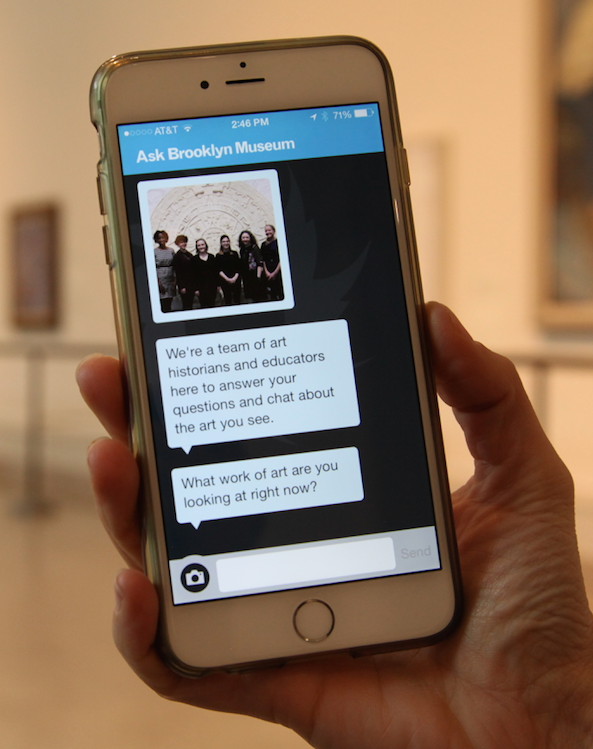
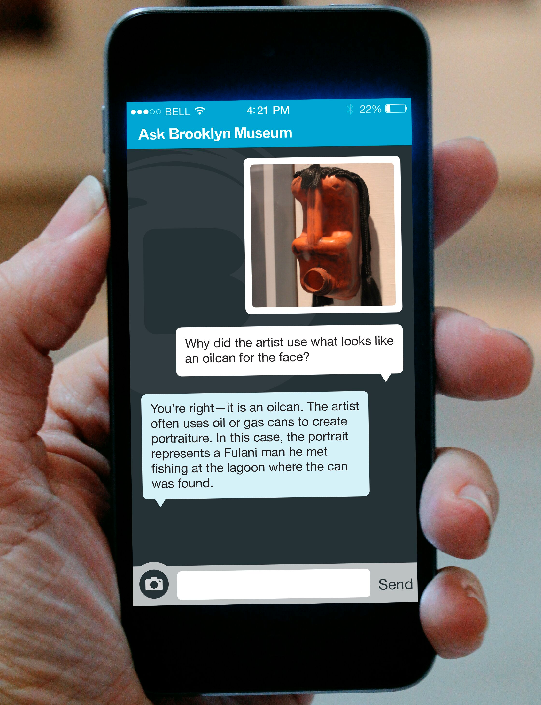
ASK is a mobile app which allows our visitors to ask questions about the works they see on view and get answersfrom our staffduring their visit.  

ASK is part of an overall effort to rethink the museum visitor experience. We began with a series of internal meetings to evaluate our current visitor experience and set a goal for the project. We spent a year pilot-testing directly with visitors to develop the ASK project concept. The pilots showed us visitors were looking for a personal connection with our staff, wanted to talk about the art on view, and wanted that dialogue to be dynamic and speak to their needs directly. We started to look to technology to solve the equation. In pilot testing, we found that enabling visitors to ASK via mobile provided the personal connection they were looking for while responding to their individual interests.

Are there specific outcome goals you have for ASK? What does success look like?

We have three goals.

Goal 1: Personal connection to the institution and works on view. Our visitors were telling us they wanted personal connection and they wanted to talk about art. We need to ensure that the app is just a conduit to helps allow that connection to take place.  

Working with our team leads and our ASK team is really critical in thiswe’ve seen that visitors want dialogue to feel natural. For example, staff responses like: “Actually, I’m not really sure, but we do know this about the object” or encouraging people with “That’s a great question” has helped make the app feel human.

Goal 2: Looking closer at works of art. We’d like to see visitors getting the information they need while looking more closely at works of art. At the end of the day, we want the experience encouraging visitors to look at art and we want screens put to the side. We were heartened when early testers told us they felt like they were looking more closely at works of art in order to figure out what questions to ask. They put down the device often, and they would circle back to a work to look again after getting an answerall things we verified in watching their behavior, too.

Moving forward, we need to ensure that the team of art historians and educators giving answers is encouraging visitors to look more closely, directing them to nearby objects to make connections, and, generally, taking what starts with a simple question into a deeper dialogue about what a person is seeing and what more they can experience.  

Goal 3: Institutional change driven by visitor data. We have the opportunity to learn what works of art people are asking about, what kinds of questions they are asking, and observations they are making in a more comprehensive way than ever before. This information will allow us to have more informed conversations about how our analog interpretation (gallery labels for example) are working and make changes based on that data.

So, success looks like a lot of things, but it’s not going to be a download rate as a primary measure. We will be looking at how many conversations are taking place, the depth of those conversations, and how much conversational data is informing change of analog forms of interpretation.  

You’ve done other dialogic tech-enabled projects with visitors in the past. Time delay is often a huge problem in the promise of interaction with these projects. Send in your question, and it can be days before the artist or curator responds with an answer. ASK is much more real-time. As you think about ASK relative to other dialogic projects, is timeliness the key difference, or is it something else entirely?

How much “real time” actually matters is a big question for us. Our hunch is it may be more about how responsive we are overall. Responsive means many thingstime, quality of interaction, personal attention. It’s that overall picture that’s the most important. That said, we’ve got a lot of testing coming up to take our ASK kiosksthe ipads you can use to ask questions if you don’t have or don’t want to use your iPhoneand adjust them to be more a part of the real time system.  Also, now that the app is on the floor we’re testing expectations that surround response time and how to technically implement solutions to help. There’s a lot to keep testing here and we are just at the very beginning of figuring this out.

That’s really interesting. If the conversations are about specific works of art, I would assume visitors would practically demand a real-time response. But you think that might not be true?

In testing, visitors were seen making a circle pattern in the galleries. They would ask a question, wander around, get an answer and then circle back to the work of art. Another recent tester mentioned that the conversation about something specific actually ended in a different gallery as he walked, but that he didn’t mind it. In another testing session, a user was not so happy she had crossed the gallery and then was asked to take a picture because the ASK team member couldn’t identify the object by the question; she didn’t want to go back. This may be one of those things people feel differently about, so we’ll need to see how it goes.

If we are asking someone to look closer at a detail (or take a photograph to send us), we’ll want to do that quickly before they move on, so there’s a learning curve in the conversational aspect that we need to keep testing. For instance, we can help shape expectations by encouraging people to wander while we provide them with an answer and that the notifications feature will let them know when we’ve responded.

Many museums have tried arming staff with cheerful “Ask me!” buttons, to little effect. The most common question visitors ask museum staff is often “Where is the bathroom?” How does ASK encourage visitors to ask questions about content?

Actually, so far we’ve had limited directional, housekeeping type questions. People have mostly been asking about content. Encouraging them to do more than ask questions is the bigger challenge.

We spent a LOT of time trying to figure out what to call this mobile app. This is directly tied into the onboarding process for the appthe start screen in particular. We know from user testing that an explanation of the app function on the start screen doesn’t work. People don’t read it; they want to dive right into using the app, skimming over any text to the “get started” button. So how to do you convey the functionality of the app more intuitively? Boiling the experience down to a single, straight forward call-to-action in the app’s name seemed like a good bet.

We used “ask” initially because it fit the bill, even though we knew by using it that we were risking an invitation for questions unrelated to content—”ask” about bathrooms, directions, restaurants near byparticularly when we put the word all over the place, on buttons, hats, signs, writ large in our lobby.

Although “ask” is a specific kind of invitation, we’re finding that the first prompt displayed on screen once users hit “get started” is really doing the heavy lifting in terms of shaping the experience. It’s from this initial exchange that the conversation can grow. Our initial prompt has been: “What work of art are you looking at right now?” This prompt gets people looking at art immediately, which helps keep the focus on content. We’re in the middle of testing this, but we’re finding that a specific call-to-action like this is compelling, gets people using the app quickly and easily, and keeps the focus on art.


Some of the questions visitors have about art are easily answered by a quick google search. Other questions are much bigger or more complex. What kinds of questions are testers asking with ASK?

It’s so funny you say that because we often talk about the ASK experience specifically in terms of not being a human version of Google. So it’s actually not only about the questions we are asked, but the ways we respond that open dialogue and get people looking more closely at the art. That being said, we get all kinds of questionsdetails in the works, about the artist, why the work is in the Museum, etc. It really runs the gamut. One of the things we’ve noticed lately is people asking about things not in the collection at alllike the chandelier that hangs in our Beaux-Arts Court or the painted ceiling (a design element) in our Egypt Reborn gallery.

Visitors’ questions in ASK are answered by a team of interpretative experts. Do single visitors build a relationship with a given expert over their visit, or are different questions answered by different people? Does it seem to matter to the visitors or to the experience?

The questions come into a general queue that’s displayed on a dashboard that the ASK team uses. Any of the members of the team can answer, pass questions to each other, etc. Early testers told us it didn’t matter to them who was answering the questions, only the quality of the answer. Some could tell that the tone would change from person to person, but it didn’t bother them.

We just implemented a feature that indicates when a team member is responding. Similar to the three dots you see in iMessage when someone on the other end is typing, but our implementation is similar to what happens in gchat and the app displays “[team member first name] is typing.” In implementing the feature this way, we want to continually bring home the fact that the visitor is exchanging messages with a real person on the other end (not an automated system). Now that we’ve introduced names, it may change expectations that visitors have about hearing from the same person or, possibly, wanting to know more about who is answering. This will be part of our next set of testing.

The back-of-house changes required to make ASK possible are huge: new staff, new workflows, new ways of relating to visitors. What has most surprised you through this process?

This process has been a learning experience at every point... and not just for us. As you note, we’re asking a lot of our colleagues too. The most aggressive change is more about process than product. We adopted an agile planning approach, which calls for rapid-fire pilot projects. This planning process is a completely new way of doing business and we have really up-ended workflows, pushing things through at a pace that’s unheard of here (and likely many other museums). One of the biggest surprises has been not only how much folks are willing to go-with-the-flow, but how this project has helped shape what is considered possible.

In our initial planning stages, we would go into meetings to explain the nature of agile and how this would unfold and I think many of our colleagues didn’t believe us. We were talking about planning and executing a pilot project in a six-week time spanabsolutely unreal.

The first one or two were a little tough, not because folks weren’t willing to try, but because we were fighting against existing workflows and timelines that moved at a comparatively glacial pace. The more pilots we ran and the more times we stepped outside the existing system (with the help of colleagues), the easier it became. At some point, I think there was a shift from “oh, Shelley and Sara are at it again” to “gee, this is really possible in this timeframe.”

After two years of running rapid pilots and continuing to push our colleagues (we’re surprised they’re still speaking to us sometimes!), we’ve noticed other staff members questioning why projects take as long as they do and if there’s a better way to plan and execute things. That’s not to say that they weren’t already having these thoughts, but ASK is something that can be pointed to as an example of executing projecton a large scale and over timein a more nimble way. That’s an unexpected and awesome legacy.

Thanks so much to Shelley and Sara for sharing their thoughts on ASK. What do you want to ask them? They will be reading and responding to comments here, and if you are excited by this project, please check out their blog for a lot more specifics. If you are reading this by email and would like to post a comment, please join the conversation here.