Showing posts with label game. Show all posts

Wednesday, August 14, 2013

Guest Post: A New Role for Science Museums--Playground for Scientists

One of the greatest gifts of my babymoon is the opportunity to share the Museum 2.0 author's desk with brilliant colleagues who inspire me. First up is Beck Tench, a "simplifier, illustrator, story teller, and technologist" working at the Museum of Life & Science in Durham, NC. Beck is the brain behind the risk-taker/space-maker paradigm I've shared here in the past. In this post, she writes about Experimonth, an intriguing set of crowd-sourced projects that connect scientists with research participants in surprising ways. 

As a person who works for a science museum, I work in an environment that supports play. But at my museum, the support doesn't stop at our visitors.  I'm also given the space to take risks and to play as my work. It's resulted in some of my favorite work ever: games like #namethatzoom, projects like FeederSketch, adult-only Ball Pits, and most importantly, the creation of Experimonth, which is what I'd like to blog about today.

Experimonth started out as play. Back in 2008, I devised a plan to outsource my New Year's Resolutions. I tweeted and Facebooked a request for friends to suggest things I could resolve to do over the course of 2009. Once compiled, I also asked folks to vote on them, promising to do whatever the top twelve were.  I charted them across the year and pledged to try one each month, inviting others to do them with me and blog about the experience.

Thus began a year of play. That is to say, we engaged in each Experimonth for the pure enjoyment of it, rather than any real serious or practical purpose.  I met many new people and learned a lot about technology and community, but the learning wasn't the point, enjoying the resolutions was.

Fast-forward a couple of years and I'm taking a shower one morning and thinking about a talk a colleague recently gave about the placebo effect and I thought to myself, "we could probably do an Experimonth about that at the museum." I'd just met a local researcher and I thought she'd be a great person to talk to about it. I came to her with an idea I called "Gut Sense." A way to explore doing a blind study on one's self. I imagined people weighing themselves everyday without looking at the scale and then also guessing what their weight was. After a month, they'd compare the numbers to see if there were any correlations between what they sensed and what was quantifiable.

The project didn't go far due to the sensitivity most folks have around numbers and their weight, but it did launch a conversation with the researcher about mood and emotion that ended up becoming the museum's first official Experimonth, Experimonth: Mood. We recruited folks and designed software that texted them five times a day for thirty days, asking one question, "Rate your mood 1 (low) to 10 (high)."

The project blew away our expectations. We retained 96% of our participants throughout the month. They were 81% compliant with texting back their mood. And we generated over 18,000 mood data points for our researcher, Frances Ulman, Ph.D. The most surprising thing to me, however, was what she had to say about the experience:
Experimonth is like playing for scientists.  A critical part of the scientific method is the development of a hypothesis, which can then be tested with well controlled research.  The rigorous and fast paced setting of academia can rarely provide a sort of experimental scratch pad that is ultimately generative for new hypotheses and methods of inquiry. Experimonth can provide this generative experience for scientists, where the flexible interaction with participants allows for potentially new hypotheses and ideas to form.
If the lightbulb had already gone off, it certainly got brighter for me at this moment.  Experimonth had the potential to generate new scientific knowledge.  All of a sudden, I looked at my town as a place teeming with scientists in need of play.  And my museum, and this new model, as a space for them to do so.

We ran with it and have since generated data about decision-making, cooperation, competition and negotiation for scientists (and also some artists) to play with. For example:

  • We worked with a local psychologist to create an implicit associations-based game called "Smart, Hot, Honest or Not?" as a part of Experimonth: Race. Using facial morphing software to change a player's avatar to a different ethnicity, we fed the game with hundreds of photos that were judged in a "hot or not" type interface and gave players a view of how intelligent, attractive, and trustworthy others perceived them to be as two different ethnicities. 
  • We worked with a neuroscientist studying cooperation and competition to develop Experimonth: Frenemy, a prisoner's dilemma-based game where players decided to friend or enemy an anonymous opponent based on one piece of information.  We generated nearly 10k data points and hundreds of text-based confessionals that he's already successfully used to model cooperative behavior and is considering publishing on it.
  • We worked with a social scientist studying the power of being able to walk away from an uncooperative environment to develop Experimonth: Freeloader, a public-goods game where players decide whether to invest in their group or freeload.  She'll have enough data from this that she can compare actual human behavior to what she's only been able to simulate via modeling software so far.
  • We worked with an anthropologist studying the evolution of coordination to develop Experimonth: Do You Know What I Know You Know?, a game where you only get points if you choose the same thing as everyone in your group but you don't have any way of communicating with them about your decision.  He'll be able to watch how certain activities evolve into coordination and what kinds of histories the people who most easily coordinate have in common.
  • We also developed Experimonths about trading objects, matchmaking and electronically racing across the country, where the data and/or purpose are less defined -- but we trust it will surely teach us something, even (or especially) if it fails.
There's something magical about the cognitive surplus most of us have at this point in time and then applying that to the challenge of doing something for 30 days.  I wholeheartedly believe it has the power to advance science (and art and cultural heritage) through the power of play. I invite you and your museum to join me as we conceive, launch and complete new Experimonths. In fact, we'll be hosting Frenemy, Freeloader, and Do You Know What I Know You Know? this fall. Sign up to indicate your interest or contact me directly to play a part.

Beck will be checking in to respond to your comments and questions here. 

Wednesday, May 22, 2013

Thinking about User Participation in Terms of Negotiated Agency

Early this month, I got the chance to hear legendary game designer Will Wright (Sim City) give a talk. I've followed Wright's work for years because of his unique perspective on the potential for game-players to be game-makers - in other words, to co-create the gaming experience.

In his talk, Wright said one thing that really stood out:
Game players have a negotiated agency that is determined by how the game is designed.
In other words, the more constrained the game environment, the less agency the player has. The more open, the more agency. Think about the difference between Pacman and Grand Theft Auto. Both games have a "gamespace" in which they are played. Both games have rules. But Grand Theft Auto invites the player to determine their own way of using the space and engaging with the rules. The player's agency is not total, but it is significant.

"Negotiated agency" strikes me as a really useful framework in which to talk about visitor/audience participation in the arts. "Negotiation" implies a respectful relationship between institution (or artist) and user. The institution initiates the negotiation with a set of opportunities and constraints. But users play a role via their own agency--both in how they engage and when they break the rules.

Sometimes the negotiation works beautifully. You offer visitors markers and tape and a wall, and they agree tacitly only to write on the tape and not on the wall itself.

Sometimes the negotiation is contested. You tell people they can't take photographs in the gallery or the performance, but the phones sneak out, covertly or defiantly, to reassert personal control of the experience. Patrons clap between movements. Visitors talk over the tour guide.

Sometimes the negotiation can be exploited for artistic means. The theater is dark and the artist breaks the fourth wall and asks for conversation. The symphony conductor asks everyone to raise their phones and join the orchestra. The museum invites art-making in the elevator. This is a kind of negotiation jui-jitsu that can create art through creative tension.

In my experience, this negotiation works best if we acknowledge people's agency and seek ways to create something surprising and high-value through it.

And so I humbly submit two questions to ask yourself when thinking about user participation:
  1. What is our negotiating stance in developing this relationship with participants? How can we make it a win-win?
  2. How will participants seek to assert their agency in the experience? Will we encourage these activities, denounce them, or divert them?

Wednesday, February 06, 2013

Challenges, Rules, and Epic Wins: Using Game Design to Build Visitor Loyalty

Think of the last time you overcame a huge obstacle. When you mastered arcane rules to achieve your goal. When you felt that sense of "fiero!"--an epic, fist-pumping win.

Was it while playing a game?

Last week, as part of my museum's year-long Loyalty Lab project, we hosted a workshop for Bay Area museum professionals with special guests Ian Kizu-Blair and Sam Lavigne of the game design firm Situate. Ian and Sam design real-world games that encourage people to engage in ordinary environments in extraordinary ways. They are the geniuses behind SF0, Ghosts of a Chance, and Journey to the End of the Night--games that encourage people to see their city or a museum in a new way through a series of unusual rules and challenges.

I've been interested in applying game design concepts to museums for a long time (there are over sixty posts on this blog on the topic). While the phrase "gamification" has been overexposed and can lead to inane design choices, the underlying elements that make games powerful--narrative, a sense of purpose, opportunity to attain mastery--are universal. Particularly when it comes to a project like Loyalty Lab, whose goal is to encourage repeat and meaningful participation, game design techniques can help visitors feel a sense of measurable purpose and mastery as they deepen their engagement with the museum.

Ian and Sam asked us to design three seemingly-simple things: a challenge to overcome, rules to master, and a win condition to celebrate. I encourage any team to try this. It's not easy. Here's what we learned from each of these activities.

A Challenge to Overcome

Every game has a central challenge or mission. Save the princess. Get four of a kind. Capture the flag. How could we design a simple, understandable challenge that visitors could accomplish in the course of a series of visits to the museum?

We've actually been experimenting quite a lot with this here at the MAH with a simple project called the Five Friday card. At the end of October, we started handing visitors business cards with all the Fridays through the end of 2012 listed on it. The "Five Friday Challenge" was simple: come on five Fridays before the end of the year, get your card punched, and earn a museum membership in 2013. Our goal was to help people see the museum as a Friday night habit. This experiment was surprisingly successful; despite the busy holiday season, we had 18 people complete the challenge (out of 500 cards distributed). The challenge was simple, understandable, and for the right person, pretty fun.

This is functionally another form of the scavenger hunt, where the goal is checkins over time instead of checkins at discrete locations. At their best, these kinds of challenges encourage people to explore the venue and feel comfortable coming back again and again. At their worst, it's just about getting the stamp and not about having the experience.

Based on the Loyalty Lab workshop, we're now talking about experimenting with a "bring a friend" challenge. We find that word of mouth is the most powerful way that people come to the museum, but once people become regulars, they may not be in the mindset of bringing others with them. We have families who are incredibly loyal to our programs, but they think of the museum as their family thing. Maybe a challenge that focuses on sharing that experience could give a nudge in a more social direction.

The hardest part of this element was thinking of challenges or missions that we felt were meaningful AND simple to convey. Abstract goals around learning or engagement don't boil down well to a short phrase. But it's worth realizing that for most visitors, they have some kind of simple goal in mind when they visit, whether it's "get inspired" or "survive until lunch." If we can offer understandable alternative goals that they haven't considered, we might be able to powerfully reframe the experience.

Rules to Follow

Ian and Sam noted that most games are based on the fact that there are rules that serve as obstacles to achieving the goal at hand. They asked us to devise rules that would make it "extra-challenging" to experience the museum.

This was met with confusion and some resistance. We're all working so hard to reduce barriers to engagement, to make the museum experience less challenging, not more. There are secret rules everywhere in a museum that challenge people as they navigate our spaces.

But when we started reframing this in terms of idiosyncratic rituals, we got further. For example, at our museum, we've been giving out free small cups of hot chocolate at winter events in a little booth made from a couch box. We offer a variety of marshmallow types, and the "price" for different types of marshmallows is paid in high fives (see photo). This silly rule--pay for hot chocolate with high fives--creates a kind of ritual that is representative of our overall approach to whimsical engagement at family programs.

And I don't want to write off rules entirely. Recently, I was talking with a colleague about the American Repertory Theater's Donkey Show, a play that breaks a lot of conventional rules of theater in its club-style venue, vibe, and marketing. Artistic Director Diane Paulus has spoken powerfully about her desire to transform Oberon, the Donkey Show's venue, into an atypical theater space by stripping away all A.R.T. branding, blacking out the windows, and generally making it feel like an underground venue. Hearing her speak about this, I was torn. I was drawn to Diane's vision--who doesn't love the magic of discovery?--while at the same time struggling with the extent to which this approach creates a kind of exclusivity that is just as limiting as the "rules" of a normal theater.

Our rules define us. Whether your rules are about the things people can't do in your space or how they have to pay for things, it changes the overall feel and engagement with the institution. For me, the most powerful outcome of this exercise was how it got me thinking about our overt and covert rules, and how we might wholly "own" them to sculpt desired experiences.

If you are interested in rules, please check out this interview with Nikki Pugh about the Ministry of Rules, a really wonderful project in which children rewrote the rules for a museum.

Celebrating the Win

Most games have a big finish. Whether it's the screen that pops up with pixelated fireworks or your own personal board game victory dance, games have clear endings, clear winners, and a bevy of special effects to celebrate.

How can we create celebratory endings to visitors' experiences in museums? This challenge elicited the most creative responses in our workshop, from take-home gifts to shared rituals. One of my favorite examples of a museum that does this beautifully is the Indianapolis Children's Museum, where they end each day with a parade that goes from their top floor to the bottom, collecting families along the way. Ending the experience can be particularly painful for children, who may have to be dragged from the museum sobbing. In Indianapolis, a shared song, some flags to wave, and a collective snowball of people rolling down to the exit replaces the tears with a celebratory event.


I'd love to hear what thoughts this brings up at your institution, and how you might use understandable challenges, tricky rules, or celebratory win conditions to build deeper relationships with your visitors and members. I know it's a challenge in itself to write a blog comment. You have to find something to say, battle the complicated comment system, and suffer an abstract payoff. But think of it as a game. Every comment that comes in earns you a celebratory cheer from Santa Cruz and all the readers around the world who benefit from your ideas. That's worth trying to win, right?

Wednesday, June 13, 2012

17 Ways We Made our Exhibition Participatory

Going to MAH and seeing the LOVE exhibition on First Friday was a wonderful experience. It made me think in ways that I haven't before about the relation of art--as expressive culture--to democracy. It was fascinating to see people--across social differences--responding to representations of love in the paintings, images, objects and narratives that were part of the installation. It was exhilarating to see them inspired to create their own meanings in response: lovers whispering together in alcoves, people of all ages writing and drawing on walls and post-its, children painting, everyone sitting rapt before screens.
--Helene Moglen, professor of literature, UCSC 
After a year of tinkering, the Santa Cruz Museum of Art & History is now showing an exhibition, All You Need is Love, that embodies our new direction as an institution. It is multi-disciplinary, incorporates diverse voices from our community, and provides interactive and participatory opportunities for visitor involvement. The exhibition is far from perfect, but it's a big step towards reflecting the "thriving, central gathering place" of our strategic vision.

This post focuses on one aspect of the exhibition: its participatory and interactive elements. We experimented with many different forms of visitor participation throughout the building, trying to balance social and individual, text-based and artistic, cerebral and silly. With one exception, no single activity cost more than $30 to produce/maintain. We developed and prototyped everything in-house with staff and interns. Pull up an armchair for a tour of our participatory hits, misses, and related discoveries. (Note: you can view these photos of the exhibition on Flickr here.)

Content Development

While most of the participatory components to the exhibition are products that are visitor-facing, there were a few ways we made our development process participatory in terms of collecting and curating content:
  • We partnered with two local newspapers--the Good Times and the Sentinel--to run contests looking for people with stories of crazy things they'd done for love and love rituals with family and friends. The best of the results were published on the papers online and included in the exhibition complete with first person labels, photographs, and artifacts.
  • We collaborated with two local organizations--the Rebele Homeless Family Shelter and Dominican Oaks retirement community--to conduct oral histories and produce a small audio and photo-based exhibit on maintaining love in tough situations. Here's a photo of one of the retired couples who came with their family to celebrate her 80th birthday in the exhibition.
  • We invited museum members and a few community members/organizations to create small exhibition components about unique love experiences with family, friends, teammates, romantic partners, and pets. 
  • We invited a private art school to fill a very public wall with paintings made by students in response to the question, "How would you depict love?" This is the most visible community component in the exhibition--a huge wall of 60 paintings hung salon-style, including a giant Marilyn Monroe, several superheroes, cats, goth girls--whatever said "love" to a range of kids. The inclusion and prominence of amateur art in the museum makes a complicated statement that is worth a whole other blog post.
  • We prototyped the most complicated interactives (the Love Styles quiz and Hearts to Hearts game) with visitors in the months leading up to opening. Because our visitation is highest during our monthly First Friday events, we used those as opportunities for testing. We called the prototypes "activities," got lots of participants, and people loved giving their feedback and seeing the prototypes evolve over a couple months. We've continued to do this for future exhibitions.
The Love Lounge

I LOVE... entryway.
On the first floor of the museum, just as you walk in, you encounter a small gallery that we have transformed into a participatory, creative space. This gallery has always been tough for exhibitions--it serves as a pass-through to the classroom, and during evening events, people pour through it on their way to and from classroom activities. We decided that instead of fighting this use, we should embrace it and reposition the gallery as an informal, welcoming space for active engagement with content. We also felt that it was useful to "front load" participation so that people understand right off the bat that they can engage actively at the MAH. So many museum exhibitions relegate the participatory bits in at the end. We wanted to welcome people in a participatory way, so that hopefully, they would carry that same energy and enthusiasm for active engagement upstairs.

The content of the Love Lounge focuses on individuals from Santa Cruz County, historic and current, and the crazy things they have done for love. Some are conceptual (i.e. interracial marriage, keeping a family together while homeless) and others are more immediate (i.e. making a special gift). The content was developed in a participatory way but is presented traditionally via artifacts, text, photos, and audio.

There are three participatory components for visitors to the Love Lounge:
  • An entrance doorway with spray-painted I LOVE ________ that people can complete with chalk. People love this and it's easy to manage with a sponge. The content is fairly surface-level, but it creates a nice feel when you walk in. 
  • A wall on which people can write answers to the question: "What's the craziest thing you've done for love?" with sharpies. This is the smash hit of the room and the most risky thing in the whole exhibition. What kind of crazy museum gives people sharpies and lets them write on a wall? As it turns out, the wall is fairly manageable and generates fabulous stories. The biggest problem is the sharpies running out; visitors pound them into the walls, and they have to be replaced every two weeks. We also have problems with kids scrawling on the bottom (you can see the height below which the wall becomes a toddler playground) and occasionally, people writing inappropriate things. We haven't had too much swearing, but there are rare moments of violence. "Murder" is not something you want to see on this kind of wall. We manage the wall by repainting it when it gets full (about every 3 weeks, and yes, we photograph it first) and spot-repainting anything offensive the day it is noticed. The content truly is amazing. Every time we repaint, I'm sad to see many of the stories go--but then I'm always overwhelmed with the quality of what replaces them.
  • A typewriter on which people can write love letters. They can pin them to the wall or take them home. This is the sleeper surprise of the room--few people do it, but those who do get completely hooked. It's not unusual to find a teenager at the typewriter for an hour or a family learning how to use it together. 
There was a fourth interactive element in the Love Lounge in which people could recommend favorite love songs to get added to the soundtrack that plays in the space. We cut it in the first week after opening. It wasn't a substantive activity, we had no way to get back to people to tell them their song had been added, and it was right next to the typewriter--too many activities on one little desk.

Sound Stairs

As you walk up the stairs to the second floor of the exhibition, where the main gallery is, your footsteps trigger voices from the community saying "I love dance," "I love anthropology," "I love cats," etc. This installation is the only one that cost more than $30--about $2,000 for the parts. We see it as a long-term investment for the museum. We stole the idea from the Pittsburgh Children's Museum and worked with a fabulous local volunteer engineer to make it happen. We invite visitors to record themselves at the front desk with the staff member, and every month, we dump new voices into the staircase. We plan for this to be a permanent installation with content specific to the given exhibition at any time. This sound installation is delightful and adds surprise to the museum. I'm not sure whether people come back to hear their voices on it, but they certainly enjoy triggering them, listening, and recording themselves.

Second Floor and the Main Gallery

The main gallery for the exhibition primarily focuses on a blend of traditional exhibition content exploring romantic and platonic love. There is a mix of artwork, historical artifacts, community stories, and labels about the psychology of love. There are also four participatory experiences spread throughout the gallery:

The abacus and sticker setup for the Love Styles test.
  • "After the Breakup, I..." wall. This is a simple post-it-based talkback wall where people share their breakup stories. Powerful, poignant, and entertaining. We used this technique to develop the prompt. Requires occasional culling for violent or overly sexual content, but mostly, it's PG-13 and on-topic.
  • Love Styles personality test. This is our most elegant interactive in the exhibition, and it is always occupied by absorbed visitors. It is a personality test (based on real science) in which you can determine your own love style by answering a series of questions, teen magazine-style. We spent a long time prototyping this one. We didn't want people to have to add up points or do anything too onerous to participate. So, we created simple handmade abacuses that people use to track their responses to sets of questions. At the end of the quiz, you look at the beads to figure out what style is dominant. You then put a sticker under the name of your dominant style. The stickers accumulate to show a simple statistical distribution of love styles in the visitor community. Every once in a while, a post-it from the breakup interactive will make its way over here as a form of commentary on the activity. 
  • Hearts to Hearts card game. This social game, based on the popular Apples to Apples, is a mixed bag. The idea is to select adjectives from a deck that best describe the feeling of common relationship experiences--Thanksgiving dinner, office holiday parties, sharing rooms with siblings. When you get a group together at the table, it's incredibly fun and successful at prompting people to share personal stories related to the topics at hand. But it's hard to explain to visitors who haven't played Apples to Apples, and if there is not a gallery host to facilitate, this one often sits unplayed.   
  • A DIY wedding!
  • DIY Wedding Chapel. This one was not created by us. Artists Beth Stephens and Annie Sprinkle decided to create an immersive, surreal wedding chapel in which to show video clips from their series of weddings to the earth. They wanted to invite visitors to engage in spontaneous wedding ceremonies in the chapel, and so we brainstormed together until we decided on a blackboard with fill-in-the-blank wedding vows. (Rejected ideas included a paper towel dispenser for vows.) While very few people actually write and recite vows in the chapel, the ones that do are passionate and heartfelt, even when goofy. This is definitely a case where people's participation is higher given the overall participatory vibe of the gallery. In a traditional museum, I suspect people would see the blackboard as "part of the art" and not touch.
Elsewhere on the second floor, there are two small activities that explicitly tie the love show to our history collection:
  • Love Map. In the history gallery, there is a map of Santa Cruz County with paper, pins, and red yarn for writing a memory about a love experience in the county and connecting it to the place where it happened. This was launched as a facilitated activity during a "Love Fest" event in April and stayed. It is a bit of an ugly stepchild interactive--since it wasn't planned with the rest of the exhibition, we tend to forget to maintain and regulate the content. It can get messy, but the layered effect is somewhat appealing despite the reduced coherence.
  • Love matching game. Also created for the Love Fest, this little game is perched on a wall on the way from the second to the third floor. It is a simple poster showcasing photos from the museum archives of couples in love, old valentines, etc., along with cards with clues to match to the photos on the posterboard. We have found these staircase landing activities to be surprisingly appealing. Here are some girls crowded around it on their way through the museum. 
3rd Floor

The third floor of the museum takes love to a more spiritual and conceptual level. The sole gallery holds extraordinary paintings by Joan Brown, mostly reflecting her deep love of cats. Outside the gallery, there are personal stories from community members about connections to animals, and a lobby area that we have rebranded as a Creativity Lounge. There are three participatory activities on the third floor:
Cat temple meditation.
  • Animal stories. At the end of a wall featuring five animal photos and related first-person stories, there is an entreaty for participation. If you have a pet story to add to the wall outside the gallery, you can email it to our curator of history/collections manager, Marla. Only two people have done this. People like looking at and reading the pet stories on display, but the idea of going home, finding a photo, writing something up, and sending it in? Not so much.
  • Me collages. The Creativity Lounge is entirely taken over by this simple activity, in which visitors are invited to make collages that represent "the things you love most" from recycled magazines. There is a beautiful, simple set of clotheslines on which visitors can hang their completed collages. This activity is a bit of a conundrum. From an experience perspective, it's terrific. Visitors of all ages spend a long time working on their collages. They talk with each other while creating, both bonding and bridging as they cut and glue. There are many people who clearly have aha moments about the pleasure of simple art activities. And yet, while the collages look lovely on the wall, the content produced by them is weak. Almost no one looks at the finished collages except as a design element. We have a basket of completed ones (too many to hang!) with a sign that says, "Take home a hand-made collage." No one does. They pile up.
  • Meditation cushions. This is a different kind of interaction. In the gallery with the Joan Brown paintings, there is a "cat temple" that Joan built and painted. It is strange and beautiful and we wanted people to have a different way to experience it. We put out some simple cushions on the floor--the kind you'd put on patio chairs--in a semi-circle around the temple. There's a simple label inviting you to sit and meditate on the work. I'm always surprised and delighted when I see people doing so, sitting quietly on red cushions, while just outside the gallery the scissors and magazine bits are flying at the collage activity. It's nice to remember that there really is room for all different kinds of participation in a museum.

So What?

What's the cumulative effect of all these participatory experiences? Do they really help people connect with the content at hand? And if their development means less room (mental or physical) for contemplation of artworks and historic artifacts, is it worth it?

Of course, I'm biased. I feel strongly that we need to provide multiple entry points to exhibitions. We need labels AND audio AND post-its AND collage-making AND games AND meditation. I am proud to see visitors increasing their dwell time, sharing their delight and enjoyment of the space, having meaningful conversations in the galleries, and generally expressing that the museum is becoming a useful place for them to explore topics near and dear to the heart (literally).

What's the downside? In this case, the tradeoff was in design. Because we were taking this "and" approach for the first time, we didn't quite have the skills to figure out how we should organize everything to be participatory AND look gorgeous. We realized we needed a more complex hierarchical design approach to incorporate all the new elements sensibly and attractively. The multi-disciplinary content and the inclusion of community voices were just as challenging from a design perspective as the participatory components. The whole process exposed our weaknesses in a good way. We know what we need learn about and improve on over time.

For now, I'm glad to hear visitor comments like this one, from a 16-year-old girl:
even though we have seen famous exhibits from picasso to monet-this is the first exhibit that makes me want to do art
Amen to that.

Tuesday, May 24, 2011

Guest Post: Lessons Learned Designing a Mobile Game for Balboa Park

Today, a guest post from one of the people who inspires me: Ken Eklund. Ken is a game designer and writer who develops narrative, collaborative augmented reality experiences about serious issues. When I worked briefly with the Balboa Park Online Collaborative to conceptualize a mobile phone-based game to connect visitors to the park to its cultural institutions and history, I knew Ken would be the perfect person to make it happen. Now, that game, GISKIN ANOMALY, is live. In this post, Ken shares some surprising lessons learned so far.


What’s the opposite of Voicemail Hell? Giskin Anomaly

Right around Thanksgiving 2010 a strange story began to unfold in Balboa Park, San Diego. An official-looking decal for the “GISKIN ANOMALY SURVEY PROJECT” appeared on a window in the park. It has a 800-number on it (877-737-3132) and a three-digit ID number (131). But “official” it is not. When San Diego visitors dial the 800-number and then the ID number, they get past the smoke screen and hear a character named Pandora, who tracks down "anomalies", leave messages for someone named Drake, who then decodes them. The “anomalies” are ghost thoughts from the past left by people who were in Balboa Park during World War Two, and still somehow tethered to the landscape.

As I said, a strange story. Mysterious! Intriguing! And of course, not exactly true. GISKIN ANOMALY is a “historical fiction” game I created for Rich Cherry and the Balboa Park Online Collaborative. They asked for an experience that could transform how you perceived the Park – whether you were new or had lived in San Diego all your life. And widely accessible. Play any time, as much as you like, and play with any cellphone. The goal was to design an audio tour for people who never do audio tours.

GISKIN ANOMALY is now pretty much complete, getting good numbers, and winner of the silver MUSE award at AAM in the Games/Augmented Reality category. What are the lessons learned?

Lessons Learned 1: Build it, and they will come
We thought GISKIN was cool and different, but was it cool and different enough to actually attract people to the Park? Was it too weird? We had a hard time describing it (still do) and worried about this.

We shouldn’t have. We got over 1,000 calls our first day. Lesson: Have faith in your community. If you think something’s cool, chances are they will too.

Lessons Learned 2: Learn as you go
GISKIN has 7 episodes, and it would have been normal, I suppose, to get them all ready, then launch. But as it happened, I got the first episode completely ready (to completely test out the concept and the voicemail system) and then launched it. Then I wrote the second episode, produced it, launched it, and so on. This had an expected benefit – we got something in front of people quicker. And an unexpected one – everyone on the team could learn as we went along what worked and what didn’t, and we could dial in more of what worked.

Lesson: when your project, like GISKIN, really depends on the end experience, there’s no better way to evaluate it than to produce a bit of it and experience it complete and in situ.

Lessons Learned 3: This is not a museum talking (what a relief!)
Being a museum must be exhausting – you have to know so much and speak so carefully. What a relief it was to not have to worry about that. In GISKIN, Pandora and Drake aren’t museum people: they have no special knowledge; they ask the same questions the audience is asking and don’t always get answers. They leave LOTS of room for the audience to ask their own questions and fill in their own answers.

Lesson: An answer is like the proverbial fish: it only feeds someone for a day. The freedom to ask questions, however, will feed someone for a lifetime.

Lessons Learned 4: The stakes are high stakes
GISKIN players follow Pandora’s directions to find markers that show Drake exactly where the anomaly is located. We use simple plastic surveyor’s stakes. To get permission to place stakes like these in a city park is not a trivial matter (it can be hell, in fact), but it’s absolutely essential for the gameplay. Finding the stake is a simple moment of pure joy for the player.

Lesson: don’t compromise on the gameplay.

Lessons Learned 5: Something for everyone
I happened to see a family playing GISKIN, and I asked the young boy (maybe 12 yrs old) what the game was all about. “It’s the coolest ever,” he said. “You find one of the markers and then you call the number and there’s blah blah blah, but then they tell you where to find the next marker.”

Lesson: one person’s carefully crafted, incredibly nuanced narrative is another person’s blah blah blah. Embrace this truth. And then make your game rich enough that it is still “the coolest ever.”

Lessons Learned 6: The storyteller’s ego
In GISKIN, Drake and Pandora are following the thoughts left behind by a small group of people during WW2. The first episode are thoughts from 1941, shortly after Pearl Harbor, and the last episode is 1945, shortly before the end of the war. It’s a great storytelling arc, but... it takes you a couple hours to experience it all. Most people can’t or won’t (certainly, they don’t) take that much time.

The lesson here is a really important one for today, and it’s this: the storytelling ego that’s so important in non-participatory media can be a liability in participatory media. I probably should have considered a series of standalone mini-stories. Watch out for that moment when your desire to tell a story your way begins to undermine your player experience.

Lessons Learned 7: Use your mythic power
GISKIN works well because, at heart, it taps into something mythic: we wish places really could talk and tell us about events that happened there and the people who were there before us. It’s hard to explain this well in words, but it’s dead obvious when you’re in Balboa Park and listening to a spooky-sounding voice out of World War 2: you wish this were really real.

Lesson: what myths are working for you in your game or participatory project? If none, why the heck not?

Ken will be checking in to answer your questions on the blog all week. You can find out more about GISKIN ANOMALY at http://giskin.org. To experience it remotely, try the Online Walkthrough.

Wednesday, March 09, 2011

The Ministry of Rules: Interview with Nikki Pugh

Last month, artist Nikki Pugh led an utterly charming, often hilarious community residency at the City Gallery in Leicester, UK. Nikki created "The Ministry of Rules"--a shadow organization that existed for one week during half-term break, staffed by visitors who served as "Inspectors" investigating, exploring, and poking fun at the rules that make museums and galleries go. I spoke with Nikki this week to learn more about the Ministry and their fun and games.


How did this project come about?

The City Gallery was mounting a contemporary art exhibition at the New Walk Museum called Play Ground, which featured artists who treat the gallery space as a kind of carnival instead of as an aesthetic temple. The gallery staff wanted half-term activities as part of their learning program and they invited me to lead these through what evolved into a residency format. The idea for the Ministry of Rules came from a desire to provide a framework as a jumping-off point for activities relating to concepts within the exhibition and my own art practice, as well as play and games in a wider sense. I wanted the details of the residency to be shaped by the people who got involved with it, so it needed a structure with an edge that could be pushed against in different directions.

What were the City Gallery goals for the project?

The staff member I worked with had in mind a particular feeling she wanted people to go away having--that kind of sense of community that comes when you've worked together to achieve something. I wanted, if possible, to really confront the ideas wrapped up in the exhibition's introductory text. But I also knew that I wanted the project to be emergent, so I had to be prepared to let this go if necessary.

I think that's what's most impressive to me about the project--the fact that every day's activities were determined by the visitors who'd come the day before. Can you explain how that worked?

I really wanted visitors to make this their own project and their own space; not mine. We had a corner of the gallery that was cordoned off as the Ministry's HQ, and you could only enter if you were a Ministry employee (my badge clearly marked me as a secretary). Most of my time was spent managing that threshold: providing the initial information and invitation; managing expectations of it being an 'easy' craft activity; helping people make their ID badges; and guiding them through taking their Inspectors' Pledge. Only then, as an official Inspector for the Ministry, could you could enter the space. “Come in, this is your headquarters now, yourinvestigation, you make the decisions.”

There was a large mind map on the wall with a prompt in the middle encouraging visitors to imagine a slightly distant future with no staff present to enforce the rules in galleries or museums. The Inspectors could contribute ideas about what that might happen as a result. We used those ideas as the basis for the daily activities in the Ministry.

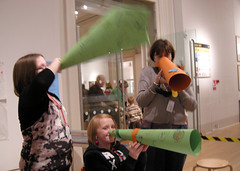
For example, at the end of day 1, we had one thread on the mind map about what would happen if the absence of staff meant that no one would be there to turn the lights on. One inspector had written that if the lights were off, "you could get up closer to the paintings and smell them as well." This sparked our activity for day 2, where we invited Inspectors to make nose trumpets to amplify the smell of the museum. They made cones from construction paper and then went out into the museum to sniff things and record the smells on clipboards.

Every day had a pattern like this. At the end of the afternoon, volunteers and I would examine the mind map and we'd come up with an activity for the next day in response to what had been written. On day 3 we made memory machines, based on a couple of comments wondering how people would learn with no staff around and whether that meant we would forget about the past. On day 4 Inspectors made "top secret trails"--personalized maps of the museum--based on a comment about kids passing knowledge to each other. Interestingly, although Inspectors spent comparatively little time working on the mind map, it was a vital tool for us in making the Ministry an emergent process.

How did the museum staff respond to this experience?

There were certain anxieties before we started: I was an unknown face; the gallery was deliberately trying a new way of working with an artist; and there were relationships between the two hosts to be negotiated. All this on top of the emergent nature of the project and no one really knowing ahead of time what was going to happen. However, once we got going there was a real buzz as the activities started permeating the whole building.

For example, on Monday afternoon Inspectors were asked to make more interesting alternatives to all the signs and rules in the building. Once the new signs had been made, I challenged Inspectors to place them somewhere in the museum. I told them that outside our HQ we couldn't be sure if staff might be sympathetic to the Ministry of Rules or not, and therefore Inspectors should sneak their signs into position whilst no one was looking. The staff had been briefed in advance and they could decide whether to be friendly or not when they encountered suspicious behavior. The Inspectors' Pledge from the initiation process established boundaries of acceptable behaviour for when the activities took place in the wild and there were no reported problems. We left a lot of cardboard around the place over those 5 days and for the most part it wasn't tidied away.

Sounds like that's a great way to play with the idea of the Ministry being a "shadow" organization within the larger museum. How important was it for people to know they were part of something secretive as opposed to just openly invited to participate?

When I do school projects or pervasive games (for adults), it's really important to set that context of an expanded version of self to steer things slightly beyond participants' comfort zone. But in the particular context of the museum at half-term, I don't know if it actually was that vital. People were quite happy to come along and draw things and make things and do things. And the kids were often 5 and younger, so some of the Ministry ritual may have gone over their heads. However, in the particular context of drop-in activities in a busy museum at half-term, I don't know if it actually was that vital. People were quite content to simply come along and draw things and make things and do things. Also many of the children were around 5 years old or younger, so some of the Ministry ritual and specific reinforcing language I used may have gone over their heads. It wasn't that important that I wouldn't drop it or adapt it if it obviously wasn't appropriate!

I deliberately ditched the whole Ministry of Rules thing on the final day to try and see if it mattered or not. Instead of asking people to join a secret organization, as they approached the HQ I would appeal to them with something like: "Thank goodness! You must be the Museum Fixer Uppers! We really need your help!" positioning them as experts whose skills and assistance were urgently required.

I think that aspect was more important: soliciting their help and expertise. That kind of conspiracy and complicity is more important than the secrecy stuff.

Going back to the original goal of people working together in community, how did you keep from being the "go to" person who all the Inspectors looked to as the facilitator of their experience?

Beyond the initial orientation I deliberately distanced myself from telling people what to do. They were the Inspectors. We facilitated the entry into the fiction and the practical activity and then the Inspectors pretty much self organised, seeking out the materials they needed and settling into whatever space was available.

Over the whole week, there were only about two or three Inspectors (old and young) who would persistently come up and ask me "what do I do next?" For the most part people took it on themselves and went with it. That kind of became the main goal as the project found it's identity - conferring ownership of the events and the space. I was always mindful of trying to step back and let as much as possible come from and belong to the participants.

In truth, while that was very successful, I don't think we cracked the challenge of really getting people to work with each other across groups. On the last day, we very intentionally designed an activity that was intended to bring people together to assemble new exhibits out of an assortment of components made by the Inspectors, but even then people gravitated towards working on their own or within their own families. ID/name badges were used to help encourage group crossover, but I think that rarely happened in practice. In the end it was a community project in which participants contributed meaningfully and sequentially to the bigger idea of the Ministry, the content of the space and the actions being made, but they didn't necessarily collaborate directly in real time.

Thanks so much to Nikki for sharing her story. Nikki can be found on the Web and on Twitter, and she will be monitoring and responding to comments here on the blog this week.

Monday, February 14, 2011

Leading the Participant

Remember the last time someone said to you, "this is entirely your choice?" Maybe it was your family saying you could pick the restaurant, or your boss offering you one of two paths forward. Whatever the situation, personal or professional, the choice is not always honestly yours. Sometimes you really are the master of your own fate. Sometimes you're not.

When institutions invite visitors to participate on their terms, it's often tinged with the same lack of clarity about visitors' personal agency. Last month, the radio show This American Life ran a fascinating episode called "Kid Politics," which starts with a long segment about the Air Force One Discovery Center immersive experience at the Ronald Reagan Presidential Library. Whatever your opinion of Reagan, the segment, reported by Starlee Kline, is a fascinating perspective on what happens when we tell visitors the choice is theirs and then subtly (or not-so-subtly) tell them what to do.

The Discovery Center is a one-hour simulation in which groups of students (grade 5 and up) role play in a realistic, interactive environment. The students are each given roles on one of three teams--the Oval Office, a military command center, and a press room. The topic is the invasion of Grenada. The students are presented with the situation that Reagan faced (1983, a Communist revolution in a small country near other Communist countries, a group of 800 American medical students stranded there) and asked to figure out what to do. You can listen to Starlee Kline's opinionated 20-minute piece about it here. There's also a shorter, more expository (and positive) CBS video about the experience here.

As the students enter the simulation, onscreen actors tell them:
When you walk through these doors, you will no longer be students. You will make history. Lives are at stake. Adult staff members are not here to answer questions or help you. The responsibility is entirely yours.
But that's not exactly true from Starlee Kline's perspective. Starlee follows the group of students who portray Reagan and his advisors in the Oval Office. The simulation is structured to give students information, then a binary choice. Then more information, then another binary choice. Each time the students decide what to do, the young Reagan picks up a red phone and presses either A or B. But it's not a fair choice. As Starlee explains:
Before they start, the kids are told there aren't right or wrong answers. But the whole thing's rigged to make what Ronald Reagan did in 1983 look like the most appealing option. Each time they choose to do what he did, a bell goes off like they've won a tropical vacation to Grenada, instead of an invasion.
The adult educators and onscreen actors reward the group, saying things like "nicely done, that's correct based on what Ronald Reagan did," and "excellent work, President Reagan."

Starlee follows several groups through the Discovery Center experience over the course of a day. It isn't until the last group when Starlee sees a young Reagan who decides against the invasion--and against history. Whenever he enters the "wrong" choice, there's a loud, angry buzzer. This time, the onscreen actors and educator don't say "good job" or reward the students for their desire to avoid invasion. Instead, they get a lecture on what really happened in 1983.

If the point of the Discovery Center is to teach students the facts of the Grenada invasion, it's reasonable to create a program in which there's a right and wrong answer about what happened in history. But walking into this experience, the kids were told that the responsibility was "entirely theirs." It's disingenuous--and makes for a lopsided role playing experience--if there's only really one path to take.

That said, I sympathize with the challenges involved in designing something like this--challenges we faced again and again when I was working on the Operation Spy immersive experience at the International Spy Museum. Mira Cohen, the Reagan Library's Director of Education (and the creator of the Discovery Center experience) told me that the intent was to design a pilot program for 5th graders with a focus on learning historical thinking skills. As Mira explained:
The goal is for students to experience presidential decision making, and then debrief, discuss, and share, utilizing historical and civic literacy skills. The buzzer is meant to show whether or not you made the same choice as Reagan--not whether or not there was a right or wrong choice made. And the intention was for the facilitator to point out either during the experience itself or during the debrief that there are a lot of different choices.
Alissa Whitely, who manages the operation of the Discovery Center for the Reagan Foundation, felt that Starlee Kline misrepresented the whole Discovery Center experience and that it is much more even-handed than was portrayed by Starlee. Alissa told me:
Again and again, our educators tell the students that there are no wrong answers here and that students have a different perspective given their place in history. Yes, the majority of the groups probably choose what Reagan actually did. But when the students leave, we want to make sure they have the right information about what really happened in history. There's a thin line between understanding what really happened and imagining something else based on what the students experienced in a simulation.
Could 5th graders handle a truly open simulation? Maybe, maybe not. In a charming and potential heretical chapter in the book Connecting Kids to History with Museum Exhibitions, Minnesota History Center Museum director Dan Spock argues that for kids, imagining history, even inaccurately, may be more valuable than teaching them what really happened. While I tend to agree with Dan, I suspect that school boards across California may not share our enthusiasm. Imagine how the Discovery Center simulation might be different if kids really had a choice, if the Library worked with historians to imagine and spin out augmented versions of the past. It would be both exciting and confusing.

It would also be expensive. In the case of Operation Spy, we developed a fictitious espionage story, so we felt free to give visitors open choices and spin out different, value-neutral outcomes. But even in that situation, we only gave visitors a truly open choice at the end--it was just too complicated and costly to design spaces, interactive challenges, and media to support multiple storylines throughout the whole experience. Mira Cohen noted some of the practical considerations that kept the Reagan Library team from going in this direction with the Discovery Center, commenting:
From an experiential perspective, if we had true forking paths, it would take more time and more complex facilitation. We had a mandate to be able to put through five school groups per day, which means 45-50 minutes per group. Also, we're working with 5th graders who actually aren't learning anything about 20th century history, so they're coming in with a focus on historical thinking but not a strong understanding of what happened in the 1980s. I absolutely could imagine that those kinds of forking scenarios could be created using more space, more historical documents, greater time for analysis, maybe a different audience, and I think that would be extraordinarily exciting.
This post isn't a question of who's "right" about how these experiences are perceived by visitors. There's no A or B button at the end of this post with a buzzer ready to go off if you agree with Starlee Kline or the folks who work with the Air Force One Discovery Center. This post is here to raise questions: what kinds of choices are you letting participants make in the experiences you design? How honest and transparent are you about those choices? And if you are leading the participant, why?

Friday, June 05, 2009

Think Like a Game Designer

I've been designing game-like experiences with museums for a long time. But this week, I participated in a game design workshop with Ken Eklund that totally changed my perspective. My starting point is interactive exhibit design; Ken's is game design. Getting a peek into how he approaches his work induced three aha moments related to prototyping, visitor entrypoints, and designing for maximum impact.

AHA #1: If you abstract far enough, you can prototype interpersonal interactions very quickly.

Ken led us through an activity in which we crowded around a table and watched six people play a quick card game called Pit. As they played, we talked openly about how the game was progressing. We observed and played many rounds of Pit, swapping in and out of the game seats. We talked about the strategies different players were using and tried to determine the most effective winning strategy based on our limited data. Finally, we developed several variations and played rounds with our own new rules.

This is, of course, a form of rapid prototyping. I've spent many hours watching people scratch their heads and bang on interactive prototypes. What stuck out about this experience was putting the focus on the interpersonal gameplay and interactions rather than the content experience. We didn't watch to see if people could "figure it out" or "get the answer." Instead, we watched to see how people pursued different strategies and how comfortable they were with different types of interaction.

We could also iterate incredibly quickly. Pit is a highly abstracted card game meant to simulate commodities trading. Because the infrastructure is so simple (just a pack of cards) and a round lasts only a few minutes, it was easy to change the rules on the fly. I've always believed in prototyping at the simplest level possible, but when it comes to group dynamics we often argue that without a full-size model or the actual space, it's hard to see how people will really interrelate. Pit proved to me that this isn't true. With a table, some chairs, and a set of cards, we were able to make some serious insights about how to affect the speed, energy, cognitive requirements, and overall nature of the game.


AHA #2: Visitors have strategies.

While watching Pit, we openly talked about strategic approaches to the game. David's strategy was to make as many trades as possible. Irina's strategy involved hoarding cards and only making high-value trades. In the context of a game, it's obvious that individuals play with some kind of strategy. Some people optimize their strategies to win, others to have a good time or explore a new aspect of the game.

We rarely talk about this when we design museum exhibits. We expect that visitors will intuit our intended strategy and play accordingly. This doesn't make sense. Games are more interesting when there is more than one viable strategy; that's why we graduate from Candyland to chess. Rather than designing a prescribed "correct" path through an interactive exhibit, we should be thinking more about the rule sets or platforms we can design that will invite visitors to successfully bring personal strategies and modes of interaction to the experience.


AHA #3: You can design interactions to encourage "playing well," i.e. in accordance with your organizational values.

Supporting multiple strategies doesn't mean you can't affect the way people play. We were amazed to realize that a simple change in the rules could transform a slow, strategic game into a fast-paced shouting match. We could change a game that was about diplomacy into one which rewarded cutthroat backstabbing. When we added rules that were well-designed, they fundamentally changed the way that people played the game and the attributes that made the game fun. When we came up with muddier rules, they just confounded the players about the overall goal. In 45 minutes, we were able to make some sophisticated observations about how to change the rules to reflect a wide variety of underlying values or goals.

Ken made the powerful point that many poorly designed games often have a mismatch between what it takes to play well and what it takes to win. Museum scavenger hunts are a classic example of this; we want people to "play well" by exploring obscure areas of the museum, but instead they focus on winning by zooming all over the place without contemplating the objects they seek. Of course, sometimes people have different opinions about what it means to play well--Scrabble enthusiasts will go to war over whether the playing well is about placing elegant word combinations or memorizing all the five-letter words in the Scrabble dictionary.

Ken challenged us to to design interactions to encourage and reward people for playing well. For example, he created a game for the retreat called "Faces in the Crowd" which was designed to encourage participants to meet each other. It had a very simple structure. Each person was given an "identity card" that featured a mashup of two faces smooshed together (see image at top). Your goal was to identify the half-faces on your card and trade cards with others until you were holding a card that featured half of your face. Once you found your partner (the other person attached to your face), you were supposed to determine what the two of you had in common and then present your completed identity set to the game master.

What did kind of values did the Faces in the Crowd gameplay reinforce? It encouraged you to meet new people and literally put names to faces. It forced you to interact with many people, and to work together to try to successfully make a match. And once you found your partner, you spent time talking about what you might possibly have in common (an interest in pyromania, for example). There were various strategies--hunt for a person on your card, ask and collaborate with others, make yourself obvious and hope others will come to you--but the overall experience was one that supported meeting people, expressing interest in them, and making connections (see fun 30-second video).

What does it mean to play well in your museum? Does it mean seeing lots of stuff? Engaging deeply with a few things? Sharing something with someone else? Taking home a memory? How can you reward people not just for following a set path, but for acting in accordance with your overall institutional values? How will you define and reward "playing well?"

Friday, April 10, 2009

Game Friday: Spore, Self-Expression, and the Pitfalls of Creating Your Own Universe

What does "game 2.0" look like? Games are already highly participatory, but over the last few years game designers have been giving players more control over the gameworld and experience. The ultimate substantiation of this is Spore, a game in which players invent their own life forms and manage their evolution. Spore was released in September of 2008 to huge sales expectations. It was intended to be a casual game that unlocked the creative potential of tens of millions of non-gamers. But it hasn't realized that goal, and it's a cogent example of what happens when you conflate self-expression with participation.

Two years ago, I wrote about Will Wright and the rise of "God games" in which players not only function within but control an expanding universe of characters, scenes, and conditions. Last week, Wright spoke at the Web 2.0 Expo about Spore, and claimed that the power of Spore is not as a game but as a "self-expression tool." Players design their own life forms, from the strange to the powerful to the very silly. These creatures can be registered on a wiki, and there are easy tools to upload videos directly to YouTube from the game of your creature taking its first steps and yawlps. There are over 100 million player-created creatures roaming video game consoles all over the planet.

Spore is being cast as a "Web 2.0" version of a video game. Spore does pass the basic test by getting better the more people use it. Each new Spore creature is automatically uploaded to a central database and then redistributed to individual players' universes. The more creatures, the more variety you can add into your own little world. The automatic tools for uploads to other venues (like YouTube) enhance the sense that Spore creatures and activities exist outside the walled universe. I particularly like the celebration of players and their creations on the Spore wiki, where you can read the stories behind the creatures, which often gives you a window into players' own lives and interests.

But Spore is an entirely "creator"-focused experience, which severely limits its potential for adoption. If you do not want to make creatures and watch them grow, this is not the game for you. Yes, the tools available to help you make creatures are lovely, but you still have to have that inclination in the first place. Spore gives players more control over the experience than Wright's other "god" games. In Sim City, you had a limited number of options available to you as you grew your metropolis. In Spore, literally, the universe is the limit.

Strangely, Spore is being billed as casual game, or even a toy, and is focusing on audiences that don't want to log hundreds of hours deep in the intricacies of a complex game. Wright argues that the power of Spore is to unlock the capacity to be a game designer to anyone regardless of programming ability, that it lowers the barrier to entry sufficiently that everyone can create. But openness can be daunting, especially to casual gamers. Not everyone wants to design games, just as not everyone wants to write a blog or post videos. Spore banks on the idea that we all secretly want to be creators, despite research that shows that people like to participate in different ways. The simple tools for creation mask the fact that players need personal drive and intention to pick up the game in the first place.

While other Web 2.0 platforms offer opportunities for creators, critics, joiners, collectors, and spectators, Spore requires every player to be a creator and offers few useful constraints on creations. Upcoming expansions will allow players to create their own "adventures" by prescribing the gameplay at different stages. This seems to be barking up a very niche tree of appealing to the same kind of folks who like to be dungeonmasters or write their own fan fiction. And while there is a thriving community of self-motivated would-be game creators, it is not a massive casual gaming market. Spore is a chemistry set without instructions, and only some of us are motivated to invent our own experiments.

What does the ultimate "game 2.0" look like? How will it balance creative acts with other forms of player participation?

Wednesday, March 04, 2009

Gaming the Talkback Experience with the Signtific What If? Machine


Jane McGonigal and the folks from IFTF have released a new future-casting game/collaborative experience called Signtific Lab. Unlike Superstruct, which employed a very open-ended collaborative framework to invite people to imagine their circumstances in 2019 relative to several provocative scenarios, Signtific is a more focused, tight experience, both in content and format. In other words, it's way better. This is one of the clearest, most physically translatable me-to-we platforms I have experienced. It's fun, I learn something, I'm challenged to contribute something meaningful, and I connect with other users. SigntificLab in its second iteration, and you can play live from now until March 5 (or again from March 9-12).

I like suppositional "what if?" questions because I believe they invite anyone to creatively respond, unlike "what is?" questions, which imply a correct answer. The Signtific platform is a kind of "what if?" machine that could be adapted to any potential scenario (and I believe that's what they plan to do in the months ahead). And while it's fun as an online experience, I see the potential for Signtific to be repurposed in physical space as a dynamic platform for capturing diverse visitor opinions on a variety of "what if?" topics. In other words, a new kind of talkback board or participatory educational program.

Here's how Signtific works (their rules here):
  1. The organizing institution presents a three-minute video exploring a "what if?" question. In the current case, the question is: "What will you do when space is as cheap and accessible as the Web is today?" In other words, what if anyone could launch a satellite into space for $100?
  2. Players are invited to play one of two kinds of cards based on the scenario: "positive imagination" cards or "dark imagination" cards. A card includes 140 characters of text either envisioning a positive or negative outcome of the suppositional scenario.
  3. On any given "positive" or "dark" imagination card, players can play four different kinds of follow-up cards: momentum, antagonism, adaptation, or investigation, to add additional ideas, disagreements, other uses, or questions to the original imagination card.
  4. Players get points for playing cards as well as for starting chain reaction of dialogue via follow-up cards. There is a simple leaderboard and each player's cards are aggregated on a personal dashboard. The organizers also curate some of the most interesting cards and offer rewards for "outlier" ideas that are improbable but fascinating.
The result is a network diagram of cards, a threaded dialogue that takes place across many nodes. On the web, these are shown via long lists of positive and dark cards, some of which have trees of follow-up cards. The visual interface is not perfect--but imagine the physical analog. A big board, with the "What if" question across the top and six different colors of cards. Red for positive. Blue for dark. Pink for momentum. Green for antagonism. Purple for adaptation. White for investigation. You get the idea. There would be lots of red and blue cards, some of which would have other colored cards clustered around them.

The thing that excites me about this is not the opportunity to use all the weird-colored cardstock hanging around the supply cabinets of most museums. What excites me is that Signtific provides a very deliberate framework that prioritizes collaborative thinking and dialogue. If Signtific just asked the "What if?" question and allowed open response, it would not be as good. If they just had positive and dark cards, it would not be as good. What's GOOD about Signtific is that it encourages people to reflect on others' submissions and react to them in a series of intentional ways. In museums, we are often struggling to find deeper ways to encourage people to engage with each others' opinions and to learn collaboratively and relationally.

The most important aspect of designing a successful participatory platform is to intentionally, deliberately, and clearly DESIGN the platform. Signtific is not an open mushy conversation about the future. It's a structured set of specific interactions that are guided by clear values like interpersonal learning and seeing multiple perspectives on an idea. The scoring system doesn't just value output; it values quality, dialogue, and uniquenss. The brevity of each card (140 characters) keeps the content tight and makes it easily repurposed to other platforms (like Twitter). I also love that they are opening the site in short iterative stints so that they can continue adapting the platform as they learn how people are using it.

I look forward to seeing where it goes, and where museums might take it as the basis for a talkback board or a programmatic live event. Maybe they'll open source the platform at some point so that anyone could use the system to play out their own what ifs.

I encourage you to check it out, submit a card, and share your comments here. What if we created suppositional interpersonal engagement platforms (what if? machines) for informal learning environments? What positive and dark outcomes could you imagine?

Wednesday, January 28, 2009

Should Museums Be Happiness Engines?


What role does “promoting human happiness” play in the mission statements and actions of museums? That’s the question I’m pondering thanks to Jane McGonigal and the Center for the Future of Museums (CFM). Earlier today, the CFM offered a free webcast of Jane McGonigal’s talk on gaming, happiness, and museums. You can now view the video in its entirety as well as the chatlog from the webcast. UPDATE: You must register an account with AAM to view the video and chatlog.

I'm a huge fan of Jane's and have been writing about her work since the early days of this blog, so I was thrilled to learn that the CFM was bringing in Jane to speak live and then opening up the lecture to a wider audience of about 300 online. We had a very active chat-based discussion during and after the webcast, and the chatlog will be available at the CFM site soon.

Jane’s main happiness argument has three points:
  1. Happiness research shows that four things make people happy: having satisfying work to do, the experience of being good at something, time spent with people you like, and the chance to be a part of something bigger.
  2. Games are happiness engines that are designed to support these four things. They provide clear instructions and rules for how to succeed, better feedback on how well you are doing, better community with which to experience the game, and induce more intense emotions of personal pride and accomplishment (fiero!).
  3. Non-game social platforms like museums should use game design techniques to make these institutions more successful at supporting user happiness.
This is not an argument that is specific to museums. Jane believes that introducing clear, intentionally designed gaming structures can make people happier as they work, explore their communities, and deal with tough personal and collective challenges (like climate change, as evidenced in the game World Without Oil).

Many game designers talk about how game mechanics can be applied to functional activities and “boring” topics, but Jane is unique in her argument that game structures don’t just make real life more fun, they help increase human happiness. One of the things that makes Jane’s work so popular and appealing is that her argument can be applied to many industries. Many industries have adopted “serious games” for use in training, but Jane is talking about pervasive gaming, gaming that is integrated into “real” life and work. A recycling bin that cheers for you when you flatten your cans. A workplace in which the path to career advancement is clearly laid out in the rules that come with the job. It’s easy to imagine ways that game structures could make life seem less capricious, more fair, more responsive, and more controllable.

However, I'm wary of the limitations of game structures to support human happiness. Games provide a powerful extrinsic motivation and reward structure via points, levels, flashing lights, slain dragons, etc. For people who receive poor extrinsic feedback in their lives--students who are told they are dumb, workers in unstimulating jobs, people who feel shy and lonely--games may provide an alternative motivational structure that supports their growth and happiness. But the motivation is still external. There are few games that teach you to "feel rewarded within" or appreciate the ways that you are part of something greater, and so I wonder whether games become an assistive technology, a happiness engine, upon which people become too reliant.

For example, consider voting. Voting is a real-life activity that suffers from poor extrinsic structure. People who don't vote (and there are lots of them) don't see the benefit of doing so, and perhaps a game structure could create an artificial benefit, like "citizen points," that would make voting feel more valuable. But would it translate to the citizen/player actually feeling that voting IS valuable? That their voice DOES matter? If not, the game becomes a crutch, a patch on a system that exacerbates our dependence on extrinsic motivation.

Early in Jane's talk, she showed statistics from a "happiness index" of countries that are most and least happy. The people in countries that are most happy--mostly small, incredibly poor countries in Central and South America--may not be as reliant on external indicators, like money and status, to feel valued, connected, and important to their communities. As Elsa Bailey asked in the chat: "Don't cultural attitudes toward the definitions/descriptions of happiness come into play here? Might relate to how to interpret the global happiness findings. Expectations may affect how people judge their ''happiness rating.'"

I'm not suggesting that games don't induce happiness, or that game mechanics are not powerful design agents of change. I think there are LOTS of ways in a society to use game structures to rewire our values and feelings of self-worth. I see games and game design methods as underutilized, exciting systems that museums should add to our experience design toolbox. But I don't believe that games are the only structures we should consider as we try to design experiences to promote feelings of self-worth, connections to community, and value. We need to make sure that we are also using design mechanisms that promote introspection, personal discovery, and intrinsically motivated exploration. There may be ways to marry these; for example, the Exploratorium has created an oxymoronic game called Be Here Now in which you see how long you can meditate on nothingness without your mind wandering.

This long reflection on external motivation relates directly to the core mission of museums. I think one reason museum professionals struggle with gaming is that many see it as a crass external substitute for the elegant, intrinsic rewards of museum-going. But for people who don't perceive those rewards (and there are many), games may offer a powerful connection point to help uninitiated visitors experience the kind of happiness, wonder, and discovery possible in museums.

And this leads to the broader question: are museums fundamentally in the business of promoting human happiness? I think many of us would like to be. As Mary Case put it in the discussion: "The point is that museums can provide satisfying work, help people be good at something, help them spend time with people they like, and be a part of something bigger. If we can do that (some of which we already do), we will all live happily ever after..." But others weren't so sure. Matthew Jenkins commented: "Still don't grasp why is creating sustainable world happiness the primary mission of a museum? What about learning?"

If we can use game design techniques to help people feel happier exploring collections, discovering exhibits, and messing with interactives, then we will help them learn. Happiness is an "enabling" emotion that makes people more open to new or uncomfortable experiences, and games may be a happiness-delivery system that enables people to be more energized and curious about museums.

And we have an enormous and unique opportunity to enable happiness. I think the point is not that museums should be happiness engines but that we can be. Museums are already good at connecting people to friends and letting them be part of something greater--we just have to work on the meaningful work and feedback part. And that's very doable. Unlike many other designed experiences, museum consumers have a great deal of agency in their visits. It is much easier to imagine museum-goers as "players" than to imagine book-readers or movie-goers as players. Museums are flexible, open spaces that support visitors creating their own connections with content. And one of the ways we should do so is via games and game mechanics.

I'll be thinking more about this and hope to play further with the idea of what a museum-specific "happiness engine" might look like. In the meantime, I'm curious to hear your thoughts. I also want to point out that you can find a LOT of game-related posts on this blog by clicking "game" in the tag cloud on the sidebar, or by clicking this link. Happy playing!