Showing posts with label youth. Show all posts

Wednesday, January 15, 2014

Teenagers, Space-Makers, and Scaling Up to Change the World

This week, my colleague Emily Hope Dobkin has a beautiful guest post on the Incluseum blog about the Subjects to Change teen program that Emily runs at the Santa Cruz Museum of Art & History.

Subjects to Change is an unusual museum program in that it explicitly focuses on empowering teens as community leaders. While art, history, creativity, and culture are the vehicles for that empowerment, the teens involved spend a lot of their time with activists, civic leaders, and social psychologists. They describe themselves as "a group of chronic doodlers who dig music, embrace creativity of all kinds, and are determined to not only make our community better, but want to get other teens involved."

Emily's post shares three things Subjects to Change has taught her about youth and community leadership. I want to return the favor with three things this project brings up for me.

Community-building/engagement is related to but not identical to content engagement. Subjects to Change isn't an art club or a history group. It's about empowerment and community leadership through art and history. One of the reasons Emily took this approach was based on what we saw in the ecology of teen programs. We heard from youth program leaders at museums who struggle to keep teens engaged despite a huge amount of committed resources. We saw a lot of intense hand-holding and not a lot of youth ownership. In contrast, when we looked at the programs we admire most locally, they all are fundamentally focused on youth as leaders and changemakers in their own lives and community. Whether they are using skateboarding to grind out child hunger or changing their own fate through farming, we saw teens taking agency and being leaders in ways we hadn't seen in arts organizations.

This meant really stripping back to our mission in developing this program and being willing to let the teens lead us in some unexpected directions. For example, they are planning a series of teen nights at the museum, complete with art activities, history exploration, youth bands, etc., but themed around community issues like "public safety" and "gender representation."

I'm completely curious as to whether their peers will actually want to come to a museum on a Friday night about public safety. I'm a little amazed that this is happening at the museum at all. It's hard to imagine a staff member pitching a public safety-themed event and everyone feeling like it is a good idea. But every step of the way these teens have shown that the issues they care about are compelling to lots of people (of all ages) in our community, and that they are ready to do meaningful work to engage people around those issues.

Scale is still a challenge for co-creative work. Subjects to Change engages fifteen teenagers. Many are having a life-changing experience, but still, it's fifteen people. How do we scale this impact to reach more people? This is a chronic problem of in-depth co-creative projects. In many museums, these tend to be youth-focused projects. In lean years, it's hard to justify focusing so many resources on a small group.

Watching these teens do their work has expanded my thinking on the issue of scale. If these teens truly become community leaders through their work with us, they will extend their impact beyond themselves. They are forming partnerships in the community, developing events to reach more teens, and developing content for general museum events. We are already seeing a difference in the makeup of our audience on the nights that these teens are involved because of their attendant communities.

This makes me realize that a leadership-focused program is fundamentally different than one that focuses inward. A city council, for example, is necessarily small and consumes a ton of resources. If outreach and community leadership is the meat of the program, maybe the scale problem isn't as big an issue as I had previously thought.

Space-making is magic. I've written before about Beck Tench's beautiful framing of how "every risk-taker needs a space-maker" to clear the path for experimentation. Emily's generous first line of her blog post makes me realize that this concept of "space-making" is bigger than just supporting risk-taking. It's about making space for real change to happen, and to grow, throughout an organization and a community. I am starting to wonder how we could take this lens to more of the work we do, both as managers internally and as facilitators of community experiences externally. Space-making may be the ultimate strategy for scaling up.

Wednesday, March 27, 2013

Kids, Coercion, and Co-Design

There's a constant dialogue in participatory work about how to make peoples' contributions meaningful. I've written about different structures for participatory processes (especially in museums), and recently, I've been interested in how we can apply these structures to the design of public space. Here in Santa Cruz, my museum has embarked on a major project to redevelop the plaza outside our doors into a vibrant, cultural hub for downtown, and we are trying to make the development process as open and useful as possible.

One of the key constituencies for this plaza are families. While we spend plenty of time talking with parents and adults about what makes a place "family-friendly," there's no substitute for kids' unique perspectives. In January, as part of a series of place-making workshops facilitated by the Project for Public Spaces, we worked with a local dad to coordinate a workshop explicitly for kids (full writeup here). Their ideas were delightful, and their contributions shifted the conversation about what family-friendly really looks like.

I came out of the workshop with a mixture of joy and unease. What should we do with the ideas the kids had generated? How does their participation, which is expressed in a somewhat haphazard and spontaneous fashion, integrate with that of adults? I'm not suggesting that the kids are less valuable as participants than their parents--or even less realistic in their impulses and desires--but that our whole adult approach to collaborative processes doesn't easily absorb youthful exuberance.

Kids frequently suffer from tokenism. We given them a gold star for participating and then sweep their drawings under the rug. Children are easy to applaud, and easy to ignore.

This grappling led me to a fascinating "ladder of participation" about kids' engagement in environmental design written by Dr. Roger Hart of Cornell (1992 paper). While Dr. Hart is focused on the design of public gardens, his overall message is broad: there is participation, and there is tokenism. He's explicit about different project structures and their implications, listing five levels of participation and three of non-participation. Here's a synopsis:

Participation

1. Child-initiated, shared decisions with adults:
  • Goal isn’t about “kids’ power.”
  • Young people feel competent and confident enough in their role as community members to understand the need for collaboration and that in asking adults for their input, the project may be strengthened.
  • Lots of trust involved
  • Adults serve as listeners, observers and sounding boards (i.e. they don’t jump in with their own designs on the project, or to organize the project). For example, young people may determine that they want to clean up an old wooded hang out area in their community to create a nature trail. They learn about all aspects of creating such a trail, hold meetings to plan it, but check in with a friend’s parent in local government, several parents, and a teacher with an interest in ecology, for their diverse ways of thinking about certain aspects the project.
2. Child-initiated and directed projects:
  • Adults notice a youth-led project emerging and allow them to occur in a youth-directed fashion.
  • Hart places this second on the ladder because occasionally young people don’t trust adults enough to seek their input. The caution with this rung is in children carrying out their projects in secret because of fear of adults, or being intimidated by them. An example is a literally secret garden/ landscape that adults are not aware of.
3. Adult-initiated, shared decisions with children:
  • Adults assume nothing about what children want in the landscape.
  • Children are involved to some degree on every part of the process of garden planning, design, and implementation.
  • Children understand issues such as fundraising, garden design, or organization and management
  • Children understand how and why compromises are made, if they are necessary. They may also begin to cultivate a “language” of talking about this with others.
4. Children are consulted and informed about project:
  • Project designed and run by adults, but the children’s views and opinions are taken seriously.
  • A good example is with a survey designed to gather young people’s input into a school garden: children are informed of the purpose, they may be asked to volunteer, and afterward, they are fully informed of the results.
5. Assigned but informed:
  • Children are assigned to a project and may not initiate the project themselves, but they are fully informed about it (i.e. a school garden project)
  • Children may still have a sense of real ownership of the project.
  • A key aspect of this rung is the degree to which children are engaged in critical reflection. For example, are children just viewed as a free source of help for the garden project, or do they have a chance to reflect on it, consider it, and learn from it?

Non-Participation

6. Tokenism:
  • The most challenging and most common among very well-meaning adults.
  • Adults are genuinely concerned about giving children a voice, but haven’t really begun to think carefully about the best approach for this.
  • The appearance of children’s involvement is there, but in fact, they have had little choice about planning the garden project, communication around it, and no time in which to critically reflect and form their own opinions.
  • An example is that adults select charming, articulate youth to talk about the garden in a public venue, but those youth haven’t had ample opportunity to critically reflect or consult with their peers. The key here is symbolic versus actual engagement and involvement.
7. Decoration:
  • Involves, quite literally, decorating children
  • For example, they may sport garden T-shirts with no involvement in organizing or understanding the program.
  • Adults use children to bolster the program as if the children were understanding participants.
  • For example, adults make children sing garden songs at a harvest festival, and it may even appear that they wrote the song, or that they were involved in organizing the garden or the festival, when in fact they were not.
8. Manipulation or Deception:
  • Adults consciously use children’s voices to carry their own message about the gardening project.
  • For example, they produce a garden poster, advertisement, or publication with drawings by children, when children aren’t involved in the program planning.
  • Adults may deny their own detailed involvement in meetings, planning, shaping the project because they think it diminishes the effectiveness or impact of the project – they may say that children are genuinely engaged, when engagement constitutes weeding or planting.
  • Adults may design a garden, have kids do a simple planting, then tell the local newspaper that kids designed and built the garden. 

Reading this ladder reminded me how easy it is to fall into the "non-participation" part of the ladder when working with any amateur participants, but especially with children. The explicit nature of the examples on levels six through eight (especially "decoration") may also be helpful in identifying times that we are treating adults as non-participants in more understated ways. We may not dress them up and make them sing songs about our projects, but sometimes, we might as well.

In the case of my project, level four is probably what is appropriate. We are engaged in active collaboration with so many stakeholders for this plaza, and kids are important but secondary contributors to the process. But more broadly, I can look at this and think about what we DON'T want to be doing--with any of our participants. Thank you, Roger Hart, for reminding me of the range of participatory opportunities and non-opportunities a project can provide... and how disastrous it can be when our words and our actions are misaligned. Let's make sure not to decorate our projects with false participation where real collaboration is possible.

Tuesday, September 20, 2011

Does Your Institution Really Need to Be Hip? Audience Development Reconsidered


Last Friday night, my museum hosted a fabulous (in my biased opinion) event called Race Through Time. It was a local history urban scavenger hunt that sent teams of 2-5 people out into the city to track down as many historic checkpoints as they could over the course of an evening. The event was oversold, and participants raved about the experience.

We created Race Through Time in partnership with a local networking group called Santa Cruz Next, whose primary aim is to support and celebrate ways that young professionals can and are changing our community for the better. Race Through Time was designed specifically for this audience of 30 and 40-somethings looking for fun social events with a Santa Cruz bent. We saw Race Through Time as an opportunity to share our mission around engaging with history with a new and highly desirable audience of young professionals. Everything about the event--from the time slot to the tone of the content to the music played--was designed for that audience.

When Friday night rolled around, we did see a crowd that skewed decidedly younger and hipper than our standard museum audience. But we also saw something else: parents and teenagers, grandparents and grandkids, elderly couples, out for a fun scavenger hunt evening. Yes, there was the 40-ish lawyer who effused that she'd never seen so many young people in the museum before. But there was also the couple in their 70s who told me this was the most fun they'd ever had on a Friday night in Santa Cruz. And from my perspective, it was this diversity that made the event unique--and made me rethink the way that cultural professionals typically approach audience development.

I've written before about the "parallel vs. pipeline" approach to new audience development. The concept goes like this: if you want to invite in people who don't traditionally engage with your offerings, you offer them an experience that is so tailored to their unique interests and preferred modes of engagement that it really is only for them. Performances just for teens. Late night mixers at museums for young adults. The experience is dramatically different from the norm and the audience is very targeted. It's a parallel experience, one that may or may not be eventually integrated into the core "pipeline" of traditional experiences and audiences.

We thought that Race Through Time would fall in this category--that it would be 90% people from the Santa Cruz Next young professional crowd. But it was more like 60%--enough for all those young people to feel like they were in the right place, but not enough to feel like it was "their" event alone. There were twenty-year old hippies. There were grizzled cyclists. There were families. It turned out that there were many different kinds of people who were excited about an active, adventurous approach to history.

This gets me thinking about whether the most productive programs for cultural organizations from an audience development perspective are not wholly parallel to the norm but somewhere just slightly outside, somewhere that links the typical to the possible. Maybe being incredibly hip one night a year or month or week is not enough to help the audiences who come to those events connect to the institution writ large. Those events bring in specific crowds for singular experiences, but to what end? If you have a wild event that feels like a spaceship landed on your institution, what happens when the ship leaves the next day?

Museums are not for specific crowds alone. As Elaine Heumann Gurian has often noted, the magic comes when cultural institutions bring together people who don't typically mix. As someone who can feel a bit alienated at events with homogenous audiences--even people who look like me--I appreciate the opportunity to be in a crowd that includes me without being prescriptive or limiting.

We lose something if we focus too narrowly on specific audiences. I've started realizing that at First Fridays, when our museum swells with people out on the town for an art experience. We are by no means the hippest First Friday destination in Santa Cruz, and sometimes, after a long evening at the museum, I'll head out to a gallery and look longingly at the young, cool artist crowd gathered within. I love hanging out with those people in those hip venues. But I also love that the museum invites those young adults in along with elderly folks in wheelchairs, families with toddlers--the happily un-hip.

And so I'm letting go of the idea that we have to be exclusionary to attract young people and looking for more diverse alternatives. The marketing argument has always been that we have to segment, that we have to tailor. But what if we segment to "people who like to meet people who are not like them?" I think that's a stronger community value proposition than becoming as cool--and limited--as an institution with a tightly-limited audience.

Do our institutions really need to be hip to be successful? Or do they just need to be welcoming, open, comfortable places that offer a diversity of experience? I realize I may be totally biased on this since I'm watching it happen in my own institution and my own community, and I'm also personally not a very hip person. What do you think?

Wednesday, April 06, 2011

Making Participatory Processes Visible to Visitors

Let's say you spend a year working with a group of teens to co-create an exhibition, or you invite members and local artists to help redesign the lobby. How do you acknowledge their participation in a way that helps subsequent visitors connect with the passion and hard work that went into the process?

Community processes are both exciting and time-consuming. In many cases, once the final project is launched, it's hard to detect the participatory touch. The exhibition or program is of high quality, and from the visitor perspective, it may look like museum as usual. There might be a plaque listing names or a group photo of participants, but that's about it.

In some ways, this is a good thing. Not every participatory process has to scream "look at me!" to create a successful product. But it's a shame when visitors can't experience the energy that went into the making of a participatory project--when the product of a living process is a dead thing. The challenge is for designers to find a way to showcase the participatory process in a way that enhances the final product rather than just feeling like a behind-the-scenes geekfest.

Last week I saw a powerful example of this at the Museum of World Culture in Gothenburg in their exhibition for children under five. The exhibition includes a large display of objects from the Museum's ethnographic collection selected by small children. The artifacts are eclectic and intriguing, but it's not obvious that children selected them, nor are there labels to help you understand why these particular objects are there (see picture at top).

An interactive changes that. In the middle of the gallery, there's a touchscreen in front of a larger projection wall. The touchscreen features a grid with all of the artifacts in the space. Touch an object, and the projection comes alive with video of small children standing behind the object, wearing conservator's gloves, explaining what they like about the object and why they picked it. I couldn't understand the videos--they were in Swedish--but I was charmed by the kids' spontaneous, infectious energy. After each short video, there was a single screen featuring a curator's comments (in text) about the importance of the object from his or her perspective.

This interactive provided context that helped me appreciate the artifacts and understand the process that had put them on display. A gallery that otherwise would have felt dead came alive with the children's voices, laughter, and antics. And even without understanding their words, I looked at the objects around me in a whole new way. I understood that the artifacts meant something to the kids I saw onscreen. It was like "staff picks" at the bookstore, but with (presumably) richer content.

How can you make the product of participation as engaging as the process itself?

Wednesday, March 09, 2011

The Ministry of Rules: Interview with Nikki Pugh

Last month, artist Nikki Pugh led an utterly charming, often hilarious community residency at the City Gallery in Leicester, UK. Nikki created "The Ministry of Rules"--a shadow organization that existed for one week during half-term break, staffed by visitors who served as "Inspectors" investigating, exploring, and poking fun at the rules that make museums and galleries go. I spoke with Nikki this week to learn more about the Ministry and their fun and games.


How did this project come about?

The City Gallery was mounting a contemporary art exhibition at the New Walk Museum called Play Ground, which featured artists who treat the gallery space as a kind of carnival instead of as an aesthetic temple. The gallery staff wanted half-term activities as part of their learning program and they invited me to lead these through what evolved into a residency format. The idea for the Ministry of Rules came from a desire to provide a framework as a jumping-off point for activities relating to concepts within the exhibition and my own art practice, as well as play and games in a wider sense. I wanted the details of the residency to be shaped by the people who got involved with it, so it needed a structure with an edge that could be pushed against in different directions.

What were the City Gallery goals for the project?

The staff member I worked with had in mind a particular feeling she wanted people to go away having--that kind of sense of community that comes when you've worked together to achieve something. I wanted, if possible, to really confront the ideas wrapped up in the exhibition's introductory text. But I also knew that I wanted the project to be emergent, so I had to be prepared to let this go if necessary.

I think that's what's most impressive to me about the project--the fact that every day's activities were determined by the visitors who'd come the day before. Can you explain how that worked?

I really wanted visitors to make this their own project and their own space; not mine. We had a corner of the gallery that was cordoned off as the Ministry's HQ, and you could only enter if you were a Ministry employee (my badge clearly marked me as a secretary). Most of my time was spent managing that threshold: providing the initial information and invitation; managing expectations of it being an 'easy' craft activity; helping people make their ID badges; and guiding them through taking their Inspectors' Pledge. Only then, as an official Inspector for the Ministry, could you could enter the space. “Come in, this is your headquarters now, yourinvestigation, you make the decisions.”

There was a large mind map on the wall with a prompt in the middle encouraging visitors to imagine a slightly distant future with no staff present to enforce the rules in galleries or museums. The Inspectors could contribute ideas about what that might happen as a result. We used those ideas as the basis for the daily activities in the Ministry.

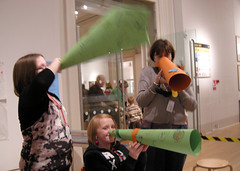
For example, at the end of day 1, we had one thread on the mind map about what would happen if the absence of staff meant that no one would be there to turn the lights on. One inspector had written that if the lights were off, "you could get up closer to the paintings and smell them as well." This sparked our activity for day 2, where we invited Inspectors to make nose trumpets to amplify the smell of the museum. They made cones from construction paper and then went out into the museum to sniff things and record the smells on clipboards.

Every day had a pattern like this. At the end of the afternoon, volunteers and I would examine the mind map and we'd come up with an activity for the next day in response to what had been written. On day 3 we made memory machines, based on a couple of comments wondering how people would learn with no staff around and whether that meant we would forget about the past. On day 4 Inspectors made "top secret trails"--personalized maps of the museum--based on a comment about kids passing knowledge to each other. Interestingly, although Inspectors spent comparatively little time working on the mind map, it was a vital tool for us in making the Ministry an emergent process.

How did the museum staff respond to this experience?

There were certain anxieties before we started: I was an unknown face; the gallery was deliberately trying a new way of working with an artist; and there were relationships between the two hosts to be negotiated. All this on top of the emergent nature of the project and no one really knowing ahead of time what was going to happen. However, once we got going there was a real buzz as the activities started permeating the whole building.

For example, on Monday afternoon Inspectors were asked to make more interesting alternatives to all the signs and rules in the building. Once the new signs had been made, I challenged Inspectors to place them somewhere in the museum. I told them that outside our HQ we couldn't be sure if staff might be sympathetic to the Ministry of Rules or not, and therefore Inspectors should sneak their signs into position whilst no one was looking. The staff had been briefed in advance and they could decide whether to be friendly or not when they encountered suspicious behavior. The Inspectors' Pledge from the initiation process established boundaries of acceptable behaviour for when the activities took place in the wild and there were no reported problems. We left a lot of cardboard around the place over those 5 days and for the most part it wasn't tidied away.

Sounds like that's a great way to play with the idea of the Ministry being a "shadow" organization within the larger museum. How important was it for people to know they were part of something secretive as opposed to just openly invited to participate?

When I do school projects or pervasive games (for adults), it's really important to set that context of an expanded version of self to steer things slightly beyond participants' comfort zone. But in the particular context of the museum at half-term, I don't know if it actually was that vital. People were quite happy to come along and draw things and make things and do things. And the kids were often 5 and younger, so some of the Ministry ritual may have gone over their heads. However, in the particular context of drop-in activities in a busy museum at half-term, I don't know if it actually was that vital. People were quite content to simply come along and draw things and make things and do things. Also many of the children were around 5 years old or younger, so some of the Ministry ritual and specific reinforcing language I used may have gone over their heads. It wasn't that important that I wouldn't drop it or adapt it if it obviously wasn't appropriate!

I deliberately ditched the whole Ministry of Rules thing on the final day to try and see if it mattered or not. Instead of asking people to join a secret organization, as they approached the HQ I would appeal to them with something like: "Thank goodness! You must be the Museum Fixer Uppers! We really need your help!" positioning them as experts whose skills and assistance were urgently required.

I think that aspect was more important: soliciting their help and expertise. That kind of conspiracy and complicity is more important than the secrecy stuff.

Going back to the original goal of people working together in community, how did you keep from being the "go to" person who all the Inspectors looked to as the facilitator of their experience?

Beyond the initial orientation I deliberately distanced myself from telling people what to do. They were the Inspectors. We facilitated the entry into the fiction and the practical activity and then the Inspectors pretty much self organised, seeking out the materials they needed and settling into whatever space was available.

Over the whole week, there were only about two or three Inspectors (old and young) who would persistently come up and ask me "what do I do next?" For the most part people took it on themselves and went with it. That kind of became the main goal as the project found it's identity - conferring ownership of the events and the space. I was always mindful of trying to step back and let as much as possible come from and belong to the participants.

In truth, while that was very successful, I don't think we cracked the challenge of really getting people to work with each other across groups. On the last day, we very intentionally designed an activity that was intended to bring people together to assemble new exhibits out of an assortment of components made by the Inspectors, but even then people gravitated towards working on their own or within their own families. ID/name badges were used to help encourage group crossover, but I think that rarely happened in practice. In the end it was a community project in which participants contributed meaningfully and sequentially to the bigger idea of the Ministry, the content of the space and the actions being made, but they didn't necessarily collaborate directly in real time.

Thanks so much to Nikki for sharing her story. Nikki can be found on the Web and on Twitter, and she will be monitoring and responding to comments here on the blog this week.

Monday, February 14, 2011

Leading the Participant

Remember the last time someone said to you, "this is entirely your choice?" Maybe it was your family saying you could pick the restaurant, or your boss offering you one of two paths forward. Whatever the situation, personal or professional, the choice is not always honestly yours. Sometimes you really are the master of your own fate. Sometimes you're not.

When institutions invite visitors to participate on their terms, it's often tinged with the same lack of clarity about visitors' personal agency. Last month, the radio show This American Life ran a fascinating episode called "Kid Politics," which starts with a long segment about the Air Force One Discovery Center immersive experience at the Ronald Reagan Presidential Library. Whatever your opinion of Reagan, the segment, reported by Starlee Kline, is a fascinating perspective on what happens when we tell visitors the choice is theirs and then subtly (or not-so-subtly) tell them what to do.

The Discovery Center is a one-hour simulation in which groups of students (grade 5 and up) role play in a realistic, interactive environment. The students are each given roles on one of three teams--the Oval Office, a military command center, and a press room. The topic is the invasion of Grenada. The students are presented with the situation that Reagan faced (1983, a Communist revolution in a small country near other Communist countries, a group of 800 American medical students stranded there) and asked to figure out what to do. You can listen to Starlee Kline's opinionated 20-minute piece about it here. There's also a shorter, more expository (and positive) CBS video about the experience here.

As the students enter the simulation, onscreen actors tell them:
When you walk through these doors, you will no longer be students. You will make history. Lives are at stake. Adult staff members are not here to answer questions or help you. The responsibility is entirely yours.
But that's not exactly true from Starlee Kline's perspective. Starlee follows the group of students who portray Reagan and his advisors in the Oval Office. The simulation is structured to give students information, then a binary choice. Then more information, then another binary choice. Each time the students decide what to do, the young Reagan picks up a red phone and presses either A or B. But it's not a fair choice. As Starlee explains:
Before they start, the kids are told there aren't right or wrong answers. But the whole thing's rigged to make what Ronald Reagan did in 1983 look like the most appealing option. Each time they choose to do what he did, a bell goes off like they've won a tropical vacation to Grenada, instead of an invasion.
The adult educators and onscreen actors reward the group, saying things like "nicely done, that's correct based on what Ronald Reagan did," and "excellent work, President Reagan."

Starlee follows several groups through the Discovery Center experience over the course of a day. It isn't until the last group when Starlee sees a young Reagan who decides against the invasion--and against history. Whenever he enters the "wrong" choice, there's a loud, angry buzzer. This time, the onscreen actors and educator don't say "good job" or reward the students for their desire to avoid invasion. Instead, they get a lecture on what really happened in 1983.

If the point of the Discovery Center is to teach students the facts of the Grenada invasion, it's reasonable to create a program in which there's a right and wrong answer about what happened in history. But walking into this experience, the kids were told that the responsibility was "entirely theirs." It's disingenuous--and makes for a lopsided role playing experience--if there's only really one path to take.

That said, I sympathize with the challenges involved in designing something like this--challenges we faced again and again when I was working on the Operation Spy immersive experience at the International Spy Museum. Mira Cohen, the Reagan Library's Director of Education (and the creator of the Discovery Center experience) told me that the intent was to design a pilot program for 5th graders with a focus on learning historical thinking skills. As Mira explained:
The goal is for students to experience presidential decision making, and then debrief, discuss, and share, utilizing historical and civic literacy skills. The buzzer is meant to show whether or not you made the same choice as Reagan--not whether or not there was a right or wrong choice made. And the intention was for the facilitator to point out either during the experience itself or during the debrief that there are a lot of different choices.
Alissa Whitely, who manages the operation of the Discovery Center for the Reagan Foundation, felt that Starlee Kline misrepresented the whole Discovery Center experience and that it is much more even-handed than was portrayed by Starlee. Alissa told me:
Again and again, our educators tell the students that there are no wrong answers here and that students have a different perspective given their place in history. Yes, the majority of the groups probably choose what Reagan actually did. But when the students leave, we want to make sure they have the right information about what really happened in history. There's a thin line between understanding what really happened and imagining something else based on what the students experienced in a simulation.
Could 5th graders handle a truly open simulation? Maybe, maybe not. In a charming and potential heretical chapter in the book Connecting Kids to History with Museum Exhibitions, Minnesota History Center Museum director Dan Spock argues that for kids, imagining history, even inaccurately, may be more valuable than teaching them what really happened. While I tend to agree with Dan, I suspect that school boards across California may not share our enthusiasm. Imagine how the Discovery Center simulation might be different if kids really had a choice, if the Library worked with historians to imagine and spin out augmented versions of the past. It would be both exciting and confusing.

It would also be expensive. In the case of Operation Spy, we developed a fictitious espionage story, so we felt free to give visitors open choices and spin out different, value-neutral outcomes. But even in that situation, we only gave visitors a truly open choice at the end--it was just too complicated and costly to design spaces, interactive challenges, and media to support multiple storylines throughout the whole experience. Mira Cohen noted some of the practical considerations that kept the Reagan Library team from going in this direction with the Discovery Center, commenting:
From an experiential perspective, if we had true forking paths, it would take more time and more complex facilitation. We had a mandate to be able to put through five school groups per day, which means 45-50 minutes per group. Also, we're working with 5th graders who actually aren't learning anything about 20th century history, so they're coming in with a focus on historical thinking but not a strong understanding of what happened in the 1980s. I absolutely could imagine that those kinds of forking scenarios could be created using more space, more historical documents, greater time for analysis, maybe a different audience, and I think that would be extraordinarily exciting.
This post isn't a question of who's "right" about how these experiences are perceived by visitors. There's no A or B button at the end of this post with a buzzer ready to go off if you agree with Starlee Kline or the folks who work with the Air Force One Discovery Center. This post is here to raise questions: what kinds of choices are you letting participants make in the experiences you design? How honest and transparent are you about those choices? And if you are leading the participant, why?

Tuesday, December 28, 2010

Improving Family Exhibitions by Co-Creating with Children


Every once in a while I come across a project I wish I could have included in The Participatory Museum. Shh... it's a Secret!, an exhibition produced with schoolchildren at the Wallace Collection in London, is a lovely example of co-creation that demonstrates the multiple benefits of inviting audience members to act as partners in arts organizations.

Here are the basics. For one year, a group of twelve schoolchildren age 9-11 were invited to work with staff at the Wallace Collection to develop a family-focused exhibition using the museum's artifacts. With the support of museum staff, children developed the exhibition theme, selected the objects, designed the space, developed interpretative materials (including interactives), managed the budget, raised sponsorship, created press and marketing materials, put on the opening party, led interpretative tours, and trained museum guides. The exhibition was open for 54 days and was visited by 14,000 people. You can read a full report on the exhibition process, including lots of quotes from the young curators, staff, and educators involved, here [pdf]. You can also watch some lovely footage of the children showing off their favorite objects along with staff reflecting on the process here.

Pouring through these materials, I was struck by several key elements of this project that made it work. While the staff who led the project cheerfully commented that they didn't know what they were doing when they started, the process they ended up with bears remarkable similarity to other successful co-creative efforts, like the Wing Luke Asian Museum's community exhibition process or the Oakland Museum's Days of the Dead project.

What made Shh... it's a Secret! a success?
  • It started with a real institutional need. The Learning Staff wanted to develop a family-friendly exhibition, and they couldn't figure out what to focus on. They decided to ask children, and the project was born. The exhibition had a real story and theme determined by the young curators. It wasn't just "here's what kids like at the Wallace Collection"--it was a real exhibition designed by the community it was intended to serve.
  • The process was professional. My favorite part of the report is the clear expectations set out for the students, museum staff, and the school (page 7). While the staff did guide students through the exhibition development process, the students had serious responsibilities and lived up to professional expectations. Even without knowing exactly how the process would go, the museum staff set themselves up for success by treating the young curators as respected partners.
  • Everybody learned something. While the exhibition report disproportionately focuses on the learning value of the experience for the children involved (reasonable considering they developed the exhibition during school hours), the staff at the museum learned quite a lot about designing for and with children. As Learning Director Emma Bryant commented, "The exhibition is much more subtle than I think we would have done if we had done it by ourselves for children."
  • The project wasn't isolated to one department of the museum. Because the children were organized into teams (design, interpretation, finance, marketing), they intersected with many staff members across the museum. This created opportunities for institution-wide learning about working with children and understanding family audiences. A curatorial assistant, Rebecca Wallis, reflected that "their creative imaginations allowed me to see the collections in a new light. From the interesting objects they chose, not the usual well-known pieces, to the way they described them in their own words, not museum speak!" The exhibition report includes both successes and challenges of the project from multiple perspectives--children, staff, parents, teachers.
  • The exhibition reflects the particular interests and abilities of children while maintaining high quality. Judging from the videos, the exhibition was well-designed, well-lit, and generally in keeping with others at the Wallace Collection. This was not a poor man's "community gallery;" it was a real show. From the limited view on the Web, I found the artifacts novel (who doesn't love a desk with secret compartments?) and the interactives that connected to the objects smart and appealing. These young curators really made 18th century design, art, and armory accessible and intriguing. I loved the mannequins you could use to understand the relative positions of people in a complex painting, and the hats you could try on to feel what it was like to wear a hidden metal protective cap under your fashionably floppy chapeau. As a lover of audience participation, I was particularly taken by the "souvenir tree," which invited visitors to emulate a woman in a painting carving a message into a tree by writing their own secrets on postcards and putting them in a box on a graphic tree on the wall.
  • The partnership was a manageable starting point for future collaborations. The museum worked with St. Vincent's school because it was just down the road from the museum, making it easy for the children to meet weekly throughout the year at either site to work on the project. While the museum and the school didn't have a strong history of collaboration, this project seemed reasonable enough to try. The project was carefully designed to achieve related but different goals for each institution--for the museum, to learn more about children and generate an exhibition, and for the school, to support children's educational development through a novel opportunity. The museum and school are now planning future projects together, including a youth advisory board for the museum and some shared professional development opportunities across museum staff and teachers at St. Vincent's.
  • The project was well-documented. The Wallace Collection folks did the little things that matter--shooting photos and video throughout the process--as well as the big things--writing a report that included multiple stakeholders. While the exhibition report could certainly be more rigorous in terms of evaluation, I appreciated the focus not only on the children's experience but that of museum staff, school staff, and parents. To me, the group most lacking from the report is the general audience. While there is some reporting about audience numbers and visitor comments, there isn't a lot of content about how people responded to the exhibition. There is an appendix with the full visitor survey, but it was administered with only a handful of folks.
Rather than write more, I urge to you to read the Wallace Collection report and enjoy the story of an institution thoughtfully engaging with community members as partners for the mutual benefit of everyone involved. Here's to many more such projects!

And by the way, I learned about this project through a blog comment by Maria Gilbert. If you know about great projects we should be discussing, please share!

Thursday, July 29, 2010

What Does it Really Mean to Serve "Underserved" Audiences?

Let's say you work at an organization that mostly caters to a middle and upper-class, white audience. Let's say you have a sincere interest in reaching and working with more ethnically, racially, and economically diverse audiences. What does it take to make that happen?

Last week, I had the honor and pleasure of giving a talk at an institution I've long admired: the Taylor Community Science Resource Center at the St. Louis Science Center. Besides having the longest name on the planet, the Taylor Center is one of my greatest inspirations when it comes to an institution authentically and whole-heartedly making a difference in the lives of underserved community members.

The Taylor Center is run by Diane Miller, who launched its award-winning Youth Exploring Science program in 1997. Diane is both visionary and no-nonsense about deconstructing the barriers that many low-income and non-white teenagers and families face when entering a museum. Most large American museums are reflections of white culture. There are expectations around what people wear, what they can and can't do, and how they relate to each other that may be comfortable for whites while feeling alien for people who don't grow up in a white culture. I'm white, and several of the things Diane told me about are things I don't notice because I'm part of the majority culture. Guards staring at black teens and grumbling about their clothes. People who feel pressured to sit quietly through a film when they've grown up in theaters that encourage vocal participation with the show.

When Diane started running community partnerships at the Science Center in the 1990s, she decided not to start with programs to bring more black and economically-disadvantaged families to the museum as visitors. Instead, she went out into local neighborhoods with low-income families and lousy schools and asked parents how they felt about their kids' science education. The parents told her they felt okay about what their kids were learning but were concerned about their children's job prospects as adults. So Diane asked them, "What if I hire your kids and pay them to learn science, teach it to other people, and gain professional skills?"

This is the root of the Youth Exploring Science (YES) program. Most teenagers join the program at fourteen and stay through their high school years. During the school year, they spend one day per week at the Taylor Center working on science projects and leading science programs for young children, seniors, and other community groups. In the summer, they spend 8 weeks working full-time at the Taylor Center learning and facilitating public programs. What started with 15 students in 1997 has grown to support 200 students per year. The program is rigorous, engaging students in serious scientific projects as well as personal and professional development workshops.

YES students defy expectations. They graduate high school in record numbers and the majority go on to post-secondary education. Diane told me several stories about teens who came in thinking of themselves as dumb but changed their perspective as their confidence grew in two areas they associated with intelligence--knowing science and being able to teach. If you can teach science, how can you be stupid? Diane told me about one young man who raised his grade point average in a single school year from 1.0 to 3.0. She asked him, "How did you do this? I don't understand what happened." And he said, "It's easy. I was misdiagnosed." Many of these kids come in mis- or self-diagnosed as dumb or incapable. YES changes that.

YES is carefully designed to support opportunities for disadvantaged kids to get involved with science. These kids are different from the mostly middle or upper-class white kids who volunteer at many science centers. Many YES teens don't come in with confidence about their own abilities. Many of them don't have the clothes required to go to a job interview. Many of them continue to be looked at suspiciously on the bus or on the street, even when they are traveling to and from a job site where they do incredible work for their community. Many of them don't come in focused on a particular topic or even science in general. The YES program helps teens not only learn science but learn how to articulate their interests and pursue new passions.

All these disadvantages don't mean that these teenagers can't be competent workers, superlative contributors, and successful learners. It doesn't mean that these teenagers are any less valuable to the St. Louis Science Center or society as a whole than others. But it does mean that they need different scaffolds and support mechanisms to succeed.

Diane pointed out several design features of the Taylor Center that uniquely serve these teenagers. Most of the walls are clear, so the space feels open, welcoming, and safely overseen. YES student projects last for several years, and teens are given dedicated space for their projects. Their work stays up on the walls and they have ownership over their project space for the long term; no one is going to reset everything or give up on them in mid-stream. There is healthy food in the fridge, and this summer, the Taylor Center became part of the city subsidized lunch program, offering a daily meal to local kids who receive free lunch at school but don't have a comparable meal source in the summer.

The Taylor Center is also explicitly not inside the St. Louis Science Center (although there are plans eventually to move to the main campus). The YES teens do most of their work as science educators within the Taylor Center, a place that they know and feel is "their" space. Some YES teens do work in the Science Center itself as well as providing outreach programs to other community centers, but for the most part, the YES program benefits from the controlled, safe environment of the Taylor Center.

The YES program doesn't just benefit the teens who participate and the community groups they serve. The Taylor Center is a testbed for the St. Louis Science Center to think more concretely about how to build successful community partnerships and how to confront internalized biases or obstacles that prevent more diverse involvement. At one point in the discussion last week, someone from the audience asked a question about whether "nontraditional" audiences really need a different kind of mediation than other museum visitors. The questioner noted that visitors have been using museums for their own diverse purposes since the beginning of time. Why can't new visitors do the same?

Diane told an amazing story in response. At one point, some YES teens told her that they thought more people from their communities would enjoy the Science Center and the other museums in St. Louis' Forest Park, which happen to be free. As they put it, "if there's one thing poor families are looking for, it's free things to do on the weekends." So the teens worked with the YES staff to put together a grant proposal in which they would partner with families at St. Louis homeless shelters to introduce them to the local museums.

The proposal was funded, and YES teens partnered up with individual homeless families on monthly outings to museums in Forest Park. The teens had an innate understanding of how it feels to be a new museum visitor, and they crafted the program carefully based on their knowledge. The teens paired up one-on-one with families, so that they could blend in easily and look like individual families instead of like a conspicuous tour group. They helped the families understand what's in the museums, how to approach exhibits, how to figure out when you can use an interactive element--all the cultural secrets that are easy for frequent museum-goers to forget. The YES teens were able to make a connection and design a program in a way that was more culturally appropriate and likely to succeed than traditional museum staff members likely could.

This story illustrates what advocates like Elaine Heumann Gurian have been saying for years: museums need to go to unfamiliar lengths to truly welcome and serve new audiences. You have to be open to listening, open to change, open to confronting unspoken biases about the "right" way to experience or engage with your institution. And you have to find ways to promote diversity, not as a nice to have, but as a must have. In the case of the St. Louis Science Center, YES teens have unique backgrounds, knowledge, expectations, and needs that positively enhance the all staff members' ability to serve wider audiences. Humble thanks to Diane, YES staff, and the teens for generously reminding me how illuminating and necessary it can be to see the world through someone else's eyes.

Tuesday, July 20, 2010

Teenagers and Social Participation

Last week, I gave a talk about participatory museum practice for a group of university students at UCSC. During the ensuing discussion, one woman asked, "Which audiences are least interested in social participation in museums?"

I immediately flashed to my work with art museums and staff members' concerns that older, traditional audiences will shy away from social engagement in the galleries. But in most cases, that fear hasn't born out; many older visitors enjoy the vibrancy of social events and are more than willing to share stories with other visitors in the context of a museum experience as long as it isn't overly technology mediated. There is another, surprising group that is much less likely to participate in dialogue with strangers: teenagers.

Teenagers are often the target for participatory endeavors, and they definitely have high interest in creative expression, personalizing museum experiences, and using interactive or technological tools as part of their visit. Many teens love to perform for each other. They like to do and touch and make. But when it comes to socializing with strangers, their interest is incredibly low.

This is true for two reasons. First, teens often have incredibly tight social spheres. They can be overly self-focused, and that focus expands only to a limited group of friends with whom they share their lives. They may love to text, take photos, and chat online, but they do so with a small group of friends (see, for example, Danah Boyd's research on how teens use social media to "hang out" with their friends, not to network or connect with strangers). In the lexicon of social capital, teenagers are much more focused on "bonding" experiences than "bridging" ones.

Second, teens today are incredibly aware of "stranger danger." Their parents, teachers, and the nightly news remind them that strangers are stalkers, perverts, and kidnappers. Even though the primary threat to teens online is peer bullying, the media still often focuses on the dangers associated with interacting with strangers, especially strange adults. More so than teens in the past, teens today have grown up in a culture of fear around engagement with strangers. Check out how these girls reacted when I asked them to make social objects and talk to strangers in downtown Santa Cruz--they were terrified, but also curious and ultimately excited by the experience.

So what's a museum to do--especially one that is funded to encourage youth and teen participation? I'm working with one such institution now, and we've had to take a bit of a reality check based on focus groups which have reinforced the fact that teens are interested in social experiences with their friends, but not so much with other visitors (even those with similar interests). I was amazed at how closely the results of the focus groups matched up with the findings from UC Berkeley's Digital Youth Research project, which offers both a white paper and incredibly useful book for free download.

Based on this research, we're refocusing on ways to invite teens to engage with their own friends around museum content--to create and share photos, stories, and ideas with each other instead of with the wider world of the institution. We're trying to contextualize museum content to their social groups, so that groups of friends can use exhibits as touch points for shared experiences--much as children's museums design exhibits explicitly for family use and learning.

We're also looking at simple staff training options to help teens feel more comfortable using the space the way they want to--loitering in large groups, goofing off, doing whatever. One of the positive opportunities for museums comes in the fact that so few public spaces are open to use as social hangouts, and few parents allow kids to loiter on street corners. Museums could potentially become "safe" places for kids to do something that is increasingly difficult: spend time in person with their friends (and yes, the research shows they would rather hang out in person than online but are often restricted by parents from doing so).

Some of these efforts will be harder to track than more public participatory projects; while staff can count the number of comments left on a museum kiosk, we can't easily count the number of personal text messages sent among a group of friends. We're still trying to figure this out, but ultimately, I feel like we'll have much more success creating opportunities for kids to share with their friends than forcing them in uncomfortable positions where they have to expose their preferences and creative expression to people (especially adults) they don't know.

But we're also thinking about ways to gently invite teenagers into bridging experiences with the unknown. Teenagers, like all humans, balance out their self-interest with curiosity about the rest of the world. And while many teens are focused on being where their friends are, listening to what they listen to, liking what they like, they also pursue personal passions. In some cases, they do so on their own, "geeking out" on music or science or web design at home, away from their friends' judgment. These personal pursuits are one of the most common ways that teens pursue bridging experiences; if someone has an intense passion for a particular novel, she might get involved with a fan fiction website and start comfortably communicating with other fans she didn't know previously.

My guess (and one I'm looking forward to testing) is that teens may be more open to this kind of bridging experience if it doesn't require personal exposure in front of their friends. If a group of teens are on a school field trip to an art museum, and a 15-year-old boy finds himself totally thrilled by landscape painting, he may not feel comfortable sharing that immediately with his friends. But he might want an opportunity to geek out on his new interest later on his own or in a private interactive space. I'm really curious to see whether there's a difference in what teenagers do when presented with opportunities to express themselves performatively (i.e. by wearing a button indicating a preference or making a video in a public gallery) vs. privately. The way a museum integrates into teens' social lives might be quite different from the way it integrates into their personal ones.

What have you observed in your own institution with regard to connecting teens to content experiences via their social and personal lives? What have you observed in your own life as a teen, parent, or teacher?