Showing posts with label comfort. Show all posts

Monday, November 12, 2018

How Hello Museum Builds Intimate Community in one of the Biggest Cities in the World

When I tell stories about how the MAH builds community, I emphasize the importance of deep partnerships and relationship-building. We connect with people both professionally and personally, at the museum and on the street. Colleagues from bigger cities often ask: is this approach relevant to us? Can this kind of intimacy and informality work in a sprawling metropolis? This weekend, I got my answer in Seoul--the 18th biggest city in the world--at Hello Museum.


Nestled in a forest of high-rise apartment buildings, this small museum connects children and families with contemporary art. Like the New Children's Museum in San Diego, Hello Museum creates building-wide interactive exhibitions with artists, on themes like nature and #NoWar. But while Hello Museum originally opened as a "children's contemporary art museum," that's not the tagline they use today. Now, they call themselves a "small neighborhood museum"--in the middle of a city of 9.8 million people.

Hello Museum embeds neighborliness in every aspect of its work, starting with its name. I assumed the name was an invitation for children to say hello to contemporary art. But director and founder Ysaac Kim explained that it's not about people connecting to the museum. It's about them connecting with each other. As she said, "I noticed that children these days are taught not to talk to strangers, not to say hello to them. So we made this museum as a place where you can say hello."

Walk into Hello Museum, and you'll encounter a million touches that create a sense of intimacy and community. Everyone takes off their shoes on entry, which creates a homey feel. As we padded in, the front desk was manned by a visiting artist. In a warren of small rooms without doors, parents sat chatting on the floor as their children swirled through art installations made from everyday objects. There were plants and books everywhere.

We wandered up the stairs, slipped on slippers and sunhats (provided on a friendly shelf), and enjoyed a small rooftop garden with waterplay and painting areas. Up on that roof, our world of paints and plants felt tiny in contrast to the skyscrapers looming all around. It felt like a place to be human in a concrete and steel world.


While Seoul is very different from Santa Cruz, Hello Museum felt like a sister to the MAH. The warm, sociable spirit felt the same. Visitors easily and happily collided and said hello to one another. Staff members and teenage volunteers brokered conversations and play. At one point, Ysaac effusively greeted a woman visiting with her child. As they hugged and laughed, they explained to me that the mother was a friend - and part of a company that had sponsored this exhibition opening. It reminded me of every time I've given a tour of the MAH and run into a friend or partner along the way.

Like the MAH, Hello Museum brokers new "hellos" through local partnerships and visitor participation. They try to be of, by, and for their community (which is why I was visiting). For example, on our way into the museum, Ysaac pointed out tiny textile factories dotting the neighborhood run by "grandmothers." In Hello Museum's maker space, children worked with scraps donated by these seamstresses. On the floor, children sat and slid on denim cushions, sewed by the grandmothers out of cast-off jeans donated by museum visitors. After the exhibition closes, these community-made denim cushions will keep doing good in the community. Hello Museum is donating them to a local animal shelter that needs warm cushions to insulate dogs and cats from cold concrete floors.

Ysaac and her team at Hello Museum have created something small, beautiful, and powerful. Seeing this hive of creativity and human kindness made me realize that this kind of museum may even be more valuable in a big city than a small one. In a city that is rapidly growing and changing, they've created a place to come together and play and create things and make friends. A place to slow down and say hello.

Hello Museum taught me that intimacy and community-building is a choice. It's a choice to keep things simple. To work with neighbors. To design spaces that feel human and warm. A choice that any small museum, no matter how big the city, can make.


Tuesday, August 28, 2018

What Church Planters Taught Me about Welcoming New People into Community Organizations

This summer, a gift landed in my podcast feed: a five-part series on evangelical church planting.

This podcast series didn't come from a Christian source. It came from Startup, a podcast about entrepreneurship. The series focuses on the intersection between mission and hustle--a battleground familiar to many nonprofit leaders.

I've been fascinated by church planting for a long time. Not because of religious affinity--I'm an atheist Jew--but because church planters teach me new lessons about relevance and inclusion.

Church planting is the act of creating new churches, often targeted for people who may not feel like church is relevant to them. Church plants bring the message of Christ to new people in new ways.

Like church planters, I'm passionate about connecting new people with mission-driven community experiences. I see church planting as way, way outside my comfort zone--leading to surprising, catalytic lessons.

Here are two reasons you might want to join me in learning from church planters:

1. Church plants are petri dishes of innovation when it comes to inviting new people into mission-based organizations.

Church plant pastors are a lot like other nonprofit leaders. They're passionate about organizational mission. They want to connect people to work they perceive as life-changing and sublime. But church planters pastors differ in an intriguing way: they are unapologetically evangelical. Their evangelism makes them creative, courageous hustlers when it comes to inviting new people into their work.

Some nonprofit leaders are put off by evangelism. It seems pushy, or gauche, to insist that passersby check out the art center or adopt environmental habits. We want people to be inspired by our mission... but we want them to come to it on their own. Instead of evangelizing, we hedge. We court newcomers, but not too much. If they don't come running to us, we demur. We don't want to be too exposed. We assume they just weren't interested. We drop it.

Evangelists don't hedge. They feel called to share the mission, to spread the message. They may be pushy, but they're also more whole-heartedly invested in bringing in newcomers. And that means they take bigger risks and attempt wilder experiments in making their work relevant.

Put in a daycare center? Hold services in a brew pub? Evangelists push themselves to reach new people in new ways. There's a lot we can learn from their experiments in pursuit of relevance.

2. Church plants are part of a healthy ecosystem for innovation and diversity--the kind of ecosystem I wish we had in the cultural sector.

The biggest, most established churches don't see church plants as threats. They see them as innovative feeders. Tim Keller, head of the giant Redeemer Presbyterian Church in NYC, claims that new churches are 3-6x better than established churches at attracting the "unchurched." And so Redeemer plants new churches. They don't just do it in far-flung cities. The majority of the churches they plant are in New York--the exact same city where Redeemer operates.

The result is an ecosystem in which large and established institutions help fuel new and risky ones. The rationale is both generous and self-serving. It's an abundance model, premised on the idea that more churches means more Christians and a better world for everyone. New churches bring new people to Christ. They bring new donors to Christ. And they bring fresh, innovative methods to pastors of churches old and new. So big churches like Redeemer spend time mentoring and funding church plants.

What would it look like if our largest organizations actively championed and funded new, experimental upstarts?

What would it feel like if we approached new potential audiences with the zeal of pastors on a mission?

What else can we learn from the weird and wonderful world of church planting?

Check out the podcast and let me know what you think.

Wednesday, July 20, 2016

What Does Audience-Centered Look Like? It Looks like Glasgow Museums.

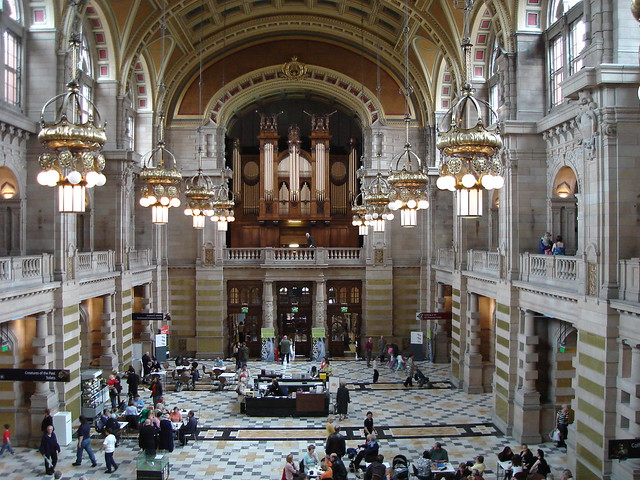
KelvingroveWhen we say we want our museum to be "audience-centered," what do we mean?

Over the past decade, I've seen two distinct versions of this term:
  1. the user-centered museum, in which visitors are active participants, invited to contribute to and co-create the experience
  2. the customer-centered museum, in which visitors are valued guests, invited to enjoy personalized experiences that cater to their specific needs and interests
It will be no surprise to hear that I fundamentally align with the user-centered model. However, I have enormous respect for the customer-centered model when it is executed in ways that truly invite visitors in on their own terms and deliver satisfying experiences. My career first got moving at a brilliant example of the customer-centered museum: the International Spy Museum. Many of my favorite museums, libraries, and zoos are customer-centered places. They care about visitor comfort. They deliver learning experiences at many levels, engaging many senses. They are responsive to visitors' needs and interests, and they are willing to tailor their offerings to better satisfy those visitors.

To be clear: I'm not a fan of all aspects of customer-centered museums. At their worst, instead of human-centered, they become commerce-centered institutions, overly focused on the shop, the restaurant, the spectacle, and the highest ticket price the market can bear. But at their best, they focus on the humans walking in the door, providing them with value on their own terms. One hundred years ago, John Cotton Dana, founder of the Newark Museum and godfather of modern museums, famously said: “A great department store, easily reached, open at all hours, is more like a good museum of art than any of the museums we have yet established." I believe that Dana's department store museum is best exemplified in the customer-centered museum. The customer may not always be right, but she deserves to have an experience that brings her comfort, satisfaction, and joy.

I felt that comfort, satisfaction, and joy on a recent visit to two museums in Glasgow: Kelvingrove Art Gallery and Museum and Riverside Museum. Kelvingrove is an encyclopedic museum, the kind where pachyderms, mummies, and Impressionists rub shoulders. Riverside is a museum of transportation, packed with trains, bicycles, and motorcars. Both of these museums delivered incredible experiences for me and my husband. These museums were terrific examples of customer-centered institutions because:
  • They engaged our curiosity. The objects were interesting, the stories surprising. At Kelvingrove, a display of knights, swords, and shields (one I'd usually skip) was peppered with animals whose skin and scales formed body armor, drawing me to look closer and better understand the connections between how living creatures defend ourselves. At Riverside, a torn-up Ford Escort explained how car thieves cut up and weld together stolen chassis, displaying the ingenuity and dangerous implications of chop shops. These displays were memorable. They taught us something new. They prompted dialogue and a desire to keep looking.
  • They catered to different audiences. Kelvingrove in particular was impressive for embracing an eclectic, "we all belong here" approach to gallery design and display. You could come for the Scottish first peoples or the World War II art or the dinosaurs or the collection of funny shoes. All were given value. I never felt like I stumbled into the gallery where no one else dares to tread (as I often feel when I enter the dioramas in many natural history museums, or the period rooms of art institutions). And they did a good job calling out and tailoring areas for families and young ones without making those spaces feel segregated from the overall experience.
  • They offered immersive, powerful environments. Both institutions made good use of their very different spaces. Kelvingrove is in a hundred-year-old palace of galleries around a central court in a park, whereas Riverside is a 2011 Zaha Hadid open-plan warehouse on a riverfront with a dramatic contemporary exterior. In Kelvingrove, we strolled easily from gallery to gallery, through open thresholds that encouraged exploration while maintaining distinct character from room to room. At Riverside, we wandered from display to display around the open floor, again, feeling comfortable, accommodated, and stimulated by bicycles racing around a velodrome overhead and 1920s buses squatting on the concrete. The objects in both museums were varied, and the display techniques incorporated movement, varied sight lines, juxtaposition, and humor to keep us intrigued and engaged.
  • They offered genuinely interesting learning experiences. In each museum, we saw thematic displays and labels that surprised and engrossed us. At Kelvingrove, we were particularly taken by Looking at Art, a gallery that invited us to check out a painting in various stages of restoration, to look at the backs of paintings and the things that were crossed out, and to learn more about the stories and influences behind specific artworks. I'd seen each of these kinds of elements in other museums, but never in such a clear way that respected visitors' intelligence and provided us with genuinely new information. At Riverside, I was impressed by the consistent integration of community voices in label text, and the very human take on a genre (transportation) that is often presented strictly in terms of technology and provenance. There were displays about the terror of motorcycle accidents, the freedoms public transportation affords, and the ways vehicles can enable people to enjoy places that are otherwise inaccessible to them. I'd heard before about Riverside's development, which involved many community focus groups, workshops, and talkbacks. That work showed in the human voices and stories throughout the museum. Of course, these are tools of user-centered institutions! It was lovely to see their integration into such strong customer-centered experiences.
  • They acknowledged our desire for comfort and variation. One of the best bits of our trip to Kelvingrove was taking a break to enjoy the free pipe organ concert in the central court. We took a break from the galleries, had a drink, and listened to the music as we chatted about our experience. This kind of accommodation in museums is nothing new, but it was made special because of how it fit into the flow of the building. We didn't have to go outside or to some segregated area to have coffee. It was there, in the heart of the museum, where we could gaze up at the galleries we'd been to and the ones we'd skipped. It wasn't a destination or a set-aside place of respite; comfort and social activity were at the very center of the building.
It's interesting to note that Kelvingrove and Riverside, like all the Glasgow Museums, are part of a public charity called Glasgow Life. Glasgow Life oversees libraries, museums, arts events, music venues, sporting events and fields, and community services on behalf of the City of Glasgow. Their vision statement is "to inspire Glasgow's citizens and visitors to lead richer and more active lives through culture and sport." In pursuing this vision statement and this diverse work, Glasgow Life recognizes serving a community means being both user- and customer-centered. Sometimes we are customers and sometimes we are users. Sometimes we are watching the match and sometimes we are kicking the ball. Sometimes we are enjoying the music and sometimes we are playing it.

Glasgow Museums include other institutions--notably, Glasgow Open Museum--that are far more user-centered. (Glasgow Open Museum, which co-creates exhibitions with and in community spaces across the city, served as a case study in The Participatory Museum.) But as a tourist on a summer day, I didn't seek out that user-centered institution. Instead, I walked into Kelvingrove and Riverside--two fine department stores of humanity--and walked out a satisfied customer.

Tuesday, December 15, 2015

Can We Talk about Money? Tweetchat on #RadicalGiving December 18

On December 18, at 10am PT/1pm ET, I invite you to join the denizens of Museum 2.0, Museum Commons, and Incluseum for a 30-min tweetchat about how and why we can give for change at #RadicalGiving. We've each written some preliminary thoughts about giving to prime the tweetchat. Here are my reflections (theirs are at the links above). Please join us on Friday on twitter to talk more.

I remember the first time I asked someone for money. I had just taken the job as director of a museum that was struggling financially. If we didn't raise substantial funds in my first few weeks on the job, we'd have to close our doors.

I stood in my bathroom, looking in the mirror. I tried saying, "Can I count on you for ten thousand dollars?" without choking or bursting out laughing.

The first few times I asked for money--heck, the first few years--it felt awkward. But it also felt amazing. I saw how we were able to garner support for work I was passionate about. How we could build a more relevant and valued museum. How we could expand our impact. How donors could be partners in change. I learned the addictive power of asking.

The more I asked, the more I found myself thinking about giving. I started asking on behalf of other organizations I care about. My husband and I started being more intentional, and bolder, with our own giving. The more I asked, the more people asked me. Even with limited means, I saw how our own giving could make a difference.

At the same time, I became more and more aware of the screwed-up societal inequities that make philanthropy possible. One of the ways we redistribute wealth in an inequitable society is by asking rich people to voluntarily donate. And then we celebrate their generosity, rarely questioning why they had the capacity to give in the first place. Especially in the arts, research shows an alarming imbalance in what kinds of organizations have access to grants and donations. Our system of philanthropy often reinforces the inequity that it theoretically has the power to disrupt.

I decided that in my own limited way, I wanted to contribute in two ways:
  1. by developing a strategy for my own giving that helps boost organizations that have powerful impact AND are more subject to philanthropic inequity than others.
  2. by trying, where I can, to talk more openly with friends and colleagues about philanthropy.
My husband and I don't have a master plan for our giving, but we have started to identify some things that are important to us. Locally, we give to organizations for which we volunteer. We give to organizations with leaders who we believe in. We try to give early, to help leaders who are starting out to believe in themselves and their ability to raise funds for their work. We try to talk to friends--especially those doing well financially--about integrating philanthropy into financial plans. Yes, it feels awkward. But other people are talking to them about investments and trips and cars. Why shouldn't we feel as comfortable talking about ways to buy into social change?

That's on the personal side. Professionally, I've always struggled with what organizations to support--especially in museums and the arts. I admire many around the world. I can't support a fraction of those I love. How should I narrow the field?

Bearing in mind the data on who has access to philanthropic capital, I've decided to give to organizations that are rooted in and/or led by communities of color. This year, that included: Rainier Valley Corps, a Seattle-based leadership development program for people of color; the Laundromat Project, a New York-based neighborhood arts organization working in communities of color; and the South Asian American Digital Archive, about which I know little but was encouraged to support by a colleague volunteering her time to a project of mine.

These are organizations that inspire me. I've learned from their work and their leaders. I'm trying to more frequently convert my admiration into cash--just as I encourage people to do as a fundraiser for my organization every day.

I've noticed that the more time I spend fundraising as part of my job, the more comfortable I get talking about money. Money has become a currency of my work. I talk about it. I think about it. I treat it the same way I treat ideas and people and objects and stories. It is an essential, powerful part of getting the work done.

I realize that not everyone is comfortable talking about philanthropy, or about money. When we do so in our field, we're often focused on pay inequities for the work that we do. But pay and philanthropy are two separate topics. We should be willing to talk about both.

Talking about money is like talking about death. The more we do it, the more we are in control of our own fates. Talking about money helps us honestly and unflinchingly tackle challenges we face in our society. The more I talk about it, the more power I see it has--and the more I feel I have an ability to influence that power, however small my influence might be.

Many professionals--myself included--have the capacity to give. We give as donors. We give as volunteers. Let's not be silent about this giving. We can be leaders with our dollars and our time. We can influence change when we put our money where our hearts are.

***

As alluded to above, topics like the role of money, or the equivalent (time/work), in bringing about radical inclusive change are little discussed in our field.

We have some questions we want to pose to YOU in an upcoming #RadicalGiving Tweetchat on December 18 at 10am PT / 1pm ET.

Below, find some questions that came from our joint discussion on these subjects and that we will ask for your responses on during the tweetchat:
  • Q1A. What is your personal motivation to give to support inclusive change and those who are leading change? 
  • Q1B. How do you give? 
  • Q2. What do you give your time/money to? Let’s signal boost these projects and efforts! 
  • Q3. How can we have these conversations about money more in museums? 
  • Q4. If money talks, how can we influence the conversation?

Wednesday, May 13, 2015

Familiarity Breeds Love…and a Desire for Things to Stay the Same: Guest Post by Karen Wise

Visitors in front of the African Elephant Diorama at the Natural
History Museum of Los Angeles County (NHMLAC photo)
This guest post was written by Karen Wise, Vice President, Education and Exhibits at the Natural History Museum of Los Angeles County

 “I love it! You’ve made it better without changing it.”

Those words haunt me. The person who said them is a member of our Board of Trustees. He’s one of our biggest supporters. He is committed to our aspiration of creating a new model of what museums can be in the 21st Century. Yet he was thrilled that we had not changed what he loved – any of it – when we installed our new signage system.

This isn’t an isolated issue. Loyal museum visitors – members, patrons, volunteer docents, people who grew up coming to the museum -- love the old exhibits they are used to. Familiarity may breed contempt in some contexts, but apparently not in museums. Familiarity with our museum seems to breed loyalty, love and a desire to have things preserved rather than changed. Dioramas. History exhibits with hundreds of objects and no coherent story. Schizophrenic bird halls with 5 different design and content presentation styles. How do we grapple with this difficult fact - that what staff may see as old-fashioned exhibits, those with no stories, just lots of coded content – can be visitor favorites???

The specifics of what visitors love is often hard to tease out. A couple of months ago, my middle school age daughter and her friends were in the back seat of the car talking about the museum where I work. One of them broke the unwritten rule against talking to the parent driver and asked me what was coming next. They got excited when I told them we were bringing in an exhibit on mummies. Then one of them asked me where we were going to put it. When I told him - into a hall that held what remains of our old California History Hall - the kids protested loudly that the old Hall is one of their favorites. When I asked them what they love about it, they named a few objects, but then one said “the whole thing” and my daughter said “the smell.”

Their loyalty, that fondness for the familiar, the smell--these precious memories do not drive attendance or keep us relevant. Even at a museum like ours, where more than 70% of our visitors are bringing others to facilitate a social (often family) experience, only new things can reliably motivate a visit.

In museum circles, there is also a widely recognized need for us to be relevant, to tell big stories that matter, to create experiences for the widest possible range of audiences, and - in the case of science museums - to help solve the STEM crisis by making science fun, accessible and interesting. As museums work to fulfill visitor-focused missions – in our case to inspire wonder, discovery and responsibility for our natural and cultural worlds - we face some ironic paradoxes.

Each month, during our visitor intercept surveys, we ask a sample of 200 visitors whether they came to see anything in particular, and if so what. The most popular answer among those that say yes is Dinosaurs. When asked what they want more of they say Dinosaurs - and more hands on experiences for kids.

No visitor has ever told us that s/he came to the museum to learn a big story or to see science in action. And yet, as museum professionals, we are constantly talking about our responsibilities to tell those big stories, to display a wider range of our spectacular stuff, to help visitors make sense of change through time, put current anthropogenic climate change by putting into the context of climate change throughout the history of the earth, and to display our collections as evidence for the history and evolution of the earth and life on it.

So how do we balance that perceived obligation to tell big stories – of the history of our planet and life on it, of evolution, extinction and survival, of how science works, visitor motivations for social experiences -- with great objects and specimens and memorable stories?

Most museums, including us, might answer this question by changing our approach as we create new experiences. But as we look at creating new layers for iconic, historic exhibits this can get dicey. In our case in LA, we’re addressing this now as we consider our diorama halls. We have some of the best diorama halls in the world. They are incredibly detailed depictions of scientifically and visually accurate moments in time and place with backdrop murals made accomplished artists – including some famous Plein Air artists who created them as part of W.P.A. projects during the Great Depression. How do we make them relevant, engaging, must-see experiences without changing them? Can we? There are plenty of models out there – and the range of options keeps increasing with technological innovations. We will learn from them all, but none that we have seen yet quite fit the full range of inarticulate needs of our visitors.

No matter what we do, I know this: we will test and test and test before we install anything in the diorama halls, lest anyone complain that we changed them.

Thanks to Karen Wise for this thoughtful post. Please share your perspective below--Karen and I both look forward to the conversation. If you are reading this via email and would like to share a comment or question, you can join the conversation here.

Wednesday, March 18, 2015

Community Science Workshops and Shared Authorship of Space: Interview with Emilyn Green

Imagine the most community-based science center possible. Imagine it in a poor, immigrant farmworker community. It exists. It thrives. In California. In a Community Science Workshop.

A couple months ago, I visited a Community Science Workshop for the first time in Watsonville, CA. I was awestruck. A small room, packed with gadgets, packed with fossils, packed with tools, packed with PEOPLE everywhere making and exploring and building and learning. The people were of all ages--moms with babies strapped to their fronts, six year-olds using skillsaws, pre-teens building robots, teenagers doing homework. There was a spirit of conviviality and purpose and helpfulness and Spanglish in the air. The design and feel of the place was different than any science center I'd ever experienced. I knew I could learn a lot from it.

I sat down with Emilyn Green, Executive Director of the Community Science Workshop Network, to learn more about their history, design, and engagement strategy.

Can you give me the overview of Community Science Workshops? What are they and where did they come from? 

A Community Science Workshop is a place for kids to tinker, make, and explore their world through science. The first one was started in 1991 by a San Francisco educator, Dan Sudran, in his garage. The Exploratorium is great, but it wasn't super-accessible. Dan was living in the Mission neighborhood, which at the time was very kid-dense, mostly first-generation immigrants, and Dan noticed that when he was messing around in his garage with physics gadgets, he could not keep the kids in his neighborhood out of his garage. They were so fascinated and wanted to be there every day.
There are lots of great science museum resources, but not where these kids can walk after school. In most cases, they're not places where kids can go by themselves at all.

So the Community Science Workshop model is to put a drop-in, FREE community science center in a place that is walkable to kids' lives and schools. In a place where kids are already walking around after school.

The core program is a permanent, dedicated physical space, full of interactive hands-on physical exhibits, as well as a tinkering and making space, and recycled materials. Most Workshops also run a wide range of additional programs - supplemental school day programs, afterschool programs, mobile units that go to housing projects. There are a whole bunch of programs to disseminate the science but the central workshop space is the heart of it.

Where do Community Science Workshops fit in the informal science landscape?

It's kind of tricky. We don't fit the more common templates. The best explanation is "community science center." But in the more traditional lexicon, these might be defined as "informal spaces."

Now that there is a new emphasis on "ecosystems of STEM learning" - for us, that's really helpful. Our programs end up being the hub of the local science learning ecosystem--especially in communities where there isn't a science center for miles in any direction.

How are Workshop locations selected?

The first one was in the Mission. We received two rounds of NSF funding in the 1990s to expand. We've focused on farmworker communities--there are so many kids in these communities throughout California. At that time, we expanded to Watsonville, where strawberries come from. And Fresno in the Central Valley--a city of 500,000, hundreds of miles from the closest science center. And a couple other sites that didn't make it financially (more on that later).

I came on in 2010 to start the statewide nonprofit network. At that point, we opened three new locations: Sanger, Greenfield, and a new San Francisco workshop in the Excelsior neighborhood because the Mission has changed so dramatically. The Mission location is still a useful hub for San Francisco school programs. Excelsior is now the walkable neighborhood space.

What happened to the ones that folded?

We received NSF funding for three years and then it cut off. In places that succeeded, at that point, a local coalition was in place to fund the Workshop. Where it didn't work, no local support stepped up. That taught us a lot. Now, when people are interested in starting one, we emphasize permanence. It takes a local coalition of people who are really committed to this to have a program that lasts.

Who are those local coalitions?

We're really different from traditional science centers in our funding model. We don't have paying members. We're not going to do that. It's not a Community Science Workshop if it's not free to participants. In fact, we have almost no individual donors. We have a few shining, beloved exceptions, but that's not a significant part of our model at this time.

So we tend to have three legs of support: municipal, grants/donations, and fee for service (usually with the school district). The municipal support can be actual funding - from Parks and Rec, or Environmental Education/Public Works in Watsonville - or a free building, or free access to a van, or materials... or free access to the dump to get materials. Several Community Science Workshops also get Measure S grants - gang prevention grants - through their cities. Grants come from community foundations, small local family foundations, local businesses. And then the fee for service is mostly school districts that contract with the Workshop for science enrichment/science instruction.

What unique design elements make Community Science Workshops work?

Geography is key. We tend to overemphasize it, because it's the initial requirement for any kind of success in these communities. Kids in these neighborhoods are wandering around alone after school. So if kids can walk to us, they can participate.

Once in the space, there are a bunch of design features that continue to be about access. Our fundamental premise is that kids are really interested in stuff. Given a wide variety of stuff, they will find something that they are excited about and will take on projects. We assume the motivation is there. The interest is there. So if a kid is not engaging, it's likely some barrier to access.

One thing you'll notice when you walk in is a ton of user-generated content. Most is hand-made, by participants or staff or parents, and that is everything from our signage to our exhibits.

We tend to be fully bilingual where appropriate. Our staff is almost always Spanish/English bilingual. And we hire from the community. Over 30% of our staff statewide are either former Workshop students or parent volunteers. That's an important design principle for the space - who the kids see when they enter the space.

We have some considerations about height and accessibility. We make sure that kids can grab materials and tools without staff intervention. Part of this is practical: you can't facilitate making and tinkering for 30 kids if you have to hand them everything they need. And it shows kids that they can be the agents of their own learning.

And then there's the most important design element - it's MESSY. We've been playing around with different ways to describe this and not terrify people. It's not messy like “vermin-infested”. It looks like a space that is used by humans every day. It's "purposfully messy." It's organized enough so people coming in can learn the layout, but it's the opposite of sterile. Surfaces are dense, and covered, and richly layered, and there is nothing in the room that implies "don't touch me or you'll get in trouble." That bar is pretty low for kids - they really need to know they are welcome to explore.

I loved the feeling of the space. It made me think of the Spanish word "ambiente"--that convivial, welcoming feeling. It also made me think about some of what we learned in a recent ethnographic study in which some Latino moms talked about "American events being so organized, whereas Latin events have joyful chaos." I know that most of your design focus is on kids. Do you think there is also a cultural/ethnic aspect to the kind of access and design you use? 

I feel very careful talking about the ways that the particular populations who we choose to work with for social justice reasons are also the people who make our work possible because of cultural expectations. For example, kids and tools. It's much easier for us to work with kids with power tools in these Workshops than it might be with other families because a lot of these parents use tools in their own lives. They are comfortable with them.

I was amazed by how community-based and authentic it feels. Many science centers struggling to engage "underserved" people with informal science. You are succeeding. What do you think is the difference? 

I come back to geography. Easy access to the space. When I talk with people in science centers, some really dedicated people working on these questions, they acknowledge that geography is a big hurdle they have to get over.

But there also is a sense of community ownership. For example, the Exploratorium is an extraordinarily participatory museum, but it's not nearly as participatory as a Community Science Workshop. Any big museum has barriers and limitations to full community ownership. Anyone walking into a CSW could repair a broken exhibit--anytime.

And that's the way we respect the contributions of the families we are working with. They are authors in the space.

To make a sweeping generalization, it seems that the folks we work with--working class people, people who work with their hands for a living, people with larger extended families - are very comfortable with spaces where multiple people are authors. They are comfortable with shared authorship of space and events. Whereas formal organizations have a harder time facilitating a shared sense of space and events.

Really interesting. So there is authorship, but no bylines.

 No visible bylines. But they still exist informally. The bylines are in the community’s awareness of the space. "Aurora made that sign." "I helped paint that sign." "I was here when Sal was working on that." People know, but they know based on their real experience of it in the space.

When I visited, it was so clear that there are so many people who use the Workshop again and again, who build things over time, who get involved in different projects for different reasons. 

Yes. And it's hard for us to document. Half of our attendance per year is in enrollment and school-based programs, but half is in our drop-in spaces, where we don't track participants at all. We know anecdotally that a lot of these people are repeating and deepening their participation, but we don't have the data.

We're just starting to interview our alumni now and creating a catalogue of their stories. It's powerful. But that's not the focus of the program. The focus of the program is to make it work every day.


Big thanks to Emilyn Green and the Community Science Workshop Network for sharing insights in this post. Emilyn will be checking in on the comments here and can respond to your questions.  If you are reading this via email and would like to share a comment, you can join the conversation here.

Tuesday, December 23, 2014

How Museum Hack Transforms Museum Tours: Interview with Dustin Growick

A new company in New York, Museum Hack, is reinventing the museum tour from the outside in. They give high-energy, interactive tours of the Metropolitan Museum and the American Museum of Natural History (AMNH). The tours are pricey, personalized, NOT affiliated with the museums involved… and very, very popular.

Today on Museum 2.0, an interview with Dustin Growick. Dustin is a science instructor at the New York Hall of Science (NYSCI) by day, Museum Hack tour developer/leader at AMNH by night. 

How did you first get involved with Museum Hack? 

Dustin: About a year ago I met a couple of people from Museum Hack at a conference. They were “preaching the museum gospel” in NYC via alternative tours at The Metropolitan Museum of Art. I was intrigued and curious to learn more, but also skeptical of the merits of an outside group running roughshod in The Met.

So I went on a tour…and experienced the museum in an entirely new way. I heard incredible—and often salacious—stories behind hidden gems I’d walked past numerous times. We interacted with the art and with each other through dynamic photo challenges, kinesthetic activities, and conversations. We discussed impressionism from Manet to Monet, and delved deeper in pointillism and Greek sculpture. Heck, I even learned about a 17th century German drinking game. For the first time in a long time, I was personally interacting and engaging with the museum, the collection, and with complete strangers in a way that highlighted the art. 

When the opportunity to design my own two-hour museum adventure at the American Museum of Natural History presented itself, I jumped at the chance. I’ve been leading my own Museum Hack tours at AMNH for about 9 months now. The tours boil down to three key things: engagement, relevance and fun. I want to help people find interactive and accessible points of entry and give them the tools to curate their own experience during every museum visit.

Can you give an example of the kind of Museum Hack activity that makes this different from other museum tours? 

Here’s an example that I experienced on that first tour of the Met. While in the American Portrait Gallery, we played a game called Matchmaker Matchmaker. Here’s how it goes:
  • Take a few minutes to allow a subject in one of the paintings to “find you”. It can be a human or an animal, and they can be the main focus of the piece or some strange-looking fellow lurking in the background. Go to whatever piques your interest and draws you in. 
  • Use both the posted information and your imagination to come up with a simple backstory for this individual. What is their name? Why are they in this scene? Where did they get that phenomenal feather boa? 
  • Find a partner or get matched with a partner. You now have exactly two minutes to concoct the epic love story that brings together the two characters you’ve chosen. 
  • As you stand amongst the portraits, share your tale of deception, love, mystery, and intrigue with the rest of the group. 
During this simple, ten-minute activity, we curated our own experience by practicing “high levels of noticing” and by investigating museum signage on the wall and online. We were encouraged to use our smartphones to search accession numbers if we wanted to dig deeper than the copy on the wall. We shared what captivated and spoke to us on a personal level, not just what we were told was “important." But perhaps most significantly, we used the art and the subjects therein as jumping off points for bringing the museum collection to life.

Who is the audience for Museum Hack? You are a museum insider and a content geek. But I know that Nick Gray, the Museum Hack founder, often emphasizes that Museum Hack is for people who don’t love (or even like) museums. 

We at Museum Hack have gone back and forth about our target audience: is it people that don’t like museums that we want to convert, or people who want a more personal experience, or people who want an active museum experience?

I don’t think anyone who doesn’t like museums would ever pay for a tour. Then again, many of our most passionate participants are somewhat ambivalent towards museums--or people who are daunted by the Met or AMNH and want a more personalized experience. I think of us guides as “museum personal trainers”. Whether you’re an art history buff, a professional athlete, or don’t think you even like museums, sometimes all you need is a little help using the equipment.

How do you advertise Museum Hack? If you want to get people who are not already interested in museums, how would they even know to look for you? 

Social media and word of mouth. It started with word of mouth, and then it got much, much bigger. Now a ton of our business comes from TripAdvisor reviews and Zerve - a ticketing website. We’re one of the top-rated destination tours to do in NYC. The reviews are so positive. And then during the tours themselves, we’re hashtagging, tweeting - that is promotional too.

When we became more known on these trip planning websites, it shifted our audience. It used to be mostly young New Yorkers. Now we have a larger and more diverse audience, including a lot of tourists who are thinking of going on tours anyway.

Are there differences between the Museum Hack experience at the Met and AMNH? I imagine that there are a lot more presumed barriers to break down at an art museum than a science museum. Dinosaurs seem pretty accessible. 

There’s a certain level of assumed stuffiness or pretention at the Met. We do a good job of breaking down those boundaries--and maybe those tours involve a little more swearing and silliness. As far as AMNH goes, there’s a little bit of that, but we focus more on offering a more personal experience, finding ways to engage with things in the space and make them personally relevant to you. One of the big ones is that we bring the people behind the artifacts to life. I don’t think on a normal tour they talk so much about the badass character and life experience of the explorers and revolutionaries behind the specimens.

How do you start a Museum Hack tour in a way that signals the different experience ahead? How do you manage the diverse people on the tour who may want different things from it? 

We have a specific opening activity to bring the group together. We huddle up, share what you should expect from the tour, and introduce everyone. Everyone puts their hands in the middle--like a sports team--and does a cheer. From the start, you are face to face with strangers. We use language throughout the tour to encourage the interpersonal, e.g. “make eye contact with two new museum friends.”

It also helps that we generally sell out at 8 people, and the guide always has a co-host if the group gets that big. Having two guides means we can do split stops at some places, giving some people one experience and some another. It allows a little more freedom, and it also gives people many voices and personalities to engage with.

It seems like there are two ways to look at Museum Hack. One is that you have completely reimagined what a museum tour can be, and for whom. The other is that you have produced the most excellent version of a museum tour—more engaging, more personalized, more entertaining. Which description do you think is more accurate? 

That’s a tough question. I think that for the two museums in which we work, it might be A. But for museums in general, it's B. There are definitely elements of what we do in use at other institutions and in other contexts, and this leads me to believe that B is a more accurate description. But as far as The Met and AMNH go, I think we've totally reimagined the tour experience (A).

How has Museum Hack informed your day job as a museum educator? 

It has made me a better educator and added tremendous value for the audiences with which I work, both at NYSCI and on Museum Hack tours. Ultimately, it hinges on coming back—time after time—to the same five questions:
  1. Why should my audience care about [insert content]? 
  2. How does [insert content] relate to their lives and their interests?
  3. What are the tangible points of relevancy that will engage my learners on a personal level? 
  4. Am I giving people the tools necessary to curate their own museum experience during repeat visits? 
  5. What is my “ask” of my audience? What are their “next steps”? 

Museum Hack let me step outside the routine context of my normal scope of work to really explore the core concepts of interactivity, engagement and relevancy. It’s made the museum experiences I facilitate more enjoyable, longer-lasting, and much more meaningful.

But you don’t have to take my word for it: next time you’re in New York, shoot me an e-mail. We’d love to give you a first-hand taste of the Museum Hack special sauce, and prove to you why we truly believe that Museums Are F***ing Awesome.

You can share your questions and comments directly with Dustin here in the comments section or by emailing him at dustin@museumhack.com

Wednesday, August 20, 2014

Blame the Crowd, Not the Camera: Challenges to a New Open Photo Policy at the National Gallery

Reader, I was wrong.

Five years ago, I wrote a post arguing that museum photo policies should be as open as possible. I believe that the ability to take photographs (no flash) in a museum greatly increases many people's abilities to personalize, memorialize, and enjoy the experience. I still feel that way. Mostly. But this past week, a string of stories from London have changed my perspective.

Several come from an aptly-named blog: Grumpy Art Historian. Blogger Michael Savage and I rarely see eye-to-eye, and that's why I love reading his posts. Last week, he wrote a series of posts about the British National Gallery's reversal of their photo policy. For the first time, the National Gallery is permitting non-flash photography.

The result appears to be a total mess. Lots of flashes. Mobs of ipads. Dangerous leaning and touching. A swarm of cameras everywhere. The paintings have become beleaguered celebrities, pursued by mobs of novice paparazzi.

Reading Michael's posts carefully, it seems that the cameras are not the ultimate culprits. Cameras weaponize an already unwieldy mob of people. They are the sidearms of packed-in novelty seekers. A scene like the one shown above is not just a mess because of the bevy of phones and cameras. It's a mess because of the crowd.

A packed crowd in a museum turns a free-choice viewing environment into a programmed event. You are stuck with the people around you, in front of you, shoving up behind you. Suddenly, a visual distraction like a camera--innocuous in an uncrowded space--becomes as bad as someone talking in the movie theater. You can't not see their camera. You are all in the same space.

Why is this gallery so crowded? Because it's famous. Michael notes that other parts of the National Gallery are still relatively quiet and manageable. But the star paintings--the Van Gogh sunflowers, the Botticelli virgins--are mobbed.

The cult of celebrity is strongest in fields where the general public knows little. How many opera singers can you name? How many painters? How many museums? The biggest museums get the most traffic--and primarily therein to the big name artworks in their collections. There are plenty of galleries in the Louvre that are empty. The one with the Mona Lisa will never be one of them.

Museums have exacerbated this cult of celebrity through an emphasis on blockbuster exhibitions and traveling shows that "package" the greatest hits into must-see moments. We push the once-in-a-lifetime experience of seeing the art. And then the crowds show up. They were told they must not miss it. They had better capture the moment however they can! And so the crowds shuffle through, cameras dutifully in hand. The art gets captured like a lame animal in a game park, instead of the wild thing it is.

Thinking about all of this, I remembered Don Delillo's beautiful bit in White Noise about the most photographed barn in America. Two of the characters in the novel go out to see this barn, and to see all the people taking pictures of it. One of them, Murray, says,
"No one sees the barn... Being here is a kind of spiritual surrender. We see only what the others see.  The thousands who were here in the past, those who will come in the future. We've agreed to be part of a collective perception. It literally colors our vision. A religious experience in a way, like all tourism."
The barn, like Van Gogh's sunflowers, is a tamed thing. With every click, it becomes less a barn and more a likeness of a barn. It is sacrificed to the continuous capture of its likeness.

I'm OK with this happening to a barn in a novel. I'm not sure I'm OK with it happening to art and cultural artifacts.

Is there an alternative?

Michael Savage might say: turn back the photo policy. Get rid of the cameras. But I think the cameras are a distraction. The real thing we have to get rid of is the crowding.

I'm heading out next week on vacation, camping in the high Sierras. To do this, I have to get a wilderness permit. To do that, I either had to plan way in advance (I didn't) or I have to get up at 5am to stand in line for three hours to get a permit (I will).

There are wilderness permits for the same reasons there are restrictions on visitors to museums: to protect the artifacts (nature) and to ensure the safety and positive experiences of the participants.

The permitting system doesn't apply to the whole park - just the parts that are most vulnerable. The permitting system is not primarily based on money; anyone can get a permit for a reasonable rate. It is based on the idea that there is a maximum capacity for safe and positive wilderness experiences, and that there are rules and systems that have to be put in place to ensure that capacity is not exceeded.

There is a maximum capacity for safe and positive experiences with art in museums. The right capacity absorbs diversity in learning styles. Some people can sketch in museums. Some people can take photos. Some people can talk. Some people can look. Any of these actions can be catalysts for deep and meaningful engagement. And they can all do all of these things peaceably if there is enough breathing room among them.

I think of the best museums as generous places. They welcome different people spending different amounts of time doing different things to connect with the work on display. If they are popular museums, they support people visiting at many hours of the day to be able to have a good experience despite the demand.

Crowded places become parsimonious places. They are transactional by necessity. Every deviance from our own preferred mode of engagement becomes more visible and frustrating. Diversity breeds name-calling instead of understanding.

Let's find a way to build generosity back into the operation of the largest museums in the world. Let Van Gogh be Van Gogh. Let the people experience the sunflowers in their own way, with their own bit of space and time. We need to build systems that let visitors, and art, bloom.

Wednesday, March 12, 2014

The Truth about Bilingual Interpretation: Guest Post by Steve Yalowitz

You know those research studies that make you want to immediately change your practice in some way? I recently read The BERI report on bilingual labels in museums and was blown away by its findings. BERI was an NSF-funded three-year collaborative project co-led by Cecilia Garibay (Garibay Group), Steve Yalowitz (Audience Viewpoints Consulting), Nan Renner (Balboa Park Cultural Partnership, Art of Science Learning) and Carlos Plaza (Babel No More). This guest post was written by Steve Yalowitz, a Principal at Audience Viewpoints Consulting, who has a Ph.D. in Applied Social Psychology and has evaluated and researched informal learning experiences in museums and other visitor institutions for over 20 years.

Bilingualism in the U.S. is a controversial topic, and the same is true in museums. If someone asked you whether museums should or need to have text in more than one language, what would you say? You probably have an opinion, or you could probably come up with an opinion without too much effort. Maybe you are in a country that mandates multiple languages, or at an institution already committed to bi- or multi-lingual interpretation. However, based on my conversations and experiences with many museum professionals, my guess is that many of you are aware of the issue, may think it’s worth discussing, but have limited knowledge about the core issues surrounding bilingual interpretation.

I was co-author of a recently completed research study [PDF] funded by the National Science Foundation, the Bilingual Exhibit Research Initiative (BERI), which strove to better understand bilingual labels from the visitor perspective. This qualitative, exploratory study involved tracking and interviewing 32 Spanish-speaking intergenerational groups in fully bilingual exhibits at four different science centers/museums. We observed and audio recorded the groups, and conducted in-depth interviews in Spanish after they went through the exhibit, with a focus on what the bilingual experience was like for the group.

The BERI study really expanded our thinking about bilingual interpretation, even though we’d been studying the topic for years. One of the main affordances of bilingual interpretation, of course, is that it provides access to content. The BERI study shows that access to content—the most obvious benefit of bilingual labels—is just the tip of the iceberg. Bilingual interpretation expands the way visitors experience and perceive museums, shifting their emotional connection to the institutions.

Here are three affordances that may not be as top-of-mind when we think about bilingual interpretation:
  1. Code-switching – We found lots of evidence of effortless switching back-and-forth between English and Spanish. We saw kids and adults switch from English to Spanish not only mid-conversation but mid-sentence, both in the exhibition and in the interviews afterwards. Museum professionals often incorrectly assume that if we provide Spanish text for Spanish speakers, they stay in “Spanish mode.” The power of bilingual text is that it’s bilingual – it provides access in two languages, and code switching lets you understand and express yourself from two different perspectives, with two sets of vocabulary. It was a huge affordance for bilingual groups, especially when some members were not able to understand English, or even if they were Spanish dominant or fully bilingual. 
  2. Facilitation – We researched intergenerational groups, so it’s not surprising that many of the adults saw their role as facilitator as essential to their own and the group’s success in the exhibition. We confirmed what other label studies have previously found: that adults were more likely to read labels than kids. However, this study found that in bilingual groups adults were more likely to read in Spanish, while the kids were more likely to read in English. With Spanish labels available, adults were able to facilitate, guiding the conversations and interactions, showing their children, grandchildren, nieces and nephews where to focus and how to interact. Adults who were previously dependent on their children could now take the lead as confident facilitators. An added benefit of bilingual labels, even for those who could read in English, was that they didn’t feel slower or that they were holding up the group.
  3. Emotional reaction – This study found that the presence of bilingual interpretation had a profound emotional effect on the groups. Groups said they enjoyed the visit more, felt more valued by the institution, and many said having bilingual interpretation changed how they felt about the institution. In our field, if we focus on the emotional aspect of the experience, it’s typically around the content and what we’re hoping people feel when engaging with our exhibits. While some of the reactions were around engagement with content (as would be expected), many of them were really about feeling confident and comfortable–key factors for a satisfying and worthwhile visit. 
When asking whether bilingual interpretation is worth it, we’re often looking at it through the wrong lens. It shouldn’t be about whether it’s worth it for us as an institutional investment, but whether it’s worth it from the visitor perspective. Does it improve the visitor experience in a way that adds value to the visit, providing affordances that don’t exist in monolingual experiences? The answer, from the BERI study findings, is a resounding yes.

BERI was a three-year collaborative effort I worked on with Cecilia Garibay, Nan Renner and Carlos Plaza. When we received the award, we felt a great sense of opportunity and responsibility, since this was the first NSF-funded research study about bilingual families and their experiences in fully bilingual exhibitions. You can download the research report and find out about the research model, methods, analysis and implications for the field.

 We saw this study not as the answer to the field’s questions about bilingual interpretation, but as the start of a conversation around better understanding how it works. In doing so, we found out that it is a much more complicated and rich experience than even we thought. After a recent presentation about the findings, a museum professional told us that the study’s findings helped change how they think about bilingual interpretation. My hope is that some of you out there will continue this important work, and help change how I think about bilingual interpretation.

Wednesday, January 16, 2013

Reflections on a Weekend with Ze Frank and His Online Community

It's not every day that a visitor buys pizza for everyone in the museum. Or that visitors form a spontaneous "laugh circle" on the floor. Or that we take a group photo together at the end of the day.

Then again, Saturday was hardly normal at the Santa Cruz Museum of Art & History. This past weekend, in conjunction with our exhibition about Ze Frank's current participatory project, A Show, we hosted "Ze Frank Weekend"--a quickie summer camp of workshops, activities, presentations, and lots of hugging. It was an opportunity for people who participate with Ze Frank's projects online to come together in real space and connect with him and with each other.

It was pretty freaking amazing. About 700 people participated over two days, including some who had traveled to Santa Cruz from London, Indonesia, and across the US. The group was mostly young (teens to thirties) and nerd-diverse: a little bit punk, a little bit hacker, a little bit craft grrl. There were two guys with rainbow beards who did not previously know each other. There were some locals who stumbled in unaware, but mostly, this was an insider's event for people who know and love Ze's particular brand of emotional connection mediated through online participation. To get a sense of what it felt like for participants, check out this great video by one visitor from afar about his experience.

A few things I learned/observed/was impressed by:

A spirit of inclusion, generosity, and welcome permeated the event. We were pretty nervous about the unknowns going into the weekend. Ze had issued an invite to tens of thousands of people online, and we had no idea how many people would attend, and who they are. What we DID know is that the people coming would be connected through work that focuses on sharing intense and not always comfortable emotions online. I was concerned about how we could welcome people into the museum in a way that acknowledged the enormous risk they were taking in showing up in a foreign city and space to connect with people they only sort of knew in an online space. 

Online to onsite migration isn't always easy. I feared that the event would feel cliquey and wouldn't represent the creative, inclusive spirit of Ze's work. But three things made the event a success in this regard:
  1. Ze was amazing. He gently acknowledged the fundamental weirdness of meeting people in real-life, in confronting their "fleshiness," giving voice to anyone else's concerns about over-stimulation in the space. Ze was really hands-on with everyone, giving hugs, taking photos, jumping in to do activities with participants. Even though for many of the participants, Ze is a celebrity of epic proportions, he did everything he could to make the event about them and their engagement and not about him. 
  2. The activities had a really low barrier to entry. We collaborated with Ze to develop activities throughout the weekend that were lightweight, fun, and encouraged low-key social interaction--exactly the kinds of activities that we have found encourage social bridging with strangers. When people walked in, they received a program and a sheet to collect finishing stamps (unique marks created by participants at one activity station) from other participants. The sheet gave people a lightweight tool to use in social interaction, to trade and share stamps. And the program helped people feel like they knew what was going on. Again and again, we tried to balance the wackiness and spontaneity of the event with the surety that people were in the right place, that we could help them, etc.
  3. Our volunteers and staff--and the participants!--rocked. Our regular museum volunteers partnered with new volunteers drawn from Ze Frank's online community, which created a nice bridge between people who knew the museum and people who knew the community and its spirit. Participants who felt more confident modeled generous behavior and engaged others. I was so proud to see how our overall ethos of participation and social bridging was manifest in making the experience really wonderful for everyone.  
The museum itself was well-integrated into the event. In some ways, this event reminded me of the Ontario Science Centre's YouTube Meetup in 2008--a real-time, physical event to support an online community. One of the concerns at the YouTube Meetup was the disconnect between the museum and the participation; for many attendees, the science center just became a venue for a social experience. In this case, because our current exhibition includes a gallery of things made by Ze Frank's community, it was natural for weekend participants to be enthralled by and want to engage with the exhibition itself. Also, our museum-wide approach to participation suited this community well; they really enjoyed exploring other floors and participating in activities that had nothing to do with Ze Frank except in the ways that our philosophy and his are well-aligned. I loved meeting so many people who were surprised and delighted by the participatory approach of our museum--it made it feel like this was a place "for them" instead of a place that was hosting them.

As always, I learned a lot from Ze Frank's unique approach to community participation. One of the regrets of this project for me is that Ze and I have had so little time to really talk about how we think about engaging people in active participation--we've just been busy making it happen. But during the weekend, Ze gave a couple talks that opened up new pathways for me, especially around designing participatory experiences that spread and grow. A couple of key points I got from him:
  1. Make sure to develop prompts or projects that are both interesting to DO and to experience as an audience. This is something I strongly subscribe to--a huge percentage of any audience is more likely to spectate than to contribute. But on the web, it's even more important than in a museum. In a museum, if something is appealing to watch, a person might share it by taking a photo or talking about it with a friend. Online, if something is appealing, a person can share it in a million ways via social media. Ze talked about having a personal filter on project ideas that really focuses on ensuring that the activity AND the resulting content is appealing to share.
  2. To get lots of participation, always celebrate the human quality of the work. Ze pointed out that many participatory projects that operate as contests end up focusing on a narrow set of "best" work that can exclude broad participation. When Ze described his Young Me Now Me project, in which people replicated photos of themselves as children, he explained that he really encouraged people not to focus on getting the props or costume right but instead to focus on getting the expressions right. By focusing on that human element of self-expression, people felt that the activity was open to them regardless of their ability to set up a scene or take a great photograph. This point is a really interesting extension of my focus on personalization and using individual experiences as a starting point for community participation. Broad participation is not the goal of every project, but I found Ze's framing here a useful salve to the frequently espoused and flawed idea that "to get lots of participation, make the activity stupidly easy."
All in all, a beautiful and stimulating weekend. You can see more comments from participants here and here and see a photo set from one participant here.

Wednesday, October 24, 2012

Traveling Couches and other Emergent Surprises Courtesy of an Open Platform

How do community members make your institution better?

I like to ask myself this question periodically, challenging myself to find substantive ways for visitors to contribute to our museum. Yes, we have the standard ways--volunteer programs, board service, and community partnerships--but I strongly believe that if we are doing our jobs right, every visitor who walks through our doors should be able to make a meaningful impact.

To that end, our exhibitions are full of participatory elements. Visitors can comment on how we can improve or what they would like to see. They can contribute their own stories, objects, and creative work to exhibitions. We actively seek participation and develop structured opportunities for visitors to collaborate with us.

That's all fabulous, but it's also all by design. And when I think back on the past year, some of the most magical things that have happened at the museum have NOT been designed by us. Instead, they've been driven by community members who see the museum as a platform for their own creative pursuits.

Here are just four surprises that have invigorated the museum in the past few weeks:
  • Pop Up Tea Ceremony. Last month, a couple came in and asked if they could stage a pop up tea ceremony at the museum. We said yes, and they have now participated in several events, offering a unique mix of traditional tea ceremony, koto music, and bedazzled plastic microphones (see bottom left of photograph).
  • Happening Couch. A local engineer, Greg McPheeters, brought his tandem-bike powered recycled couch to our Trash to Treasure festival last Friday night. Riding the art couch through downtown Santa Cruz with two visitors and a dog while blasting the Jackson 5 was one of the highlights of my year. Here's a picture of it in action.
  • Evergreen Cemetery Board Game. One of our research volunteers, Sangye Hawke, blew me away when she posted a photo on Facebook of the board game she's developing about the restoration work we're doing at historic Evergreen Cemetery. What started as a fun personal project for her will hopefully become part of our permanent history gallery--a space we are trying to make more interactive over the coming years.
  • Connections through Collections. A college student who visited our Santa Cruz Collects exhibition wrote to us after her visit to share that she has a childhood collection of bouncy balls (like Aaron Schumacher, a young collector profiled in the exhibition). The student is now donating her collection to Aaron so his can keep growing.
Of course, for every one of these enchanting surprises, we also have many of more variable quality: people who walk in with their paintings on their back asking about display opportunities, people who send us poorly-produced videos of their bands or projects, and lots of speculative, odd conversations. It's not unusual for me and our public programming staff members to have several short interactions every week with newcomers who walk in the door with idiosyncratic visions for cultural engagement.

I've realized that while I always used to ask that question in the frame of "what are we doing to make it possible for community members to make this institution better?," the most powerful evidence of it happening is when our active role as designers/facilitators becomes invisible. Community members, artists, and organizations increasingly see our museum as a place where they can advance their own goals, and so they approach us. We don't have to convince them that it's their museum. Instead, we just have to be generous and thoughtful about how they can--or cannot--participate with us. We've even started reflexively mumbling, "well, it is your museum," when someone comes dancing in the door or moves a chair or starts reciting poetry.

To me, this is an example of how the aggregation of participatory practices fundamentally changes the role that an organization has in its community. We've created a very consistent message about being an open platform for local creativity--through exhibitions, event design, online, even the conversations we have with the press. And while we are still continually seeking out great partners and cultural combinations, we're not always the instigators of those opportunities. The more we structure in participation, the more people feel empowered to bring their own brilliance to the table, spontaneously and completely beyond our expectations. The magic isn't by design. It happens because people see an opening where there wasn't one before.

Wednesday, March 21, 2012

Wandering Down the "Don't Touch" Line

How do you help visitors know what they can and cannot do in your museum? Most museums have this figured out: they have signs, they have guards, they have cases over the objects. But what happens if you take away the "Don't Touch" signs and the uniforms? What if you want to create a more generous atmosphere that presumes the goodwill and propriety of visitors? What if you WANT them to touch certain things?

I used to think these were easy questions to answer. I grew up professionally in the science and children's museum field, where touching is guaranteed and floor staff spend more time helping visitors learn and ensuring their personal safety than they do protecting the objects. I believe in the same idealistic vision that Frank Oppenheimer brought to the Exploratorium: if you respect visitors' intelligence and good sense, they will respect your objects. And this works pretty well in science museums, where designers talk about "hardening" exhibits to withstand the more aggressive touchers among us.

Art, however, does not come to museums pre-hardened. At the museum of art and history where I work, we are grappling with the question of how to help people enjoy themselves while keeping the art and artifacts safe.

We've taken down the don't touch signs and created a friendly, welcoming atmosphere. We've increased attendance among people who are new to museum experiences. The level of touching, especially of art, has increased. While it's great that people feel comfortable here, it's not great that they are (presumably unwittingly) endangering the art. This challenge is exacerbated by several factors including:

  • Inconsistent level of touching allowed. We are increasing the number of interactive elements in the galleries, and we haven't found a clear way to say to people, "touch this but don't touch that." In the history gallery, we have some blended props and artifacts, and it's rarely clear what is and is not ok to touch. I sometimes talk to parents who are stressed out trying to figure out what their kids can and can't do.
  • Many objects not in vitrines. We love showing objects outside the confines of a case. But it makes it less clear that they are not for touching. Putting objects on pedestals helps, but not always. 
  • Focus on family audiences. As we make the museum more family-friendly in a number of ways (activities, casual spaces, interactive bits), we have a lot more kids in the galleries. They love to run up and grab things. Their parents are not always able or willing to stop them. Many don't have "museum experience" and don't know what we expect.
  • Low level of staffing and security. We intentionally do not have much security at the museum. We don't have signs that say Don't Touch. We don't have guards. We do have friendly gallery hosts, but not every hour of the day. 
  • Engagement with local artists. One of the things we love about exhibiting local artists is that they are often here to talk with visitors about their work. It's not unusual to see an artist showing a visitor how she constructed something or created an effect. It's also not unusual to see an artist touching their own work as they show it to visitors. Especially during our woodworking show, we had a flurry of fabulous woodworkers opening their cabinets and drawers. This was amazing. It also made visitors feel like they could do it too. 
This is only going to become a bigger issue for us as we invite in new audiences and incorporate more participatory experiences throughout the museum. I am unwilling to adopt standard strategies of security guards and cases everywhere--both of which I believe introduce an inhospitable environment to engaging with artworks and with other people. I want to provide a higher standard of care for the objects while also pushing forward a friendly, generous standard of care for visitors. 

How will we deal with this? Here are a few solutions I've seen and options we could consider:
  • The Denver Art Museum does a terrific job indicating where there are family activities in galleries with a consistent visual look and feel that is repeated throughout the museum. We've talked about doing a "family guide" to our museum that helps people find these "do touch" spaces. However, in Denver, this approach is supported by the fact that there are guards in other spaces. The Oakland Museum, which tried a similar approach with their "touch me" stickers throughout the galleries (as shown above in the photo), has reported an overall increase in touching... all over the place.
  • Labels that explain the reasons behind the "don't touch" rule. We had a "please don't lick the art" sign for woodworking that talked about the oils impacting the wood. I've enjoyed seeing labels that explain these things, but I wonder if it's a museum-wonk approach that doesn't work for general audiences.
  • The Milwaukee Art Museum has a video explaining do's and don'ts of the museum for children. This video rubs me the wrong way because it reinforces the basic "nos" of museums in a cutesy way. Keep your arms behind your back. Avoid the guards who wag their fingers at you (until the part at the end where it suggests that guards are people too). In some ways, I feel like this is just a "don't touch" rule dressed up in a Reading Rainbow costume. But I appreciate the concept of a family-friendly introduction to the museum and I understand that this is not geared to me as a viewer.
  • At the MAH, we've tried proactively "helping" visitors touch in certain exhibitions. For example, in the woodworking show referenced above, we ended up giving our gallery hosts white gloves so they could open drawers and doors for visitors. It's not the same as getting to stroke the wood (which everyone wanted to do), but it addresses some of their desires.
  • Lots more trained staff or volunteers--not guards, but people who can welcome visitors to the museum and help them be comfortable and clear about the experience available. 
  • More hardening (without casework). Maybe it's not possible to be as friendly as we want to be without a certain number of kids zooming up to grab a sculpture or people mistakenly thinking they can stroke a cabinet. Maybe there are design solutions that introduce barriers in less stark ways than casework. I'm kind of dubious of this, but it's possible.
What do you think? If you want to create a friendly, welcoming environment AND protect objects, what do you do? What's the "yes and" solution to this? I'd particularly love to hear from people who are non-museum professionals on this one.

Wednesday, February 08, 2012

Come On In and Make Yourself Uncomfortable

Last week, I did something I hadn't done in ten years. I walked into a boxing gym. In college, I'd boxed a bit recreationally, and it seemed like a good time to pick it up again. In the fall I bought a Groupon to a local gym. Four months later, here I was, ready to take my first class.

The gym was full of young men working out, pushing themselves, and generally having a great time. The vibe was friendly and aggressive. I'd called the day before and knew what to expect. Despite this preparation--and the years I'd spent in similar gyms as a college student--it took almost all my willpower not to turn around and walk out the door immediately after entering.

I'm glad I didn't; the class was excellent. But I was struck by the incredible stress that comes when you jump into an unfamiliar situation or subculture. There was nothing threatening about the people at the boxing gym. And yet I felt threatened, uncertain of whether I was up to the challenge, ready to be the newbie, willing to be a novice woman among men.

We often talk in cultural institutions about reaching out to new audiences and helping them break through the threshold fear that may accompany first-time museum or cultural experiences. And yet for many cultural professionals, "threshold fear" is a hazy term. How could a person possibly feel intimidated, truly frightened, of entering a museum? How scary or confusing could it be? We can't fathom that kind of fear, and so we demean or disregard it.

If you're a museum person and you want to understand threshold fear, don't go to a museum. Go to a boxing gym. Go to an uberhip bar. Go to a place of worship that is not your own. Go to a tattoo parlor. Find a place where you feel an incredible urge to bolt out the door the minute you walk in.

Go there alone. See what makes sense and doesn't to you. Consider what intimidates you and what you feel comfortable with. Note the people, areas, or experiences you gravitate to as safe starting points.

And then go back to your own institution and try to see it through that lens. Hold on to your pounding heart, and imagine carrying that adrenaline through your own front door.

This is incredibly difficult. I can't do it with my imagination alone. But what I can do is put myself in those uncomfortable situations and perceive the raw power of the stress that accompanies them. What I can do is find people who feel that way about my institution and travel the halls with them as my guide. Threshold fear is very real. If we're going to overcome it, we've got to respect it.

Wednesday, November 23, 2011

What Hours Should Museums Be Open?

An exhibiting artist approached me recently at an evening event at the museum. "Hey!," he said, "I have some feedback for you. You know, the hours that you're open--they're not very accessible for people who work."

He's right. They aren't. We're open Tuesday-Sunday, 11am-5pm. And if you work and or have a family, that doesn't exactly make it easy to visit.

This isn't rocket science. But it's a question that many museums seem to address inadequately. We try so hard to make our visitors feel welcome and comfortable once they're inside, ignoring the glaring obstacle that may prevent them from even getting in the door.

It's interesting to me that so many museums debate admission fees but don't get comparably riled up about open hours. Some of the most innovative, community-focused museums I know of are trapped in the 11-5 game, and it's frankly a little bizarre--especially from visitors' perspective.

The obvious outcome of daytime hours is fewer visitors. But it also has a lot of other chicken-egg effects. Imagine if a theater or jazz club was only open during the day, and what conclusions one might draw about audience type and preferences based on that decision. For example, in museums:
  • Retirees and vacationers--two groups with daytime availability--become primary audiences that receive significant attention and subtly influence programming choices. Who would be "core" audiences if our institutions were open from 3-9pm instead of closing at 5? How might programming shift to support them?
  • Evening events provide rare opportunities to experience the museum after work. Are these events popular because of programming, or are they popular because of the hours? Would events be as significant in the experience of young adult audiences if there were more opportunities to experience the exhibitions after work without special programming?

In thinking about whether, why, and how we might rethink hours at my institution, I've come with the following list of pro's and con's for shifting the hours later.

PRO:
  • more accessible to working people
  • more symbiotic with times people are recreating downtown (dinner, happy hour, shopping)
  • separates school tours from public visiting hours, which can be helpful in a small building
CON:
  • requires changes to staffing and signage
  • can't rent the museum for lucrative evening events as often. If we're open every evening, it cripples this business. If we're open only a few evenings, it may confuse visitors.
What do you think? What questions should I consider in examining this? What have you seen change--or not--when hours change? What institutions are worth looking at to learn more? I'm particularly curious about other cultural and community organizations--libraries, performing art spaces--and how hours impact their use and value.