Showing posts with label work. Show all posts

Tuesday, November 19, 2019

Teams, My teams, and Are we one team?

The Ship of Fools by Hieronymus Bosch, licensed under CC BY-SA 4.0

By Seema Rao and Paul Bowers

I've been living in a wintery wonderland and luxuriating a beachy wonderland in equal turns recently. Last week, Rob Weisberg posted when I was at MCN (sadly as missing him terribly at that conference.)

I'm so glad to have gotten to go to MCN. Museum Computer Network has become my Shangri-la, in a way. A mirage, I see even when it's not there. I connect with many of those people online and in email. I wrote a bit about my true love for my conference friends last week on Medium. I wrote that post because I had one heck of a conference. So many things that had meant so much to me were coming to fruition, and like a godparent, I had barely anything to do with them. It felt great and also like an out of body experience.

In some ways, museum work has this illusory aspect. Or museum work is like atomic theory perhaps. We all have so many colleagues we rarely meet. And, then you run into each other in life or online, maybe exchange some energy, and like electrons bounce to higher levels.


This idea of bouncing ideas and growing them might be said for my other post of the week, about touching art. I'm pretty open to a number of possibilities in museums. I am most definitely not open on the issues of collection care. The sanctity of the work is paramount. So how do we balance NO Touching policies and messaging against welcoming visitors? I don't have an answer, but would love to increase my energy levels on best solutions with your help. (as always drop by a line in comments or at Twitter @artlust)  So in this case, I'm hoping you run into me with your ideas. (I did this illustration on my plane back from MCN that made me feel better though offered few solutions. And yes, it really is 2 Legit 2 Legit to quit. But I couldn't. I just couldn't).

All this meandering introduction, perhaps, is to lead up to this week's guest speaker. I've definitely felt energized by interacting with him, usually online. Paul lives in Australia, and I've had a couple of meals with him at most. I've also had very thoughtful conversations with him and I feel I've found a kindred spirit. So much so, we've presented a paper together on the stage of MuseumNext. I was thrilled he was willing to share some of his thoughts here today. Enjoy.

---
Are we one team? 
By Paul Bowers
As Seema wrote in the first of the work series, our sector has been professionalized and reshaped over the past few decades. While we are enriched by the many professional fields intersecting to create the contemporary museum workplace, it presents a challenge we rarely talk about. 
In every museum, we find different values, language and work practices. I want a debrief, you talk about retros; I ask for the budget, you offer me the ‘P and L’. A successful day for the retail team is not the same as for the registrars - how do we work together when some people want to make a profit, and others study provenance? Many workplaces have these complexities, but I think our sector is unique in the sheer number of different domain experts - and that means we have to work harder than most at building common cause.
Lots of low-level workplace frustration can be laid at this door. I think I could fund my coffee habit if I had a dollar for each complaint of ‘Jeff from department blah is messing up my project, grrr.’ And there’s always a Jeff to blame: I’m sure even Jeff has a Jeff.
Before offering some suggestions, it’s important to emphasize there are a lot of unspoken assumptions of privilege and social encoding around values and how things should be done: that ‘academic’ is superior to ‘technical’, for example. We must be mindful, humble and open to learn about the privilege we may have in the workplace.
That being said, my first suggestion is to slow down: invest time in being clear what we mean and why we are acting as we are. Expertise gleaned from years in one sector, understood easily with your department colleagues, doesn’t automatically feel valid to someone without this experience. Deploying authority to win is easy but doesn’t help in the long run. We build trust and social capital by taking the time to explain - and explaining our reasoning can often assist in clarifying our thinking.
Overt your values, rationale and motivations. When passing on a piece of work, be clear, ‘I did it like this because _____.’ An exhibition team of mine was in conflict with the functions and events team - it was resolved when that department head said ‘I love doing two things at work: making money and supporting the arts. When I make money, it pays for exhibitions. That’s why I want to make more money.’ Written here, it looks patronizing - but in that moment, the direct simplicity brought clarity and drained conflict from the conversations.
My second suggestion is to remember that no-one comes to work to do a terrible job or annoy their co-workers. So when someone seems frustrating, work really hard at assuming good intent. Reflect on ‘how do they think they are creating a positive impact in this conversation?’ Find a way to ask - can you explain a bit more about how this way of working moves us forward? Usually, there is an excellent reason!
The legal team in a previous museum frustrated me - they were excruciatingly slow. And then a mutual colleague explained how it looked from their perspective - slowing me down and checking the detail was their job, to protect the organization against the existential threat of a huge legal cost in the future. This helped me see their contribution as a positive thing.
My final suggestion is to be more intentional about purpose, and who owns it. We can often unintentionally create micro-empires around tiny tasks, rather than cohesive language around a shared endeavor. Stating ‘I will select the artworks, you will prepare and document them, they will install them’ may be factually accurate, but it is so much better to say ‘let’s work together on getting this exhibition looking great, let’s agree how we’ll get it done, how about this: …’ before that statement. Use collective language in every situation, unless talking about your own direct accountability.
I’m sure there are many more ways to create and maintain common cause with the different professionals who make up our workforce. The goal isn’t to make everyone work the same - I’d be a terrible legal counsel! - but if we can reduce friction and create more harmony, the rewards for us as workers (including Jeff!), and eventually for our audiences, will be great.


Paul Bowers is a museum professional in Melbourne, Australia, who usually blogs at


Tuesday, November 05, 2019

Museum Work


Author: Seema Rao

This month, we’re talking about work. Not the work we do, but the ways we do that work.
While many American museums require 37.5 or 38 hours of work a week, most of us put in way more. In some old jobs I've had, particularly when I was full-time at part-time, juggling multiple roles, I regularly put in 100 hours a week. I came from a family that did that, so it seemed normal, though my relatives were all earning considerably more for their 100 hours a week.

I’m setting wages aside this month. Trust me, I know they are important. Salary is, often, the way organizations signal your worth. This is particularly evident when organizations pay greater salaries to certain departments overall than others. And, as Phillip Thompson said inour panel last week, the museum business model sets up problems for our field, because we are always trapped by the amount of money we can raise. Therefore, the whole issue of wages gets at the heart of the faulty systems of capitalism, the culture of women’s work, and museums as privilege-concentrating institutions. In other words, wage is enormous conversation and deserves its own month down the road.

This month though, I want to deal with something a bit more manageable. How we do our work and how we can improve it. The big questions are, how can people make changes to improve the working conditions, and how can leaders help organizations run better?

Efficiency is a favorite topic of mine. I like to think about where to shave off a little time (though who knows what I’m doing with that extra.) And, next week, I can share some of my thoughts on efficiency. But efficiency is like calibrating a well-run machine. This month, I’d like to think about our many broken machines.

Museums might earn their philanthropy partly through gifts from commercial enterprises, but for a very long time, their workplaces were run very differently. They had the committee decision-making structures from universities and the collections-authority systems of libraries. But they had a flavor all their own, spiced up with curatorial authority and donor privilege. In the last twenty years, or so, professionalization has changed museum work. Much of the quirkiness in the field has given way to corporate norms. Dashboards and ROI are as much part of our workplace language as community engagement and light-sensitivity.

This transformation has brought some good. Last month, we talked about audience engagement. Almost twenty years ago, when I started in community engagement, meeting after meeting would be held about what X group of people wanted. We never once asked them. We had no data to support our suppositions. And, we still barreled in and gave them the wrong thing. Now, I can’t imagine creating a new program without data.

Moving toward a more professionalized, and I might say corporate, structure has also brought negative issues in the workplace. In an old job, I was asked to track all the costs and benefits of family programs. Our systems weren’t up to snuff enough to let me click a button to generate a dashboard pulling directly from enterprise software. Plus like many organizations, family programs were a necessary evil for that organization, not what the museum perceived as their worthy audience. So, I sat at my little desk and crunched away. In an old life, I took plenty of stats. Numbers and graphs excite me. They are as plain, if not more, than words, in my mind. I sent the report to my boss. Six months later, she said she didn’t read it. She wasn’t into numbers. My tale of wasted work woes isn’t being retold for sympathy. I’m using this as an example of when a museum workplace needs fixing. First, we are often asking ourselves to do more, but we don’t scale up our system to do so. If you are going to become data-informed, you need to have your data easily accessible (or pay someone extra to crunch the data). Data is not free. Second, we are often choosing to make a change without scaling up internal capacity. If your leaders don’t use numbers, get them training, or don’t waste the junior staff’s time on generating them.

We have a certain amount of time allocated for work. As individuals and organizations, we choose how to allocate them. Giving a critical eye to labor, and the reasons certain systems don’t work is an essential way to improve work overall.

Museums are often run like city-states, each solving for their own problems. Just as Sparta and Athens solved city management differently, two museums on the same block can be run quite differently. Diversity in organizations and workplace solutions can be good for our field, that is, if we learn from each other. We often look across the street or nation at other museums for how they solve the big things: exhibitions, building projects, technology. But, we aren’t all that good at talking about the boring mundane parts of our lives like the way we do work. I suggest speaking across the sector about work could improve working conditions and as a result the field.

We are at that museum way more than 37.5 hours a week, and why should those hours be frustrating and unhappy? So, this month’s big issues are: What are some of the big issues you see about how work is done in Museums? What can you do to change this?

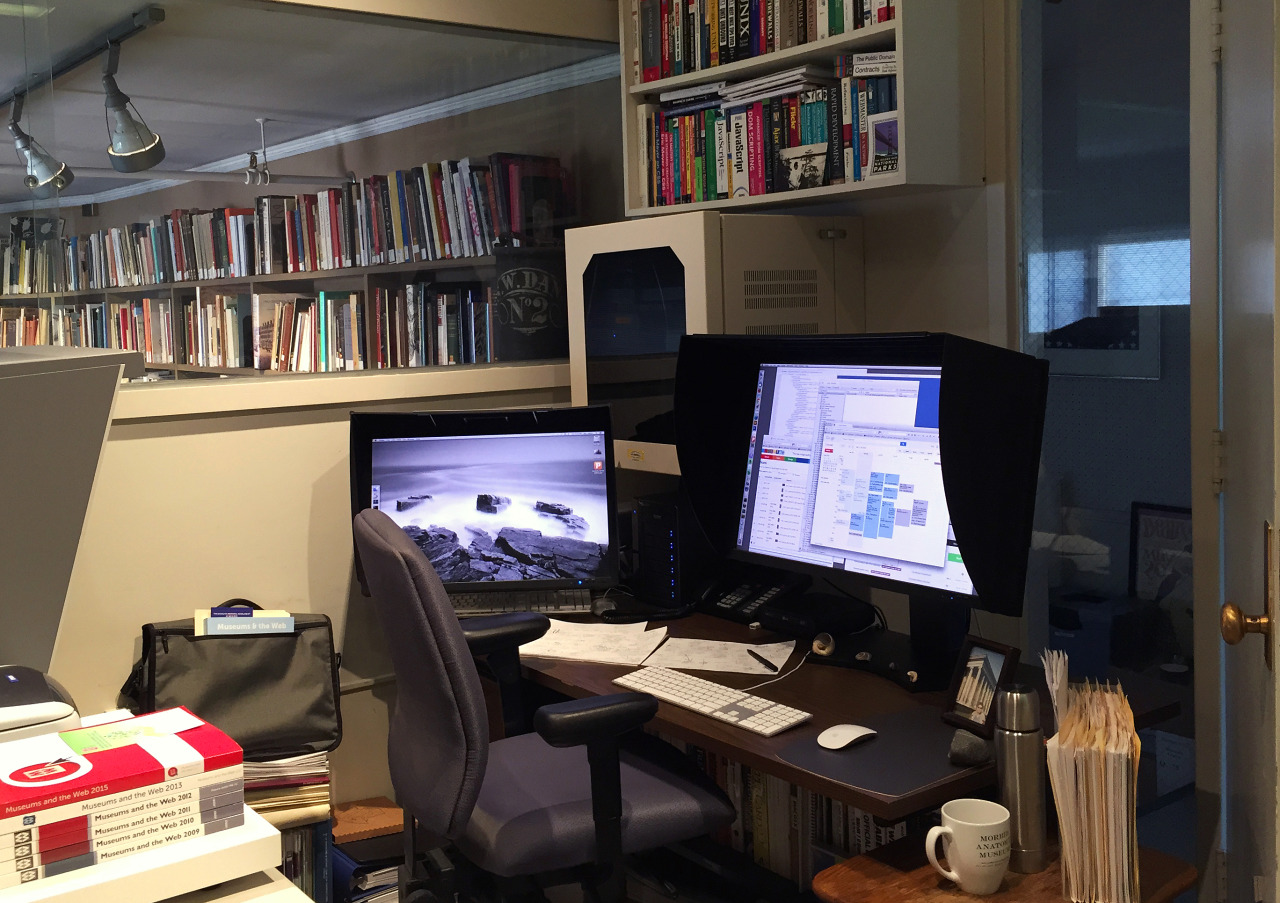
Also the picture at the header was Rob Lancefield's old desk, and it was part of Chad Weinard's wonderful talk about work from an age old MCN conference.

Tuesday, August 20, 2019

One-Person Bands and Museum Labor as an Access Barrier


When I was little, my uncle drove me to see a real big top circus. I don’t quite remember where it was, somewhere over in the farmlands near Santa Cruz, like Gilroy or Watsonville. Like so much of those valleys, I mostly remember the lush flatness, in this case with the red tent popping up like a mirage. I was younger than school age, and little from that circus visit remains in my memory.
One distinct memory I have, to this day, was of a single one-man, or we might say one -person band. He wandered around the big top playing music with his jiggered musical contraption attached to his body. As a kid, this one-person band didn’t seem all that extraordinary. The guy after him was on a unicycle juggling rubber chickens, after all. Seemingly without thought, cymbal hand and kazoo mouth sounded in time with keyboard hand and horn foot. Everything ordered, everything in time, everything easy.  

But, now as an adult, I am amazed at the guy’s ability to move his limbs in harmonious synchronicity. I can barely drink coffee and read my email some mornings, let alone play a full symphony alone. (Of course, I was four when I saw the guy. It might have been barely a harmony.)

I tell the story of the one-person band because I think many museum professionals feel like him. We are spinning and performing, and most people have no idea of the preplanning it takes to make it look so easy. But, most importantly, few museum professionals have a free hand or moment. We are just doing our best to keep from going off-key.

Last week, I asked what are the barriers to keep us from throwing open the doors. There are plenty. We might think of structural racism or the classism inherent in our funding structures. I hope to hear you articulate your thoughts in comments or on social.

Today, I’d like to call out a huge one. We will always find it hard to implement equity and access, metaphorically throwing open the doors, if our leaders don’t spend time thinking about how we do our work. We can’t serve our patrons if we are not thinking about the people doing the work.
Museums rarely have the funding to replicate positions. If the building operations guy is sitting with you in a meeting, there is no second building operations person at his desk. If you have a teen program running, there are no second teen programs person out drumming up business. While we might not play accordions with our feet while shaking maracas, most museum professionals are orchestrating huge amounts of disparate forms of labor all the while making it look effortless.

As a field, we spend a whole lot of time evaluating patron’s experiences (hopefully). Museums are for people, after all. But patrons are only a portion of the people in museums. Staff is an important part of the equation. The systems that staff work with can be empowering or inveigling. So much of our work is collective, a lifelong group project. But as a field, we don’t always articulate our work norms to each other. Our organizations often have people playing different songs, with earplugs on, instead of finding ways to perform together.

What’s the solution? Well, noticing each other, listening carefully, and trying solutions. We do this for our visitors (hopefully). Why not for staffing functions?

Recently, my amazing colleagues and I have started to articulate and improve many aspects of our work. For example, we are working out what needs a meeting and what can use an email, writing out process documents, and then putting these efforts into action. This is stuff that any workplace does, ad hoc, but we are trying to be purposeful and thoughtful. Why? Because while we want to do the real work, we first have to work out how to best keep our own sanity. If we can as a staff decrease the cognitive load of our everyday work, think of how far we can fly. I am humbled by how awesome my colleagues have been to take the leap with me. We’re not quite at the point where we can share all our efforts, though we will eventually. But, in a broad sense, we are trying to be purposeful in how we do our work, so we can free ourselves up to do our work better. BTW, Thank you. Thank you, awesome colleagues.

To take it back to this month’s topic, what is holding back our ability to metaphorically throw open the doors? Time and energy are finite resources. Are we using them well? Work practices can be a boon, helping you do more better. But efficient and effective work practices take thought and refinement. Most museum workplaces don’t place energy or thought into work practices as they focus their scant energy on collections or visitors. If you can spend real time on improving work, you might find yourself freed up, emotionally and with labor. With that freedom, you might feel giddy and free—so free you decide it’s time to plan to throw open the doors.

Managers have a huge part in this. Leaders often look at their best staff, and think, ‘hey let’s put them on this project.’ But what they might not realize is that they are potentially destabilizing that employee. They are asking the one-person band to jump on a unicycle. Now, maybe that performer can do that, but he will need time to practice and fall. Similarly, when good employees are asked to take on more thing, they will need time to fail. Many of our institutional efforts at throwing open the doors, add labor to staff. But, leaders don’t create the systems to understand how it impacts overall work. We are asking our staff to perform without a net with their hands tied behind their back. They can’t throw open the doors.

What’s the solution? Leaders need to realize access and equity isn’t solely about visitors. It’s about systems and staff too. They need to think holistically and carefully. They need to put in the effort to support their staff and try to support process improvements. They also need to honor the careful orchestration that happens in every museum in the country, with each museum professional, spinning, dancing, and performing amazing feats every day.

---

Also, please consider passing on your ideas about what keeps us from throwing open the doors. Tag me so I can add your thoughts to this month’s summary post @artlust on twitter, @_art_lust_ on IG, & @brilliantideastudiollc on FB). 

Thanks to Cynthia Robinson of Tufts University for talking out the one-man/ one-person band. I appreciate her reaching out and discussing it. I was worried one-person band wouldn't work since one-man band is common idiom. But we agreed one-person works--we are flexible, equitable thinkers after all. I write these things late in the evenings alone. Without a sounding board in person, I need your voices to help me.