Showing posts with label staff. Show all posts

Tuesday, November 26, 2019

Doing Museum Work: Your Thoughts


This week has turned out to be the hardest post I've written yet. Not because of the subject matter, but because of the sheer volume of awesome I'm trying to summarize. This month, we're thinking about the way we do work in museums. I'd ask questions on Twitter before. But this one resonated clearly, as I got 75 retweets and 61 comments. So many wonderful ideas, and I shared a few below.

An important thread throughout was that managers can use their power for good.  A few offered solid concrete suggestions that take the big idea of "advocacy" and make it concrete, like list wages on hiring requests and refusing to use unpaid interns. Also, being flexible about work times, as both Jennifer Foley and Emily Lytle-Painter amongst others mentioned. Work isn't prison; don't make them feel like they're doing time.

But, being a manager is a learned skill. A few suggestions were about outside training to improve your skills. Everyone can learn from others. Training, reading, and practicing are three key elements in becoming a better leader. As someone texted me recently, Art History grad school didn't teach us anything about working with others in museums. We all need help to do this better. And there are many sources out there. I've been reading non-stop in the last few months, let me tell you. And here are a few suggestions from commenters. Dan Hicks suggested:
Nikhil Trivedi suggested reading Kenneth Jones and Tema Okun's White Supremacy Culture document and reflecting on how those issues relate to management. Many others suggested articles to read. Sharing articles that work is a great reason to stay on Museum Twitter by the way.

Managing also requires understanding the work that happens in your departments and the workers who do that labor. Dan Brennan had a plan that is powerful and simple. Everyone can do it today:
Some suggestions were about gaining empathy and looking for solutions by seeing work differently, like Micah Walter who suggested:
Others, like Suse Anderson, also talked about swapping as a way to help you see the big picture from another point of view. Much of leadership is advocacy for your team, and it's hard to do that without understanding their work.

Many people suggested regular one on one meetings with colleagues. (I get they are on your team if you are a leader, but they are not your staff. They are staff of your organization, and you lead them.)

Learning alongside your team was a suggestion that went across many comments. One such way to learn with your colleagues is:

Making work visible is a favorite topic of mine. Understanding why people do what they do, and how much they have to do, helps organizations run better. Lindsay Green suggests:

Many people discussed good leaders as being people who help staff look forward, not just for the organization, but for their team member's own growth. Part of a leader is telling your staff you advocate for their future. Ask your teams where they want to be in a few years, and work with them to get there. Jenn Edgington said:

Letting your staff look forward also requires allowing them to shine for the work they do today. Credit is infinite; let them enjoy the benefits of their labor. Find ways they can get their own voices out there, either by encouraging them to go to conferences (and financially supporting that) or helping them find publishing opportunities.
Though with both, try to find ways to make sure this doesn't add labor. If they are writing an article you want them to do, you have to find space in their workload. Or rather, you have to ask them to find space in their workload. Allow them to decide, using their knowledge of their work, where space could open to open up to do that presentation or paper.

Circling back to the idea of the power of the manager, you have the power to say yes or no to all sorts of things. Museums are "no" cultures, often for good reason. Dance while juggling flaming sticks in front of tapestries? No. Tell untruths about collections? No. But that no culture also often translates into a no culture in the workplace. Changing that can be powerful, as Nathan Lachenmyer says:
Managers need to model working smart. As Katie Eagleton reminds me--I mean all of us:
Overall, the biggest topic that came up was to communicate. As Kate Livingston suggests:
Now, I've only hit the top level of comments, I'd invite you to move over to Twitter to read the full thread:

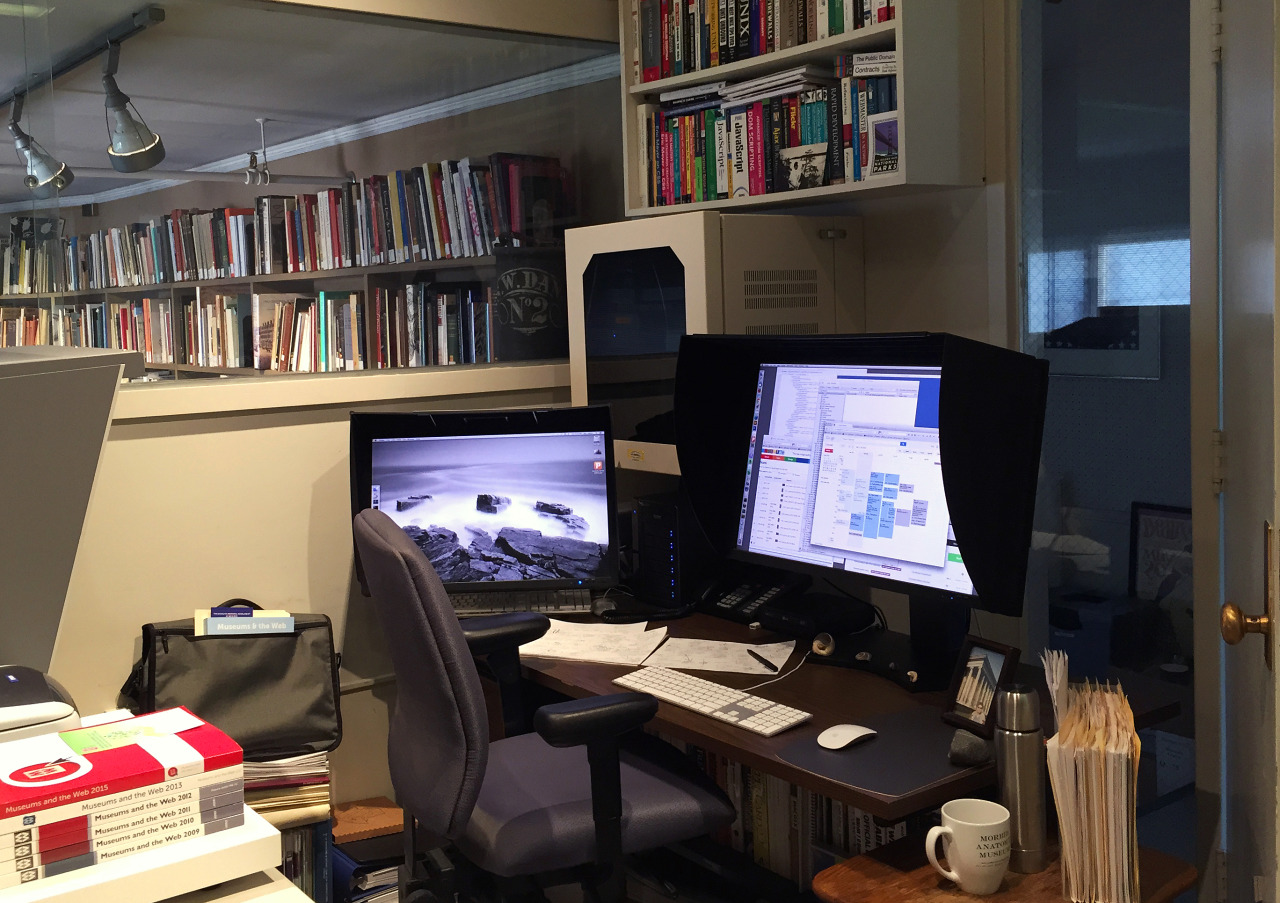
Also the picture at the header was my old desk, and it was part of Chad Weinard's wonderful talk about work from an age old MCN conference.

Tuesday, November 19, 2019

Teams, My teams, and Are we one team?

The Ship of Fools by Hieronymus Bosch, licensed under CC BY-SA 4.0

By Seema Rao and Paul Bowers

I've been living in a wintery wonderland and luxuriating a beachy wonderland in equal turns recently. Last week, Rob Weisberg posted when I was at MCN (sadly as missing him terribly at that conference.)

I'm so glad to have gotten to go to MCN. Museum Computer Network has become my Shangri-la, in a way. A mirage, I see even when it's not there. I connect with many of those people online and in email. I wrote a bit about my true love for my conference friends last week on Medium. I wrote that post because I had one heck of a conference. So many things that had meant so much to me were coming to fruition, and like a godparent, I had barely anything to do with them. It felt great and also like an out of body experience.

In some ways, museum work has this illusory aspect. Or museum work is like atomic theory perhaps. We all have so many colleagues we rarely meet. And, then you run into each other in life or online, maybe exchange some energy, and like electrons bounce to higher levels.


This idea of bouncing ideas and growing them might be said for my other post of the week, about touching art. I'm pretty open to a number of possibilities in museums. I am most definitely not open on the issues of collection care. The sanctity of the work is paramount. So how do we balance NO Touching policies and messaging against welcoming visitors? I don't have an answer, but would love to increase my energy levels on best solutions with your help. (as always drop by a line in comments or at Twitter @artlust)  So in this case, I'm hoping you run into me with your ideas. (I did this illustration on my plane back from MCN that made me feel better though offered few solutions. And yes, it really is 2 Legit 2 Legit to quit. But I couldn't. I just couldn't).

All this meandering introduction, perhaps, is to lead up to this week's guest speaker. I've definitely felt energized by interacting with him, usually online. Paul lives in Australia, and I've had a couple of meals with him at most. I've also had very thoughtful conversations with him and I feel I've found a kindred spirit. So much so, we've presented a paper together on the stage of MuseumNext. I was thrilled he was willing to share some of his thoughts here today. Enjoy.

---
Are we one team? 
By Paul Bowers
As Seema wrote in the first of the work series, our sector has been professionalized and reshaped over the past few decades. While we are enriched by the many professional fields intersecting to create the contemporary museum workplace, it presents a challenge we rarely talk about. 
In every museum, we find different values, language and work practices. I want a debrief, you talk about retros; I ask for the budget, you offer me the ‘P and L’. A successful day for the retail team is not the same as for the registrars - how do we work together when some people want to make a profit, and others study provenance? Many workplaces have these complexities, but I think our sector is unique in the sheer number of different domain experts - and that means we have to work harder than most at building common cause.
Lots of low-level workplace frustration can be laid at this door. I think I could fund my coffee habit if I had a dollar for each complaint of ‘Jeff from department blah is messing up my project, grrr.’ And there’s always a Jeff to blame: I’m sure even Jeff has a Jeff.
Before offering some suggestions, it’s important to emphasize there are a lot of unspoken assumptions of privilege and social encoding around values and how things should be done: that ‘academic’ is superior to ‘technical’, for example. We must be mindful, humble and open to learn about the privilege we may have in the workplace.
That being said, my first suggestion is to slow down: invest time in being clear what we mean and why we are acting as we are. Expertise gleaned from years in one sector, understood easily with your department colleagues, doesn’t automatically feel valid to someone without this experience. Deploying authority to win is easy but doesn’t help in the long run. We build trust and social capital by taking the time to explain - and explaining our reasoning can often assist in clarifying our thinking.
Overt your values, rationale and motivations. When passing on a piece of work, be clear, ‘I did it like this because _____.’ An exhibition team of mine was in conflict with the functions and events team - it was resolved when that department head said ‘I love doing two things at work: making money and supporting the arts. When I make money, it pays for exhibitions. That’s why I want to make more money.’ Written here, it looks patronizing - but in that moment, the direct simplicity brought clarity and drained conflict from the conversations.
My second suggestion is to remember that no-one comes to work to do a terrible job or annoy their co-workers. So when someone seems frustrating, work really hard at assuming good intent. Reflect on ‘how do they think they are creating a positive impact in this conversation?’ Find a way to ask - can you explain a bit more about how this way of working moves us forward? Usually, there is an excellent reason!
The legal team in a previous museum frustrated me - they were excruciatingly slow. And then a mutual colleague explained how it looked from their perspective - slowing me down and checking the detail was their job, to protect the organization against the existential threat of a huge legal cost in the future. This helped me see their contribution as a positive thing.
My final suggestion is to be more intentional about purpose, and who owns it. We can often unintentionally create micro-empires around tiny tasks, rather than cohesive language around a shared endeavor. Stating ‘I will select the artworks, you will prepare and document them, they will install them’ may be factually accurate, but it is so much better to say ‘let’s work together on getting this exhibition looking great, let’s agree how we’ll get it done, how about this: …’ before that statement. Use collective language in every situation, unless talking about your own direct accountability.
I’m sure there are many more ways to create and maintain common cause with the different professionals who make up our workforce. The goal isn’t to make everyone work the same - I’d be a terrible legal counsel! - but if we can reduce friction and create more harmony, the rewards for us as workers (including Jeff!), and eventually for our audiences, will be great.


Paul Bowers is a museum professional in Melbourne, Australia, who usually blogs at


Tuesday, November 05, 2019

Museum Work


Author: Seema Rao

This month, we’re talking about work. Not the work we do, but the ways we do that work.
While many American museums require 37.5 or 38 hours of work a week, most of us put in way more. In some old jobs I've had, particularly when I was full-time at part-time, juggling multiple roles, I regularly put in 100 hours a week. I came from a family that did that, so it seemed normal, though my relatives were all earning considerably more for their 100 hours a week.

I’m setting wages aside this month. Trust me, I know they are important. Salary is, often, the way organizations signal your worth. This is particularly evident when organizations pay greater salaries to certain departments overall than others. And, as Phillip Thompson said inour panel last week, the museum business model sets up problems for our field, because we are always trapped by the amount of money we can raise. Therefore, the whole issue of wages gets at the heart of the faulty systems of capitalism, the culture of women’s work, and museums as privilege-concentrating institutions. In other words, wage is enormous conversation and deserves its own month down the road.

This month though, I want to deal with something a bit more manageable. How we do our work and how we can improve it. The big questions are, how can people make changes to improve the working conditions, and how can leaders help organizations run better?

Efficiency is a favorite topic of mine. I like to think about where to shave off a little time (though who knows what I’m doing with that extra.) And, next week, I can share some of my thoughts on efficiency. But efficiency is like calibrating a well-run machine. This month, I’d like to think about our many broken machines.

Museums might earn their philanthropy partly through gifts from commercial enterprises, but for a very long time, their workplaces were run very differently. They had the committee decision-making structures from universities and the collections-authority systems of libraries. But they had a flavor all their own, spiced up with curatorial authority and donor privilege. In the last twenty years, or so, professionalization has changed museum work. Much of the quirkiness in the field has given way to corporate norms. Dashboards and ROI are as much part of our workplace language as community engagement and light-sensitivity.

This transformation has brought some good. Last month, we talked about audience engagement. Almost twenty years ago, when I started in community engagement, meeting after meeting would be held about what X group of people wanted. We never once asked them. We had no data to support our suppositions. And, we still barreled in and gave them the wrong thing. Now, I can’t imagine creating a new program without data.

Moving toward a more professionalized, and I might say corporate, structure has also brought negative issues in the workplace. In an old job, I was asked to track all the costs and benefits of family programs. Our systems weren’t up to snuff enough to let me click a button to generate a dashboard pulling directly from enterprise software. Plus like many organizations, family programs were a necessary evil for that organization, not what the museum perceived as their worthy audience. So, I sat at my little desk and crunched away. In an old life, I took plenty of stats. Numbers and graphs excite me. They are as plain, if not more, than words, in my mind. I sent the report to my boss. Six months later, she said she didn’t read it. She wasn’t into numbers. My tale of wasted work woes isn’t being retold for sympathy. I’m using this as an example of when a museum workplace needs fixing. First, we are often asking ourselves to do more, but we don’t scale up our system to do so. If you are going to become data-informed, you need to have your data easily accessible (or pay someone extra to crunch the data). Data is not free. Second, we are often choosing to make a change without scaling up internal capacity. If your leaders don’t use numbers, get them training, or don’t waste the junior staff’s time on generating them.

We have a certain amount of time allocated for work. As individuals and organizations, we choose how to allocate them. Giving a critical eye to labor, and the reasons certain systems don’t work is an essential way to improve work overall.

Museums are often run like city-states, each solving for their own problems. Just as Sparta and Athens solved city management differently, two museums on the same block can be run quite differently. Diversity in organizations and workplace solutions can be good for our field, that is, if we learn from each other. We often look across the street or nation at other museums for how they solve the big things: exhibitions, building projects, technology. But, we aren’t all that good at talking about the boring mundane parts of our lives like the way we do work. I suggest speaking across the sector about work could improve working conditions and as a result the field.

We are at that museum way more than 37.5 hours a week, and why should those hours be frustrating and unhappy? So, this month’s big issues are: What are some of the big issues you see about how work is done in Museums? What can you do to change this?

Also the picture at the header was Rob Lancefield's old desk, and it was part of Chad Weinard's wonderful talk about work from an age old MCN conference.