Wednesday, January 16, 2013

Reflections on a Weekend with Ze Frank and His Online Community

It's not every day that a visitor buys pizza for everyone in the museum. Or that visitors form a spontaneous "laugh circle" on the floor. Or that we take a group photo together at the end of the day.

Then again, Saturday was hardly normal at the Santa Cruz Museum of Art & History. This past weekend, in conjunction with our exhibition about Ze Frank's current participatory project, A Show, we hosted "Ze Frank Weekend"--a quickie summer camp of workshops, activities, presentations, and lots of hugging. It was an opportunity for people who participate with Ze Frank's projects online to come together in real space and connect with him and with each other.

It was pretty freaking amazing. About 700 people participated over two days, including some who had traveled to Santa Cruz from London, Indonesia, and across the US. The group was mostly young (teens to thirties) and nerd-diverse: a little bit punk, a little bit hacker, a little bit craft grrl. There were two guys with rainbow beards who did not previously know each other. There were some locals who stumbled in unaware, but mostly, this was an insider's event for people who know and love Ze's particular brand of emotional connection mediated through online participation. To get a sense of what it felt like for participants, check out this great video by one visitor from afar about his experience.

A few things I learned/observed/was impressed by:

A spirit of inclusion, generosity, and welcome permeated the event. We were pretty nervous about the unknowns going into the weekend. Ze had issued an invite to tens of thousands of people online, and we had no idea how many people would attend, and who they are. What we DID know is that the people coming would be connected through work that focuses on sharing intense and not always comfortable emotions online. I was concerned about how we could welcome people into the museum in a way that acknowledged the enormous risk they were taking in showing up in a foreign city and space to connect with people they only sort of knew in an online space. 

Online to onsite migration isn't always easy. I feared that the event would feel cliquey and wouldn't represent the creative, inclusive spirit of Ze's work. But three things made the event a success in this regard:
  1. Ze was amazing. He gently acknowledged the fundamental weirdness of meeting people in real-life, in confronting their "fleshiness," giving voice to anyone else's concerns about over-stimulation in the space. Ze was really hands-on with everyone, giving hugs, taking photos, jumping in to do activities with participants. Even though for many of the participants, Ze is a celebrity of epic proportions, he did everything he could to make the event about them and their engagement and not about him. 
  2. The activities had a really low barrier to entry. We collaborated with Ze to develop activities throughout the weekend that were lightweight, fun, and encouraged low-key social interaction--exactly the kinds of activities that we have found encourage social bridging with strangers. When people walked in, they received a program and a sheet to collect finishing stamps (unique marks created by participants at one activity station) from other participants. The sheet gave people a lightweight tool to use in social interaction, to trade and share stamps. And the program helped people feel like they knew what was going on. Again and again, we tried to balance the wackiness and spontaneity of the event with the surety that people were in the right place, that we could help them, etc.
  3. Our volunteers and staff--and the participants!--rocked. Our regular museum volunteers partnered with new volunteers drawn from Ze Frank's online community, which created a nice bridge between people who knew the museum and people who knew the community and its spirit. Participants who felt more confident modeled generous behavior and engaged others. I was so proud to see how our overall ethos of participation and social bridging was manifest in making the experience really wonderful for everyone.  
The museum itself was well-integrated into the event. In some ways, this event reminded me of the Ontario Science Centre's YouTube Meetup in 2008--a real-time, physical event to support an online community. One of the concerns at the YouTube Meetup was the disconnect between the museum and the participation; for many attendees, the science center just became a venue for a social experience. In this case, because our current exhibition includes a gallery of things made by Ze Frank's community, it was natural for weekend participants to be enthralled by and want to engage with the exhibition itself. Also, our museum-wide approach to participation suited this community well; they really enjoyed exploring other floors and participating in activities that had nothing to do with Ze Frank except in the ways that our philosophy and his are well-aligned. I loved meeting so many people who were surprised and delighted by the participatory approach of our museum--it made it feel like this was a place "for them" instead of a place that was hosting them.

As always, I learned a lot from Ze Frank's unique approach to community participation. One of the regrets of this project for me is that Ze and I have had so little time to really talk about how we think about engaging people in active participation--we've just been busy making it happen. But during the weekend, Ze gave a couple talks that opened up new pathways for me, especially around designing participatory experiences that spread and grow. A couple of key points I got from him:
  1. Make sure to develop prompts or projects that are both interesting to DO and to experience as an audience. This is something I strongly subscribe to--a huge percentage of any audience is more likely to spectate than to contribute. But on the web, it's even more important than in a museum. In a museum, if something is appealing to watch, a person might share it by taking a photo or talking about it with a friend. Online, if something is appealing, a person can share it in a million ways via social media. Ze talked about having a personal filter on project ideas that really focuses on ensuring that the activity AND the resulting content is appealing to share.
  2. To get lots of participation, always celebrate the human quality of the work. Ze pointed out that many participatory projects that operate as contests end up focusing on a narrow set of "best" work that can exclude broad participation. When Ze described his Young Me Now Me project, in which people replicated photos of themselves as children, he explained that he really encouraged people not to focus on getting the props or costume right but instead to focus on getting the expressions right. By focusing on that human element of self-expression, people felt that the activity was open to them regardless of their ability to set up a scene or take a great photograph. This point is a really interesting extension of my focus on personalization and using individual experiences as a starting point for community participation. Broad participation is not the goal of every project, but I found Ze's framing here a useful salve to the frequently espoused and flawed idea that "to get lots of participation, make the activity stupidly easy."
All in all, a beautiful and stimulating weekend. You can see more comments from participants here and here and see a photo set from one participant here.

Wednesday, January 09, 2013

Should Museum Exhibitions Be More Linear? Exploring the Power of the Forced March in Digital and Physical Environments

When I was a teenager, I was enthralled by interactive fiction. I loved the idea of the web as an infinite landscape, with stories and poems spiraling out in nonlinear directions.

Fifteen years later, the web has evolved tremendously... but hypertext-based interactive art and fiction is  still a nerdy sideline at best. A cult of linearity has dominated content on the web, with implications about how we think about effective storytelling both online and in museums.

One of the loveliest recent examples of linear multimedia storytelling is the Avalanche at Tunnel Creek story produced by the New York Times. Spend a bit of time exploring it, and you'll notice:
  • Incredible pacing brings you into and out of media components to the story just when you want them. The photos, videos, and maps are not distractions; they are embedded wisely in terms of size, frequency, and length.
  • It's a linear story, told top to bottom, with pagination for "chapters" of the story. You scroll down, you read, you watch, you continue on.
There are real positives to linearity in storytelling, even in an online environment freed from the page. Consider this lovely little story about past and present colliding in a Portland basement. It's a simple linear progression of text and images. The back and forth between the images and text creates a kind of dramatic tension that builds suspense and encourages a slower, more contemplative read. Slight introductions of movement, as in this Pitchfork feature on Natasha Khan, help you connect the words on the screen with the ideas they intend to animate.

And yet it surprises me that we have come this far, and linear storytelling - mostly top-to-bottom, occasionally left-to-right - is the still the best option for most content. It would have been so easy--and appealing--to read the Tunnel Creek story laid out on a giant map of the mountain, with different pockets of the story emerging in the different areas where things happened. 

The cult of linearity online isn't limited to storytelling. Continuous scroll is now a dominant design pattern across the web. Whether you are browsing through Facebook posts or Pinterest pins, you scroll from top to bottom through a never-ending march of content. Why wouldn't it be preferable to see pins in clusters based on similarity? Or to see Facebook posts grouped by geography, or proximity to me on the social graph, instead of in a long, chronological list?

My reluctant conclusion is that for now, simplicity trumps possibility when it comes to online navigation. It would take time and energy to familiarize users with new modes of navigation, and that could cause people to opt out. Ergo, Jorge Luis Borges and I will have to wait for the garden of forking paths to become a reality.

This makes me wonder: does this preference for linearity impact people when visiting museums? Are people overwhelmed or confused by the "infinite paths" that we offer through galleries, collections, and exhibitions? 

I used to work at the International Spy Museum in Washington DC, a "fixed march" museum that sends all visitors on the same linear path through the permanent exhibition. This format became increasingly popular in the 1990s and early 2000s, particularly in history museums, where you could reasonably dictate the "right" path through chronological content. In some museums, like the US Holocaust Memorial Museum, the fixed march itself serves as a symbol of the content, whereas in others, it's a convenient way to manage visitor flow.

I grew to disdain the fixed march approach to exhibitions as too controlling and directed, leading to less interesting arrangements of objects than are possible in a more varied, free-choice approach. But maybe my disdain is based on the diverse and long experience I've had in museums. Maybe it is actually more comforting for visitors, more grounding, to experience most museums as linear stories. That's not to say you can't skip certain bits or linger in others--just that some expert is subtly telling you that you are on the right path, progressing through the story as it was intended to be shared. Maybe we fight our own purposes when we deliberately eschew the powerful dramatic tools available in the linear storytelling format. 

I'd love to see research on how open and closed exhibition layouts impact visitor dwell time, satisfaction, and engagement. What have you observed? 

Perhaps open floor plan museums are my dream opportunity to nerd out on forking pathways. Are museums pioneering renegades for their free-choice approach to visitor navigation and exploration of content? Or are we fools to ignore the preponderance of linearity in other forms of media?

Wednesday, January 02, 2013

How I Learned to Think about Marketing/PR Differently, and a Job Opportunity

We just posted a part-time position at my museum for a Community Engagement/Marketing Associate. This is a big step for us, not because we haven't had a dedicated marketing person for a long time, but more because I wasn't sure we would ever want or need one. But several experiences and smart people have changed my perspective on this, and that's what this post is about.

Does a Small Museum Really Need a Marketing Person?

For a long time, I was super skeptical about marketing and public relations professionals. At their worst, they seem like self-deluded cheerleaders for their organization/cause/event, wielding exclamation points instead of analytical rigor. I've had bad direct experiences with high-priced PR firms that are slaves to antiquated promotion calendars. I love Trevor Donnell's brilliant book and blog, Marketing the Arts to Death, in which he documents the disasters caused by our inability to be audience- and data-driven in our marketing efforts.

So I assumed we didn't want a marketing person, or at least, not THAT kind of marketing person. At our museum, we distribute marketing tasks--some with our membership director, our programs staff, and our visitor services staff. The people who produce the programming or who have the relationships produce the messaging, so the conversations are authentic and personal. Curators and front desk staff blog about their interactions with objects and visitors. Program staff invent guerrilla marketing techniques, run the photobooths and program evaluations, and send out the follow-up emails.  As director, I post, tweet, and talk with visitors along with the rest of my team.

For a long time, I thought this was the best approach. It allows us all to be involved in promoting and documenting experiences at the museum. It cuts out the middleman--when someone from the press wanted to know more about an event, they talk to that event producer. It invites spontaneity and diversity of voice on a range of social media outlets, from Facebook to Twitter to Pinterest to Instagram. And it cultivates authentic relationships between staff members and the awesome community members who can make our museum better.

But then, a few things happened. We started...
  • to see the limits of our distributed approach to marketing. We sometimes lose track of the big goals that should underline all of our promotion, and we don't spend the time to develop and refine those goals based on research. Our programs staff are overtaxed and spending a lot of time putting together materials to promote their events. We rarely get the chance to go deeper or follow up when creative opportunities arise. No one has time to analyze the results of our approaches when it comes to what is and isn't working. In other words, we're getting tasks done, and we're doing it creatively, but no one is steering the bus... and thus, we're not learning and adapting as much as we could. 
  • imagining possibilities that no one "owns" currently. Our programming and exhibitions staff work with visitors to co-create a huge amount of stuff--from giant yarn-bomb sculptures to funny breakup stories. We don't "do" much with this content currently. We'll post a few stories on Facebook, share photos, and of course, let visitors take things home with them. But we started imagining a person who could focus a bit on these collaborations and say--hey, let's turn those stories into a funny little book, or let's make sure the local radio station knows we're capturing people's bird sounds and get them in on it. Recently, Alpo hosted a block party in Santa Cruz inspired by a guy who came to our Wearable Art Ball in a costume made from dog food bags... but we didn't have anyone to get the museum involved in the followup. We produce a lot of "wasted" media here with our visitors, and with a bit of tweaking, it could become something really amazing and shareable.
  • realizing that there are community-based organizations that do marketing really, really well. Only they don't call it marketing. They call it advocacy. I got so many emails over the past year from political and cause-based groups that are super-smart about how they build movements and inspire participation. They do constant A/B testing to understand what is and isn't working. And they are driven by a passion not just to advance their cause but to do so by increasing the engagement and involvement of collaborators and supporters. That sounds a lot more like what we want to focus on at our museum than selling tickets.
  • meeting people in arts marketing who changed my perspective. My favorite new conference  in 2012 was the National Arts Marketing Project in November. I went into it pretty nervous--how would a group of marketers respond to my talk about active audience participation, inclusion, and social change? Turns out they were the MOST engaged, the most thoughtful... and in their other sessions, having really interesting conversations about experimental projects, diversifying constituents, the neuroscience of choice, and the ethics of pricing. It made me think that this kind of person could help our organization if we could articulate the position properly. And smart people I met there, like Clay Lord, helped me think that through.
And so we came up with a job for a person who is part marketing/PR task-master, part journalist/media-maker, part community organizer. We made research and creative collaboration key parts of the job description. I'm excited to see what comes of it, and if this sounds like you, by all means, please apply.

Wednesday, December 26, 2012

End of Year Smatterings and Inspirations

Whether you're on vacation, making cookies with nephews, grinding out some work through the end of the year, or sitting in your kitchen drinking tea and watching the fog roll off the redwoods, it's probably a low week for blog-reading. That said, maybe you're bored or desperate for stimulation of the non-gastronomical variety. In that spirit, I offer a few things that have excited me in recent weeks:
  • The MCA Denver Holiday Video is out, and it is very, very good. Way better than that video at Museum X where the director drones on about the new initiatives of the year. I have felt in the past that some of the MCA's holiday videos were a bit too pretentious, but this year's edition is full of joy and a message that really reflects what they do in Denver. 
  • I LOVE the way the James Irvine Foundation presents their lessons learned from grant-making in the Arts Innovation Fund program. It is attractive, smart, and packs rich information into a navigable format that makes you want to explore and learn more. I know I have a lot to learn from the content AND the format of this report.
  • This is just a super-interesting review of an exhibition of damaged art. What happens to objects when they are no longer art? How should (and do) we treat them? This article sparked some interesting discussion online with colleagues from natural history museums, which deal with damage and touching very differently than art institutions do.
  • We're working at my museum on a strategic approach to our educational outreach with K12 classes and students. This Createquity article by Talia Gibas on "Unpacking Shared Delivery of Arts Education" was so useful to me that I shared it with our whole advisory group. I found the article to be a clear starting point for thinking in a fresh way about how our museum can best intersect with schools and artists (and students, in our participatory setting) to develop strong programs.
  • EMCArts put out a brief report from their recent study on how arts organizations deal with conflict around new ideas. The results are fairly interesting, and not entirely surprising: clear decision-making processes, shared agendas, action-oriented leaders, and comfort with conflict all lead to better support of innovation. I'm sometimes wary of studies of "innovation," but I like how this one could be used reflectively within an organization to assess openness to change. 
What's inspiring you in these last days of 2012?

Wednesday, December 19, 2012

Three Exhibition-Related Opportunities in 2013

The year is ending, and I have three exciting opportunities to share with you if you are an exhibition-oriented individual, or someone with an interest in the indoor side of creative placemaking.
  1. Join our team. We're looking for an Exhibitions Manager to join our team here at the Santa Cruz Museum of Art & History. In this full-time role, you will be responsible for interactive exhibition development, project management of all our site-specific work, and you will lead the redevelopment of our permanent History Gallery into a more dynamic, participatory, and flexible space. This is a highly collaborative role, and we are looking for the perfect blend of strong design skills with a generous enthusiasm for amateur and professional co-creation. Please check out the full description and how to apply if you are interested. 
  2. Come to Camp. You Can't Do That in Museums Camp is filling up. Next week, I will be reviewing applications for this event and making decisions. If you are interested, please apply soon! This camp will be a 2.5 day event in July of 2013 at which participants work in teams to create an exhibition full of intriguing, unusual, risky experiences. If you've ever wanted to design an object-based exhibit that really pushed the boundaries, this is the event for you. You do not have to be a museum professional to be part of this--we'd like a diverse mix of participants. Registration will be $150 and by application only
  3. Join the conversation. Spurred partly by the most recent (and fabulous) issue of the Exhibitionist and conversations we're having at our museum, I'd like to hear your reflections on how you think about exhibition formats and schedules. We're toying here with switching from a format where we change all of our exhibitions four times per year to something more flexible throughout the building. I'm curious what has worked or been challenging at other museums, especially small and mid-sized ones, when it comes to both frequency of exhibition changes and the approach. Some of the big questions on my mind include:
    • If we change exhibitions more frequently, will it drive more repeat visitation? Will it give a sense of energy and change? 
    • What do we lose in quality and ability to create complex work if we rotate more frequently?
    • Would it work to create an infrastructure for exhibitions that are flexible, inviting changing insertions and shifts, but don't rotate entirely? Would visitors "read" that as new content, or would the visual similarities make it seem like same old same old?
    • What if we slowed down and changed some spaces less frequently--like once a year? What opportunities might that open up for participatory and community projects that evolve over time in the space?
If you have thoughts on any of these questions or want to share the story of how you approach exhibition rotation and formats, please share a comment!

And if you know anyone who should be at Camp or should apply for the job, please pass this on.

Wednesday, December 12, 2012

Facing My Fears with the Work in Progress Exhibition

This is a picture of the largest temporary exhibition gallery in the Santa Cruz Museum of Art & History. Our next exhibition is opening in here in two days. And no, we are not about to embark on a Herculean 48-hour blitz to fill it with exhibits. This is pretty much what it will look like when we open on Friday.

Needless to say, this is a scary thing. And even scarier? We planned it this way.

This winter, my museum is trying an experiment called Work in Progress. We're turning over the whole museum to projects that invite visitors to connect with the behind-the-scenes in the making of art and historical research. Our goal with the project is two-fold:
  1. To help visitors engage with the creative process as well as the end result. Research shows there is a lot of interest in how art gets made, and we don't often dive into that in museums.
  2. To create an installation that changes. I've always been interested in the "perpetual beta" approach, and this project embodies that. We're also curious to see if an evolving project draws people to come back again and again to see how it grows over time. 
I feel great about both of these goals, and I feel even better about the amazing artists, innovators, and historians we're working with to make it happen. That said, this project has really challenged me to question my own expectations and assumptions about how an exhibition "should" look and function.

There are three big worries on my mind:
  1. What will visitors think when they walk into an empty gallery? Will they think we are conning them, or that we're lazy, or that the museum has stopped showing anything interesting? Is this a project that is highly appealing in documentation but confusing or unappealing in real time?
  2. How do we plan for spaces that will evolve over time? One gallery is opening half-full, with the expectation that additional work with be added over time--but we have no idea of what that work will be or how much space it will take up. It's surprisingly hard to design a space that looks decent from day 1 but can accommodate growth over time.  
  3. How do we facilitate visitor experiences in these spaces? What different kinds of tools do our volunteer gallery host and visitor services staff need to help visitors engage and enjoy the process of art- and history-making as opposed to its results?
It's been really good for me to slam up against some of these concerns--especially the first one. It makes me more sympathetic to anyone who is nervous about taking a risk or making a big change. I've known about this project for months, I advocated for it to happen, and I'm still scared. I had to laugh at myself when I got freaked out in a meeting with an artist last week, waving my hands around the gallery saying, "we can't just have NOTHING in here when we open!" Fortunately, he smiled and reminded me, "of course we can."

Of course we can. It's a good feeling to lean into the things that scare you. I feel lucky to be able to do it.

I'm curious what you think about this particular project--ways you think we should be documenting or sharing this work, and ways you think we might communicate with visitors about it. I'm also curious what risks you've taken that you had to confront head-on like a bad morning in the bathroom mirror. Thanks in advance for sharing your comments!

Wednesday, December 05, 2012

Defining Impact Beyond Attendance Numbers at the MCA Denver

I've always been a bit confused when people talk about the impact of a museum or arts institution as being about "more than numbers." I understand that there are shallow and deep experiences. I understand that some museum offer extraordinary, intimate programs. I understand online vs. onsite. I understand that some shows draw more people than others.

But at the end of the day, attendance is a completely reasonable measuring stick for engagement. Low attendance is often a sign of tepid community involvement or interest. When someone says, "it's not about numbers," I hear "our attendance is inadequate and we want to distract you with this other thing we are doing." In my experience, organizations that are doing well and are proud of their work don't feel the need to justify or compensate for their attendance.

But. Two weeks ago, I had an experience that made me understand and respect a different approach to numbers and impact. I was visiting with Adam Lerner, Director and Chief Animator of the Museum of Contemporary Art Denver. The MCA Denver has had a big impact on the art world with its fresh approach to programming, and it is located in a large city with a vibrant art scene. So I was surprised to hear its annual attendance is about 50,000.

Because Adam's a friend, I could be impolite and ask him about it. He told me the overall goal of the museum and its impact is not so much about attendance inside the building but the extent to which the museum itself is a creative producer whose work infuses the city. Adam and his colleagues are more like a conceptual art collective than arts administrators. They produce work, and they measure success by the extent to which it is seen/discussed/debated/loved/hated--both by people who directly experience it and those who do not. Adam encourages his staff to develop programming as "tight stories that can be shared, even with those who won't attend."

For example, when I was visiting, the MCA was about to host Art Meets Beast, a two-day festival of bison butchering, meals, and lectures that slams together contemporary art and the spirit of the American West in an original way. Adam told me he cares just as much about people who hear about Art Meets Beast and associate with MCA as people who actually attend. It makes sense. His goal is for people to have a new idea about a museum, or art, or the West. He doesn't care what kind of engagement has to happen for them to get the idea.

Adam described his vision for the MCA Denver's impact this way:
I often think about a performance I attended at my college when I was studying in England in 1990. It was early in the school year, email had only recently become available and I had just spent a couple of hours in the college computer lab with other foreign students corresponding with friends back home, composing DOS messages in glowing white text on black screens. In the evening, I walked across the plaza to the auditorium for the performance along with all the other foreign students who had nothing else going on. The show was billed as a comedy and it started off more or less like a stand-up comedy act. But the performer gradually became more and more active and theatrical. He also became increasingly lewd and at some point began shouting manically at the audience, building up to a finale, where he turned his back on the audience, dropped his trousers and bent over so that only his bare, white behind was visible under the spotlight on stage. Then, as if trying to prove that he was capable of going far too far, he took out a Roman candle, shoved it in his butt, and lit the fuse, so sparks and flares began flying out towards the stupefied audience. 
While this was happening, all I could think was that those white flares flying through the air would become hundreds of email messages launched from the computer lab the next day. The association was instantaneous, as if the recurring bursts from his butt were electronic messages themselves containing the words: “You wouldn’t believe what I saw last night…” And the insight I had at that moment stayed with me. 
Now, over twenty years later, I think about that event as a kind of ghastly myth at the origin of what I am continually trying to create at the museum. I am interested in the way that art and every other creative act have the power to ignite stories. Beyond the visitors who directly experience the art and the imagination of the museum, I care as much about the people who are see our signals from a distance, who are thereby inspired and energized by the sense that there is something extraordinary happening here.
It sounds unorthodox. It sounds wild. But it also sounds like a logically consistent reason NOT to focus on attendance.

I wish there were more organizations like MCA Denver, with thoughtful and powerful definitions of success that may or may not include attendance. What drives me crazy is the folks who say "it's not about the numbers," but don't have a Roman candle metaphor or other set of criteria for how they define their goals. If you are really about kids growing up with your museum, measure frequency of attendance over time. If you are about adults reenergizing their lives through creative play, measure happiness and workshop attendance. If you are about people getting in touch with local history, measure archive research requests and visits to local historic sites.

This whole experience got me thinking about how we measure success at our museum in Santa Cruz. For me, attendance is a big factor. Our vision is to be a "thriving, central gathering place." Accomplishing that goal requires many diverse people who actively participate in our space with each other. It means people becoming members and feeling community ownership. It means producing dynamic programming that is relevant to Santa Cruz County.

But we also have a social mission to build social capital through bridging experiences at and beyond the museum. For us, the crux questions are often, "did you meet someone new [through a museum experience]?" "Did you encounter something that surprised you?" Those questions address our goal of bringing people from diverse walks of life together. And one of my jobs is to find a way to describe, measure, and trumpet that as much as we do attendance or membership figures.

What's the Roman candle metaphor for your measure of success?

Wednesday, November 28, 2012

Selling a Product vs. Building a Movement

Do you consider yourself an "activist" for your organization, avocation, or art form? I've been increasingly turning to that word as a descriptor for the mixture of advocacy, passion, and action that I try to bring to my work. For me, it's a more comfortable term than something like "evangelist," which just feels like boosterism. I feel like I'm on a mission, and I know a lot of colleagues feel the same way.

I've always thought of this activist stance as a behind-the-scenes thing, something that might be useful in talking with professionals in the field, but not necessarily with visitors. Sure, I admire cultural organizations that have a strong mission to change education or diversify access or transform the role of art in everyday life, but I'm an insider. It seems wonky and possibly confusing to talk strategy with visitors. It's a distraction from their experience at our venue. Visitors care about us because we provide enjoyable, enriching, creative opportunities for them. Who's really going to read the fine print to find out why?

The election season, as well as a recent research study on museum membership, has change my perspective on this. A national election is the ultimate participatory project. Everyone of a certain age is in on it, and for the most part, the folks putting on the show want everyone to be engaged. There are multiple potential levels of involvement available. Advocacy groups of all stripes fall over themselves to give you opportunities to get involved, fight the good fight, fund the need, defeat the bill.

When you are part of a cause you believe in, you get incredibly invested. When you hit a personal goal that helps a larger effort, you feel like a real contributor. As Jane McGonigal has written, "the chance to be part of something bigger" than yourself is one of the four things that make people feel happy and fulfilled. With the exception of work and sports fandom, opportunities to be part of something bigger is in short supply. Election season stirs it up and makes us all remember how energizing it can be.

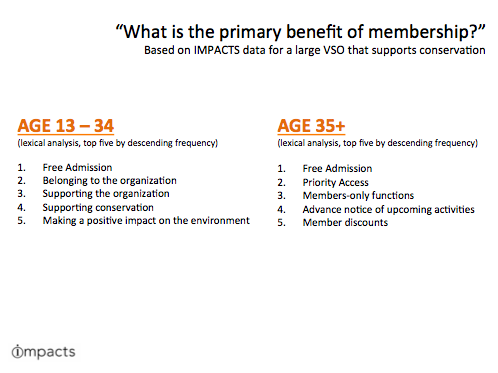
This is especially true for young adults today ("millenials"), who exhibit many of the same attributes of the World War II "greatest" generation--increased civic engagement, optimism, sense of communal purpose and responsibility, and conformity to group norms. Consider this recent study about the perceived benefits of membership in an aquariuam, referred to as a "visitor serving organization" in the chart below. As Colleen Dilenscheider reported, young people were MUCH more "cause-oriented" in their reasons for membership than their older counterparts:


This research and the post-election buzz is making me think differently about how we invite people to be involved with our organizations. Why AREN'T we asking visitors to join the fight for arts education? Why WOULDN'T a science museum engage members in the crusade to draw clear lines between science and pseudoscience? Why not build a grassroots movement to define the most effective ways we can make our communities stronger?

I realize as I write this list that we do invite certain people to participate in these conversations, but not our onsite audience. I talk a lot about the "why" behind our work at the Santa Cruz Museum of Art & History when I'm with donors, at conferences, or presenting at Rotary Clubs. I know that these folks care a lot about building strong communities and that it's intriguing and exciting to discuss how that might be driven by a cultural institution. These conversations are the basis for institutional partnerships and much of our funding. But they don't happen on enough levels with enough people to be accessible for broad involvement and shared activist energy.

For some reason, when it comes to talking and engaging with the people who are already in the door, we clam up about core messages and focus on selling them tickets to the next event or exhibition. This has two negative effects:
  1. It blocks our most engaged participants from getting involved in the most important work of the organization. If what we really are working on is building social capital, why are we hiding that? Why not give visitors ways to advocate and act to help advance our goals? Why not restructure our marketing and community engagement efforts to more closely model successful campaigns and activist movements?
  2. It creates a disconnect between the "why" and the "what" that may weaken institutional progress. Imagine a theater company where the leadership talks publicly about diversity and access but there is little evidence of it on site. Is the organization really doing what they talk about, or is it just lip service? If we create "reasons" for the work we do that are different in different contexts, we're losing energy and diluting our ability to get the most important work done.
Granted, I know that people still want the great experiences that our organizations provide. They don't want to go to the aquarium solely to learn how to save fish. But when we invite them to get involved in the work that drives us, about which we are most passionate, we create incredibly powerful advocates and partners in our cause. That's what's sexy and exciting about what we do. We need more tools to open it up.


Wednesday, November 21, 2012

What a Difference a Prompt Makes... Simple Analysis of a Participatory Exhibit Element

I am fascinated by the incredible differences in what people contribute based on format and phrasing of the invitation to participate. This week at my museum, as we are wrapping up our current set of exhibitions on collecting, I noticed a simple, subtle example of this that I thought might interest you.

Our current exhibition is about why people collect things. We are featuring several diverse collectors from our area--from a couple who collects priceless American flags to a woman who collects dryer lint.

One of the collections on display is a set of "found lists" collected by a local farmer, Danny Lazzarini. We decided to show a selection of Danny's lists in a hallway surrounded by a participatory element where we invite visitors to contribute to new lists on evocative themes ("Things we forget," "The best feelings in the world," etc.) that we selected during prototyping. This activity has been incredibly popular, and about every three weeks we replace one of the lists with a fresh copy so there is always space for some new contributors.

Last week, we made a mistake. The show was two weeks away from closing, and we needed to replace a "The best feelings in the world" list, but we had accidentally prepped a "Things we forget" list. To add another wrinkle, the volunteer had accidentally written "Things I forget" instead of "Things we forget" as the prompt on the new list.

We decided to go with it, and for the final two weeks of the show, we have both a "Things we forget" and a "Things I forget" list on the wall. Here's a closeup of each:

While the lists look the same on the surface (and bear in mind that the one on the left has been on display for 3 weeks longer than the one on the right), the content is subtly different. Both these lists are interesting, but the "we" list invites spectators into the experience a bit more than the "I" list. The prompt "Things we forget" tends to invite more communal or broad responses, i.e. "everything," "to be grateful," "that Bob Dylan is from Hibbing, MN" whereas "Things I forget" yields more personal responses, i.e. "zip up my pants," "my glasses," "who I picked for Birthday Club!"

A reference to dental hygiene shows up on both lists, but on "Things we forget," the response is "brush the teefres" whereas on "Things I forget," the response is "brush my teeth."

This is not earth-shattering, and there is definitely overlap on the two lists. But it's a good reminder that:
  • different prompts DO yield different actions on the part of visitors
  • careful writing and design decisions on the programmer's side DO impact on the overall result
  • sometimes, exhibit research is as simple as taking a couple photographs 

So think about your prompts, happy Thanksgiving, and keep those teefres clean.

Wednesday, November 14, 2012

Opening Up Museums: My TEDxSantaCruz Talk


I'm just home from a whirlwind of speaking engagements--Oslo, Denver, Charlotte, Roanoke. So it seems fitting to share my TEDx talk this week, one that was filmed here in Santa Cruz and which I have since taken around the world. The theme of TEDxSantaCruz was "Open." It gave me a chance to really think about how we have been opening up our museum and what it means for our community. Doing this talk was an incredible experience, both because of the warm and energized response I received at the event and because the format forced me to hone in on what's most important to me these days and share it in a succinct way.

It's only 15 minutes, so I encourage you to watch it, but here are the crib notes for the video-adverse without the hilarious stories and charming photographs.


Museums can be incredible catalysts for social change. But they're not there yet. Right now, they're often seen as elitist organizations serving an diminishing percentage of our population. We can change that by embracing participatory culture and opening up to the active, social ways that people engage with art, history, science, and ideas today. We're doing it in Santa Cruz and it has absolutely transformed our museum into a thriving community institution.

The first way we open up is by inviting active participation. We see every visitor who walks in the door as a contributor who can make our museum better. We seek and encourage collaboration with diverse groups and individuals in our community, and we develop ways for people to contribute in both immediate and long-term ways.

I know that not all public participation is substantive. I believe that everyone has the ability to contribute something powerful, and everyone also has the ability to be an idiot. The difference in what we contribute is in the design of the invitation conferred onto us. At the MAH, we carefully design invitations to participate to convey a high level of respect and value for what visitors bring to the table. They sense that respect and respond by bringing their best selves forward, sharing powerful creative work and personal stories. The result makes our museum more vibrant and multi-vocal, and it creates a powerful sense of ownership in our community.

The second way we open up is by treating our artifacts as social objects that can mediate interactions among people from different backgrounds. We've all seen how a pet dog can connect two strangers despite the social barriers that abound. How can we make museum objects more like dogs? How can we use our artifacts to activate important conversations about the future of our communities? At the MAH, we do this by designing thoughtful opportunities for interaction around artifacts, so that visitors see them less as holy objects and more as starting points for dialogue. And when we do it right, this approach brings people together across social division towards something approaching understanding and mutual respect.

This combination--inviting active participation, treating museum objects as locuses of important conversations--makes our museum a more relevant, essential community space. This isn't just happening in Santa Cruz. There are museums all over the world that are reinventing themselves as spaces for making and sharing, and in doing so, are fulfilling their public missions.

For me, the mission that is most compelling is the goal to build social cohesion by bringing people together across differences. We live in such a divided world. It is increasingly difficult to find opportunities to engage with people who are truly different from us in a positive way. If museums can build those social bridges, then we're not just doing great work for our institutions. We're doing great work for our communities, too.


Thanks to everyone who I met in the past weeks who has inspired and challenged me based on this talk. And thanks especially to the folks at TEDxSantaCruz who got it going and made this fabulous video. On that note, if you're interested in open data, I highly recommend Martha Mendoza's talk from that same event on FOIA requests and journalism--very powerful stuff.